Why Yacht Insulation Is the Foundation of Onboard Comfort and System Performance
SEO Title: The Ultimate Guide to Yacht Insulation | FCS Marine Meta Description: Discover how professional yacht insulation prevents condensation, reduces noise, and lowers HVAC energy use. Learn about marine-grade materials and South Florida services. Primary Keyword: yacht insulation Secondary Keywords: marine insulation, boat insulation, yacht insulation South Florida, condensation control, engine room soundproofing URL Slug: ultimate-guide-yacht-insulation Search Intent: Informational / Commercial Investigation Primary FCS Marine Service Page to Support: Yacht Insulation (https://fcsmarine.com/services/yacht-insulation/) Recommended Yacht Insulation, Marine Air Conditioning, Marine Refrigeration, Yacht Mold Removal, Locations Recommended Outbound Links: ThermaSmart Marine, ThermaSmart Marine Brochure

Yacht insulation is one of the most overlooked systems on a vessel — yet it directly affects cabin temperature, humidity levels, condensation, noise, mold risk, and how hard your HVAC and refrigeration systems have to work every day.
Here is a quick answer to what yacht insulation does and why it matters:
- Controls condensation — prevents moisture from forming on cold hull surfaces, pipes, and bulkheads
- Stabilizes cabin temperature — reduces heat transfer through the hull, deck, and engine room
- Reduces HVAC energy use — a well-insulated yacht demands far less from its air conditioning and refrigeration systems
- Limits noise and vibration — absorbs sound from engines, generators, and mechanical equipment
- Protects against mold — removes the damp surfaces where mold colonies grow
- Extends equipment life — reduces thermal stress on nearby systems, piping, and electronics
In South Florida’s warm, humid coastal climate, these problems are not seasonal. They are constant. Salt air, high ambient humidity, and intense solar heat put relentless pressure on every vessel. Without adequate insulation, your air conditioning system works overtime, condensation drips behind bulkheads unnoticed, and mold finds the dark spaces you cannot see.
One real-world example puts it in perspective: on a properly insulated boat operating in sub-zero Norwegian winters, an 800W electric heater was enough to maintain a comfortable 18°C (64.4°F) interior temperature when the outside temperature dropped to -5°C. In South Florida, the challenge runs in the opposite direction — keeping heat out rather than in — but the physics are identical. Without insulation, your systems fight a losing battle.
Whether you are managing a private yacht, overseeing a charter fleet, or working as a captain trying to keep guests comfortable, understanding how insulation works is the first step toward a vessel that performs reliably year-round.
The Core Problems: Condensation, Thermal Discomfort, and Energy Loss
When a vessel lacks high-quality yacht insulation, it experiences three primary failures: structural condensation, thermal bridging that creates hot spots, and extreme energy waste.
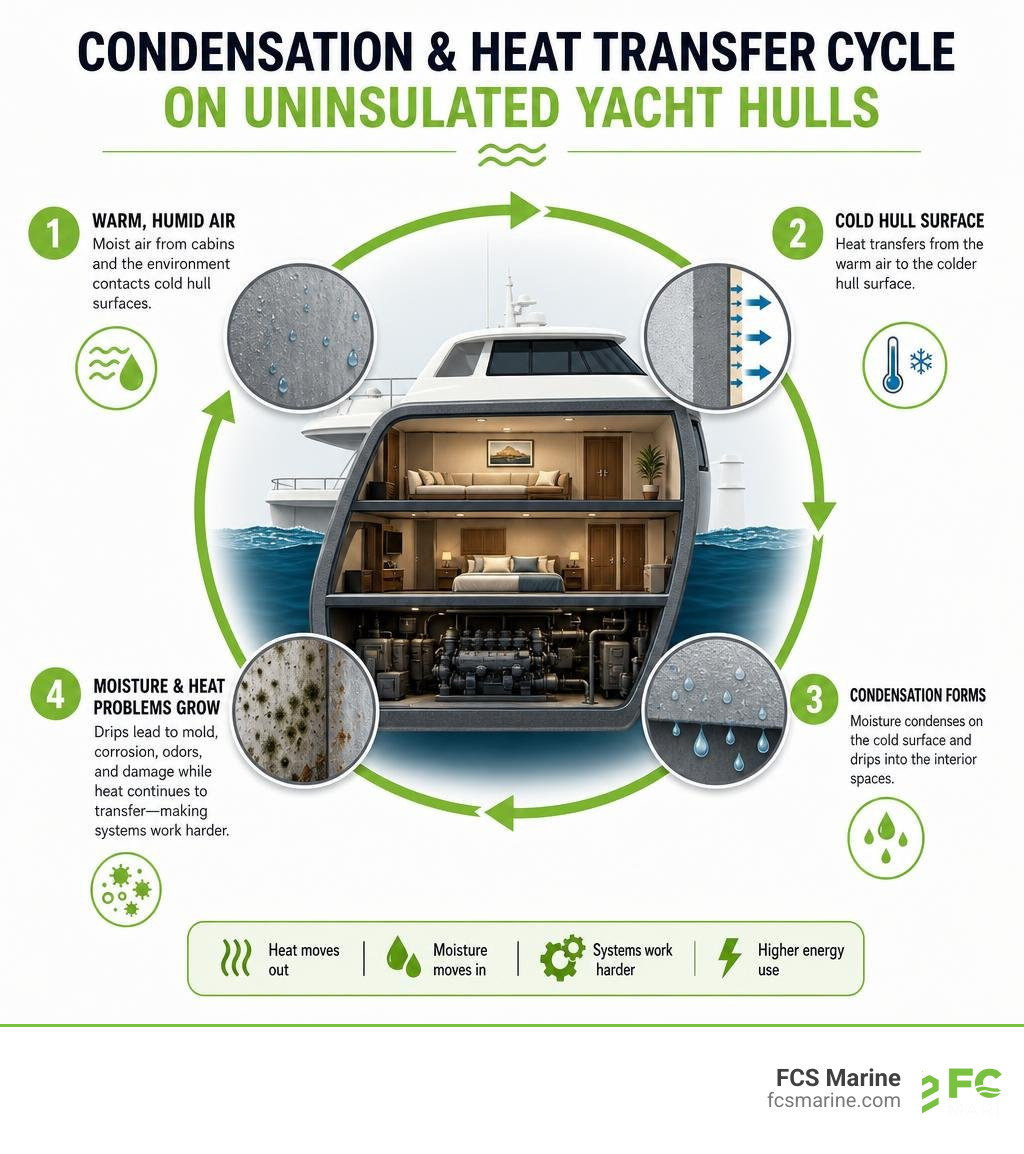
On the water, heat transfers rapidly. Seawater and warm ambient air constantly exchange energy with your hull. When humid South Florida air meets a surface cooled by water temperatures or internal air conditioning, the air reaches its dew point. Moisture changes from an invisible gas into liquid water.
Without a protective barrier, this condensation pools in unventilated areas:
- Behind cabin linings and overhead panels.
- Along aluminum or steel hull stringers.
- Around structural bulkheads and bilge access points.
This moisture does not just cause aesthetic damage. It attacks the structural integrity of your vessel, causing corrosion on metal hulls and creating an active breeding ground for spores. This is why addressing insulation issues is the most effective form of Yacht Mold Removal — it stops the moisture source before the mold can ever take root.
Furthermore, uninsulated surfaces act as thermal bridges. Intense solar radiation beats down on fiberglass or metal decks, transferring heat directly into the living spaces below. This places a massive load on your Marine Air Conditioning system. Instead of maintaining a stable, cycling temperature, your AC compressor runs continuously, spiking your generator’s fuel consumption and accelerating mechanical wear.

Thermal Yacht Insulation and Condensation Control
To stop condensation, the insulation material must prevent warm, humid air from contacting cold surfaces. This is achieved by using closed-cell materials that feature an integrated vapor barrier.
One of the premier products we utilize is ThermaSmart® Marine – Premium Ship Insulation Solution. This advanced direct-extruded closed-cell polyolefin foam features a tough black aluminum foil skin, creating a completely vapor-tight barrier. Because the material is hydrophobic, it cannot absorb water.
This thermal protection is equally critical for your Marine Refrigeration systems. Standard factory refrigeration boxes are often insulated with thin, generic foam that degrades over time. By retrofitting these areas with high-performance materials like flexible Aerogel blankets, the performance gains are staggering. In fact, using Aerogel insulation for lagging onboard fridges can reduce their power usage by half (50%). A 10mm flexible Aerogel insulation blanket is thermally equivalent to 50mm of traditional Kingspan foam, allowing you to maximize storage space while cutting energy consumption in half.
The Critical Role of Yacht Insulation in Vessel Performance
The construction material of your yacht determines exactly how heat and sound travel through the vessel, and how we must approach the insulation process.
- Fiberglass (GRP) Hulls: While fiberglass has a lower thermal conductivity than metal, production cored decks and solid fiberglass hulls still offer very little insulation on their own. Condensation still forms readily in the humid South Florida climate.
- Aluminum Hulls: Aluminum is highly conductive. It transfers heat almost instantly. Without a complete thermal break, aluminum yachts operating in warm waters become incredibly hot inside, while air-conditioned interiors cause the hull plating to sweat profusely behind the joinery.
- Steel Hulls: Steel shares the high conductivity of aluminum but carries the added risk of severe rust and structural corrosion under insulation (CUI) if moisture gets trapped between the insulation layer and the metal.
To address these different substrates, we use a variety of specialized marine-grade materials. The table below compares how these common choices stack up:
| Material Type | Thermal Efficiency | Moisture Resistance | Fire Safety | Best Application |
|---|---|---|---|---|
| Elastomeric Foam (Armaflex) | Excellent (25mm equivalent to 250mm mineral wool) | Outstanding (Closed-cell, zero absorption) | Good (Class O, flame-retardant) | Hull sides, overheads, chilled-water piping |
| Aerogel Blanket | Superb (10mm equivalent to 50mm rigid foam) | Outstanding (Hydrophobic) | Excellent (Incombustible) | Refrigeration boxes, tight spaces, high-heat areas |
| Closed-Cell Spray Foam | Excellent (Fills irregular gaps seamlessly) | High (Must be applied professionally to prevent voids) | Moderate (Requires marine-rated formulations) | Deep hull compartments, metal hulls, structural ribbing |
| Mineral Wool (Rockwool) | Moderate | Low (Requires a separate vapor barrier) | Exceptional (Melting point ~2150ºF) | Engine rooms, A-60 fire-rated bulkheads |
Why Yacht Insulation is Limited on Factory Builds
A common question we hear from owners in Fort Lauderdale and Pompano Beach is: “Why wasn’t my yacht insulated properly at the factory?”
The reality of production boatbuilding involves strict trade-offs. Manufacturers design vessels to appeal to the widest possible market, which means prioritizing visible features like high-end galley finishes, advanced electronics, and spacious layouts over hidden infrastructure like hull insulation.
The primary reasons factory builds limit insulation include:
- Production Costs: Properly insulating every stringer, frame, and bulkhead requires dozens of hours of skilled, manual labor.
- Space Constraints: In production yachts, every fraction of an inch matters. Adding an inch of insulation to the hull sides can reduce the usable width of a cabin or companionway.
- Weight Limits: While individual foam sheets are light, insulating a 60-foot yacht completely can add significant weight, affecting the vessel’s speed and fuel efficiency.
For owners planning to spend extended time cruising, or those keeping their vessels in the high-heat environment of South Florida, retrofitting high-performance insulation is a necessity. Using advanced, lightweight materials like those detailed in the ThermaSmart Marine Brochure allows us to add maximum thermal protection with minimal weight and space impact.
Warning Signs Owners and Captains Should Watch For
Insulation failure is often silent, occurring behind wood panels, under floorboards, and inside mechanical spaces. However, there are clear warning signs that indicate your yacht needs professional insulation service:
- Persistent High Cabin Humidity: If your marine AC is running constantly but the air inside still feels damp and heavy, heat and moisture are likely radiating through uninsulated hull sections.
- Musty Odors: A lingering, earthy smell is a direct sign of mold growth, which is fueled by hidden condensation.
- Dripping Chilled-Water Pipes: If the insulation wrapping your AC chilled-water lines has degraded, it will sweat. This water drips onto finished wood, carpets, and sensitive electrical components.
- Cold or Hot Spots on Bulkheads: Feeling distinct temperature differences on your interior cabin walls indicates thermal bridging through uninsulated frames or stringers.
- Excessive Generator and Engine Noise: If conversations in the saloon require shouting, your engine room’s acoustic insulation is failing.

Why Professional Marine Service and Regulatory Compliance Matter
Insulating a yacht is not a standard DIY project or a job for residential contractors. Marine insulation must withstand constant vibration, salt exposure, extreme temperature swings, and strict regulatory standards.
Classification societies such as Lloyd’s Register, the American Bureau of Shipping (ABS), the U.S. Coast Guard (USCG), and SOLAS enforce rigorous fire-safety standards. In the event of an onboard fire, insulation must not contribute to the spread of flames or release highly toxic halogenated gases.
For fireproofing bulkheads (especially A-60 rated zones), we use specialized mineral wool fiber insulation. Made from natural basalt rock and slag, this material has an incredibly high melting point of approximately 2150ºF (1177ºC). This creates a critical thermal barrier that protects passenger cabins from engine room heat and potential fire hazards.
Acoustic Yacht Insulation for Noise and Vibration Reduction
Onboard comfort isn’t just about temperature — it is also about peace and quiet. Engine rooms, generators, and stabilizer systems produce intense airborne noise and structural vibrations that can easily transmit into sleeping quarters.
To combat this, we install multi-layered acoustic barriers. These systems combine high-density mass-loaded vinyl (such as Tuffmass) to block low-frequency engine rumble, coupled with decoupling foam layers to absorb high-frequency vibrations.
For a clean, professional finish that stands up to the harsh engine room environment, we face these acoustic layers with perforated aluminum panels. This setup not only dampens decibel levels significantly but also allows for easy cleaning and protects the delicate sound-absorbing materials from fuel or oil splashes.
How FCS Marine Can Help
At FCS Marine, we specialize in providing custom, high-performance yacht insulation solutions designed specifically for South Florida’s demanding marine environment. We understand that you don’t want the hassle of moving your vessel to a shipyard just to address insulation or condensation issues. That is why FCS Marine comes to where your vessel is located. We provide complete mobile marine service directly to your marina, private dock, or boatyard.
Our highly trained technicians handle the entire process:
- Inspection: We use thermal imaging cameras to locate hidden thermal bridges, failing pipe lagging, and moisture build-up.
- Custom Design: We select the ideal materials — from lightweight polyolefin sheets to high-performance Aerogel — tailored to your yacht’s specific structural layout.
- Professional Installation: We meticulously bond insulation directly to the hull and wrap chilled-water lines, ensuring zero air gaps where condensation could form.
Whether you need to reduce engine room heat, stop your AC ducting from sweating, or completely replace degraded insulation, our team delivers clean, guaranteed results without disrupting your schedule.
Preventive Maintenance and Long-Term Durability
Like any other system on your vessel, insulation requires periodic attention to ensure it continues performing.
- Inspect Chilled-Water Lines: Check the tape and seams on your AC piping. Any unsealed joint is a pathway for humid air to enter, condense, and break down the adhesive.
- Monitor Bilges for Debris: Crumbling, low-grade foam from older factory installations often sheds, ending up in your bilge where it can clog bilge pumps and float switches.
- Check for Corrosion Under Insulation (CUI): On steel and aluminum yachts, we periodically inspect the bond between the insulation and the metal to ensure no moisture has bypassed the barrier.
By catching small tears or failing seams early, we can perform targeted repairs before condensation causes widespread water damage or mold growth.
Service Areas in South Florida
FCS Marine provides premier on-site yacht service across all major South Florida yachting hubs. Our mobile service vehicles are fully equipped to perform professional insulation, AC, and refrigeration repairs directly at your vessel’s location.
We proudly serve:
- Broward County: Fort Lauderdale, Pompano Beach, and local shipyards.
- Palm Beach County: Palm Beach, West Palm Beach, Jupiter, and Boca Raton.
- Miami-Dade County: Miami, Key Biscayne, and Coconut Grove.
- Martin & St. Lucie Counties: Stuart, Jensen Beach, and Port St. Lucie.
No matter where your vessel is slipped, our team is ready to deliver fast, reliable service with a satisfaction guarantee.
Frequently Asked Questions About Yacht Insulation
Why do yacht manufacturers often omit or limit hull insulation?
Most production boatbuilders focus their budgets on visible, high-end interior finishes rather than hidden insulation. Additionally, adding extensive insulation increases manual labor costs, adds weight, and consumes valuable interior space that could otherwise be used to make cabins feel larger.
What is the best insulation material to prevent condensation on a metal hull?
Closed-cell elastomeric foam (such as Armaflex) or vapor-tight polyolefin sheets are the best options. These materials must be bonded directly to the metal surface with high-strength marine adhesive. This eliminates any air gaps where humid air could settle and condense against the cold hull.
How does failing pipe insulation lead to mold growth on a yacht?
Chilled-water AC lines carry very cold water throughout the vessel. If the insulation around these pipes fails or develops gaps, the humid South Florida air will condense on the bare pipe. This water drips continuously into dark, unventilated overheads and wall cavities, creating the perfect damp environment for toxic mold to grow.
Conclusion
A well-insulated yacht is a quiet, dry, and energy-efficient vessel. By investing in high-quality yacht insulation, you protect your interior woodwork from water damage, prevent mold growth, reduce cabin noise, and allow your air conditioning and refrigeration systems to run smoothly.
If your vessel is experiencing high humidity, sweating pipes, or engine room noise, you don’t have to navigate the repair process alone. Contact FCS Marine today to schedule an on-site consultation with our mobile marine service team. We will bring our expertise directly to your dock, ensuring your yacht remains the comfortable sanctuary it was meant to be.