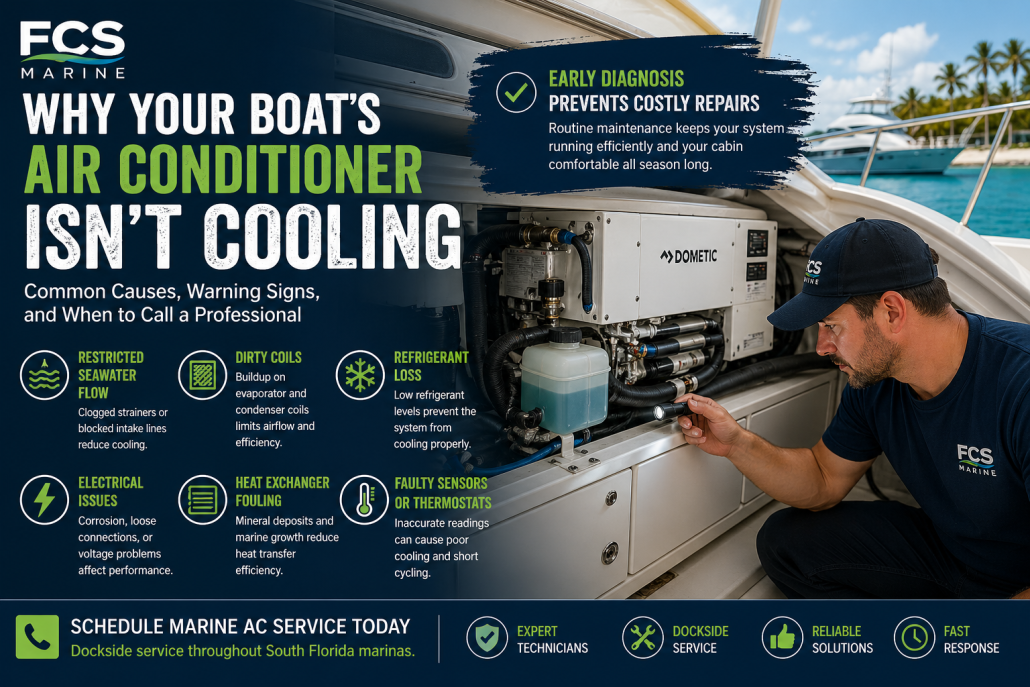
Marine air conditioning systems work hard in South Florida’s heat and humidity. When a boat’s AC stops cooling properly, the issue rarely resolves on its own. Small warning signs often develop into larger system failures if they are not addressed early.
Whether your vessel uses a compact self-contained unit or a multi-zone chilled-water system, understanding the causes behind cooling problems helps protect onboard comfort and avoid unexpected downtime.
This guide explains the most common reasons marine air conditioners stop cooling and what vessel owners should do next.
HOW MARINE AIR CONDITIONING SYSTEMS KEEP CABINS COOL
Marine air conditioning systems remove heat from inside the cabin and transfer it into seawater through a condenser heat exchanger instead of releasing heat outdoors like residential HVAC systems.
This cooling process depends on steady seawater circulation, proper refrigerant pressure, unrestricted airflow, and reliable electrical supply.
When any part of this cooling cycle becomes restricted, performance drops quickly.
EARLY SIGNS YOUR BOAT AC IS LOSING COOLING POWER
Cooling problems often begin gradually before becoming serious.
Common warning signs include:
-
Airflow from vents feels weaker than normal
-
Cabins take longer to cool
-
Humidity increases inside enclosed areas
-
Unusual sounds occur during startup
-
Seawater discharge from the outlet becomes weaker
-
The system shuts off unexpectedly
Because marine HVAC systems rely heavily on raw-water circulation, reduced discharge is often one of the earliest indicators that service is needed.
Addressing these symptoms early helps prevent compressor damage and more expensive repairs later.
RESTRICTED SEAWATER FLOW IS ONE OF THE MOST COMMON CAUSES
Most marine AC failures in South Florida begin with reduced seawater circulation. Warm coastal waters encourage marine growth inside intake hoses and strainers, and even small obstructions can affect cooling performance.
Common causes of restricted flow include:
-
Clogged seawater strainers
-
Marine growth inside intake lines
-
Partially blocked thru-hull fittings
-
Failing circulation pumps
-
Trapped air in the cooling loop
When seawater flow drops, the condenser cannot release heat efficiently. In many cases, the system shuts down automatically to protect itself.
Routine inspection of strainers and intake fittings helps maintain reliable cooling performance throughout the boating season.
DIRTY EVAPORATOR AND CONDENSER COILS REDUCE COOLING EFFICIENCY
Salt particles, airborne debris, and moisture naturally accumulate inside marine HVAC systems over time. As buildup develops on evaporator and condenser coils, airflow becomes restricted and cooling performance decreases.
This often leads to:
-
Uneven cabin temperatures
-
Longer cooling cycles
-
Increased electrical load on the compressor
-
Reduced overall system efficiency
Professional coil cleaning restores airflow and helps extend system lifespan.
REFRIGERANT LOSS CAN PREVENT PROPER COOLING
If your marine air conditioning unit runs but produces little or no cold air, refrigerant pressure may be outside the recommended operating range.
Typical causes include:
-
Aging hose connections
-
Vibration-related wear
-
Corrosion at fittings
-
Small leaks within sealed components
Because marine refrigeration systems operate under pressure, inspection and recharge should always be handled by trained marine HVAC technicians.
ELECTRICAL SUPPLY ISSUES OFTEN AFFECT SYSTEM PERFORMANCE
Marine air conditioning systems depend on stable electrical supply from shore power, onboard generators, and distribution panels. Even minor corrosion at wiring terminals can interfere with voltage delivery and reduce reliability.
Electrical problems may appear as:
-
Intermittent cooling
-
Delayed compressor startup
-
Breaker trips
-
Inaccurate thermostat readings
Electrical inspections are especially important for vessels operating year-round in coastal environments.
HEAT EXCHANGER FOULING REDUCES COOLING CAPACITY
Marine heat exchangers transfer cabin heat into seawater through narrow cooling passages. Over time, mineral deposits and biological growth can restrict these pathways and reduce the system’s ability to remove heat efficiently.
Signs of heat exchanger fouling often include reduced cooling performance even when airflow appears normal.
Regular flushing helps maintain proper performance and prevents overheating conditions.
SALTWATER EXPOSURE ACCELERATES COMPONENT WEAR
Saltwater environments create unique maintenance challenges for marine HVAC systems. Corrosion can affect electrical connections, fittings, pump assemblies, and compressor housings if preventative service is delayed.
Understanding how saltwater accelerates corrosion helps explain why scheduled inspections are essential for vessels operating in South Florida waters.
Routine servicing helps protect system reliability and extend equipment lifespan.
SENSOR OR THERMOSTAT PROBLEMS CAN AFFECT COOLING ACCURACY
Some cooling issues originate within the control system rather than the mechanical components themselves. Faulty sensors may cause the system to cycle incorrectly or maintain inaccurate temperature readings across different cabins.
Modern marine climate-control systems often provide diagnostic information that allows technicians to identify these issues quickly during inspection.
WHY COOLING PROBLEMS SHOULD BE ADDRESSED EARLY
Marine air conditioning systems operate under heavier environmental stress than residential HVAC equipment. Constant vibration, humidity exposure, salt air, and confined installation spaces all contribute to accelerated wear.
Ignoring early warning signs can lead to:
-
Compressor failure
-
Airflow restriction damage
-
Electrical component wear
-
Moisture-related interior issues
-
Higher repair costs later
Preventative service helps maintain both onboard comfort and system reliability during peak boating season.
PREVENTATIVE MAINTENANCE HELPS AVOID MID-SEASON FAILURES
Routine inspection of seawater circulation components, airflow pathways, refrigerant pressure levels, and electrical connections helps keep marine HVAC systems operating efficiently throughout the year.
Most vessels operating in South Florida benefit from annual servicing, while frequently used boats often benefit from mid-season inspections as well.
Preventative care significantly reduces unexpected downtime during the busiest boating months.
WHEN TO SCHEDULE PROFESSIONAL MARINE AC SERVICE
Professional inspection is recommended if you notice:
-
Reduced cooling performance
-
Unusual operating sounds
-
Weak seawater discharge
-
Frequent system shutdowns
-
Rising cabin humidity
-
Musty airflow from vents
Early diagnostics typically prevent larger component failures later.
NEED FAST MARINE AIR CONDITIONING REPAIR IN SOUTH FLORIDA?
If your boat’s air conditioning system is no longer cooling properly, restricted seawater flow, electrical faults, or compressor issues may already be affecting performance.
FCS Marine provides dockside marine air conditioning diagnostics, maintenance, and repair throughout Fort Lauderdale, Palm Beach, and surrounding South Florida marinas.