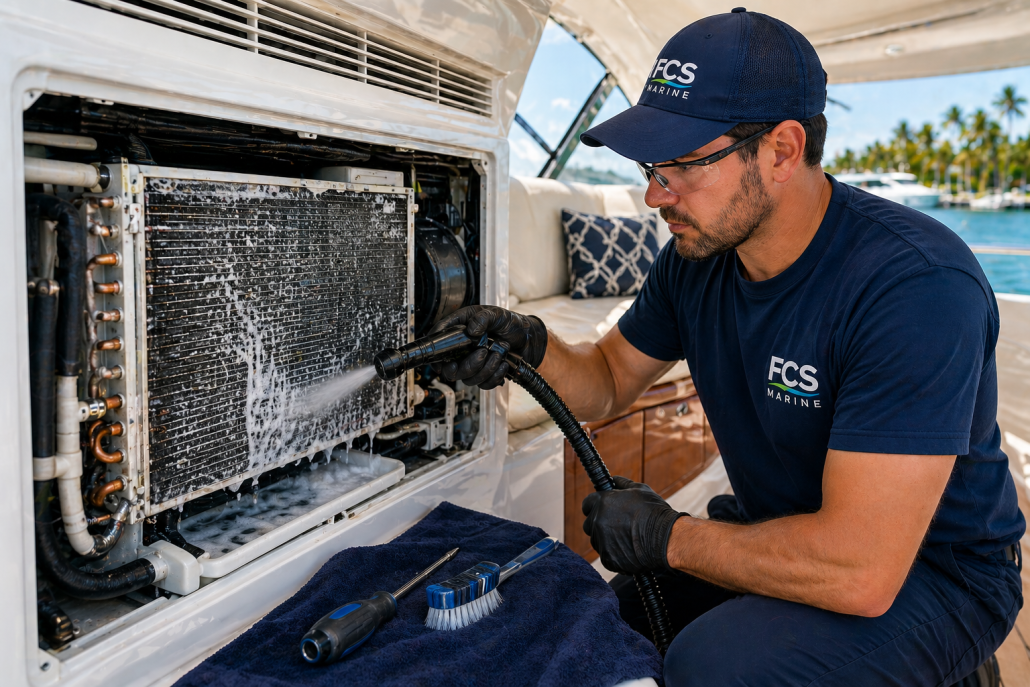
Signs Your Yacht AC System Needs Professional Cleaning
Marine air conditioning systems operate in a challenging environment where salt air, humidity, and continuous vibration affect performance over time. Even when cooling equipment appears to be working normally, internal buildup can slowly reduce airflow, strain system components, and increase cabin humidity.
Professional marine AC cleaning helps restore cooling efficiency, improve onboard air quality, and extend equipment lifespan—especially for vessels operating in South Florida’s warm coastal conditions.
This guide explains the most common warning signs that indicate your yacht’s air conditioning system may need professional cleaning.
Why Marine Air Conditioning Systems Require Regular Cleaning
Unlike residential HVAC systems, marine air conditioning equipment operates in a closed environment exposed to salt particles, moisture, and biological growth. These conditions allow buildup to develop inside evaporator coils, condensers, circulation lines, and duct pathways more quickly than many vessel owners expect.
This marine air conditioning checklist helps maintain airflow balance while protecting compressors from unnecessary strain.
Reduced Airflow From Cabin Vents
One of the earliest indicators that cleaning is needed is weaker airflow from supply vents. As debris collects on evaporator coils or inside duct pathways, the system must work harder to circulate conditioned air throughout the vessel.
Owners often notice that cabins take longer to cool or that airflow feels inconsistent between living spaces. Over time, reduced airflow can affect both comfort and humidity control inside enclosed compartments.
Professional cleaning restores airflow efficiency and helps stabilize temperature distribution across the vessel.
Musty Odors Coming From the Ventilation System
Musty odors inside the cabin frequently indicate biological buildup forming on evaporator coils or inside ductwork. Because marine HVAC systems operate in humid environments, moisture can accumulate within airflow pathways if cleaning is delayed.
These odors are often most noticeable when the system first starts running after being off for a period of time. Cleaning the evaporator assembly and associated airflow components helps remove contamination sources and improves cabin air quality.
Addressing odor issues early also helps prevent moisture-related interior concerns from developing inside enclosed spaces.
Uneven Cabin Temperatures Throughout the Vessel
When airflow becomes restricted inside the system, cooling distribution between cabins can become inconsistent. Some areas may remain comfortable while others feel warmer than expected even when the system is operating normally.
This imbalance often indicates evaporator coil buildup or airflow obstruction rather than compressor failure. Cleaning the affected components helps restore balanced airflow across multiple cabin zones.
Improved airflow distribution supports both comfort and energy efficiency during extended cruising periods.
Increased Humidity Inside Interior Spaces
Marine air conditioning systems play an important role in controlling cabin humidity as well as temperature. When evaporator coils become contaminated, moisture removal efficiency declines and interior humidity levels begin to rise.
Higher humidity inside the vessel may lead to:
-
condensation forming on surfaces
-
discomfort during overnight stays
-
reduced cooling effectiveness
-
increased risk of mildew inside enclosed compartments
Professional cleaning helps restore the system’s ability to remove excess moisture from interior air.
Visible Dust or Debris Around Supply Vents
Another sign that cleaning may be required is visible dust accumulation near vent openings or inside return-air grilles. Although some buildup is normal over time, excessive debris usually indicates that airflow pathways inside the system are collecting contaminants.
Cleaning the evaporator assembly and duct pathways helps reduce circulation of airborne particles throughout the cabin environment.
Maintaining clean airflow components also improves long-term HVAC performance reliability.
Reduced Cooling Performance Without Mechanical Failure
In many cases, vessel owners assume reduced cooling performance indicates compressor problems. However, airflow restriction caused by dirty evaporator coils or clogged strainers is often the underlying cause.
When airflow improves after cleaning, cooling efficiency typically returns to expected levels without requiring major component replacement.
Routine cleaning helps technicians identify whether performance issues are related to airflow restriction or mechanical wear.
Seawater Circulation Components May Also Require Cleaning
Marine HVAC systems depend on seawater flow to remove heat from the condenser. Over time, marine growth inside intake strainers and circulation pathways can reduce cooling performance even when airflow inside the cabin appears normal.
Cleaning seawater strainers and circulation components helps maintain consistent heat-exchange efficiency throughout the cooling cycle.
Maintaining steady seawater flow is especially important for vessels operating year-round in South Florida waters.
How Often Yacht Air Conditioning Systems Should Be Cleaned
Cleaning frequency depends on vessel usage patterns, cruising locations, and how often the system operates throughout the year.
Vessels operating regularly in warm coastal environments often benefit from annual evaporator cleaning and seawater circulation inspection. Boats used frequently during peak summer months may benefit from additional mid-season service to maintain consistent performance.
Routine inspection helps determine the most effective maintenance schedule for each vessel.
When Professional Marine AC Cleaning Is Recommended
Professional cleaning is typically recommended when vessel owners notice airflow reduction, rising humidity, musty odors, or uneven cabin temperatures during operation.
Additional warning signs that indicate cleaning may be needed include:
-
longer cooling cycles than normal
-
visible debris around vents
-
reduced seawater discharge strength
-
inconsistent temperature control between cabins
-
increased system operating noise
Addressing these symptoms early helps prevent compressor strain and protects long-term system reliability.
Improve Airflow and System Performance With Professional Marine AC Cleaning
Restricted airflow, musty odors, or uneven cabin temperatures are often signs your evaporator coils or condensers need professional cleaning.
FCS Marine provides detailed marine air conditioning component cleaning services designed to restore airflow, improve cooling performance, and reduce humidity inside your vessel.
Contact FCS Marine today to schedule professional marine air conditioning cleaning service.