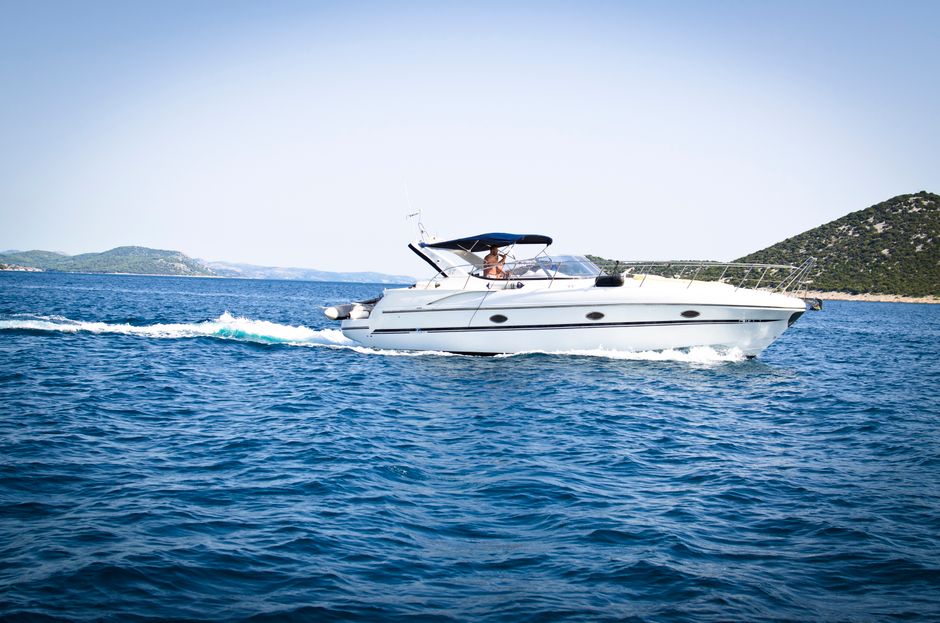
Why Every South Florida Yacht Owner Needs a Reliable Boat Water Maker
A quality boat water maker can be the difference between a stress-free offshore passage and an unplanned dash back to the marina just to fill your tanks.
Here is a quick snapshot of your main options:
| System Type | Best For | Typical Output | Power Source |
|---|---|---|---|
| 12V/24V DC | Sailboats, solar-powered vessels | 1–14 GPH | Battery bank, solar |
| 110V/220V AC | Powerboats, larger yachts | 20–125 GPH | Generator or shore power |
| Engine-driven | Motoryachts, trawlers | 24–95 GPH | Main engine |
| Manual/emergency | Survival backup | ~1.5 GPH | Hand-powered |
Whether you are crossing to the Bahamas, anchoring in the Keys, or simply staying off the dock for a long weekend, having your own freshwater supply onboard changes everything.
The reality for South Florida yacht owners is this: dock water is not always available, not always clean, and not always convenient. Marina water quality varies, fill-up lines waste time, and some of the most beautiful anchorages in the region have no dock access at all. A properly sized and installed marine desalination system solves all of that.
A typical cruising crew needs 5 to 10 gallons of fresh water per person per day for drinking, cooking, and bathing. Without an onboard watermaker, that need drives your entire itinerary.
This guide compares the leading marine watermaker systems on the market — covering DC, AC, and engine-driven designs — so you can choose the right unit for your vessel, your crew, and your cruising grounds.
At FCS Marine, we provide professional onboard water system service for yacht owners and captains across South Florida, coming directly to your vessel wherever it is located.
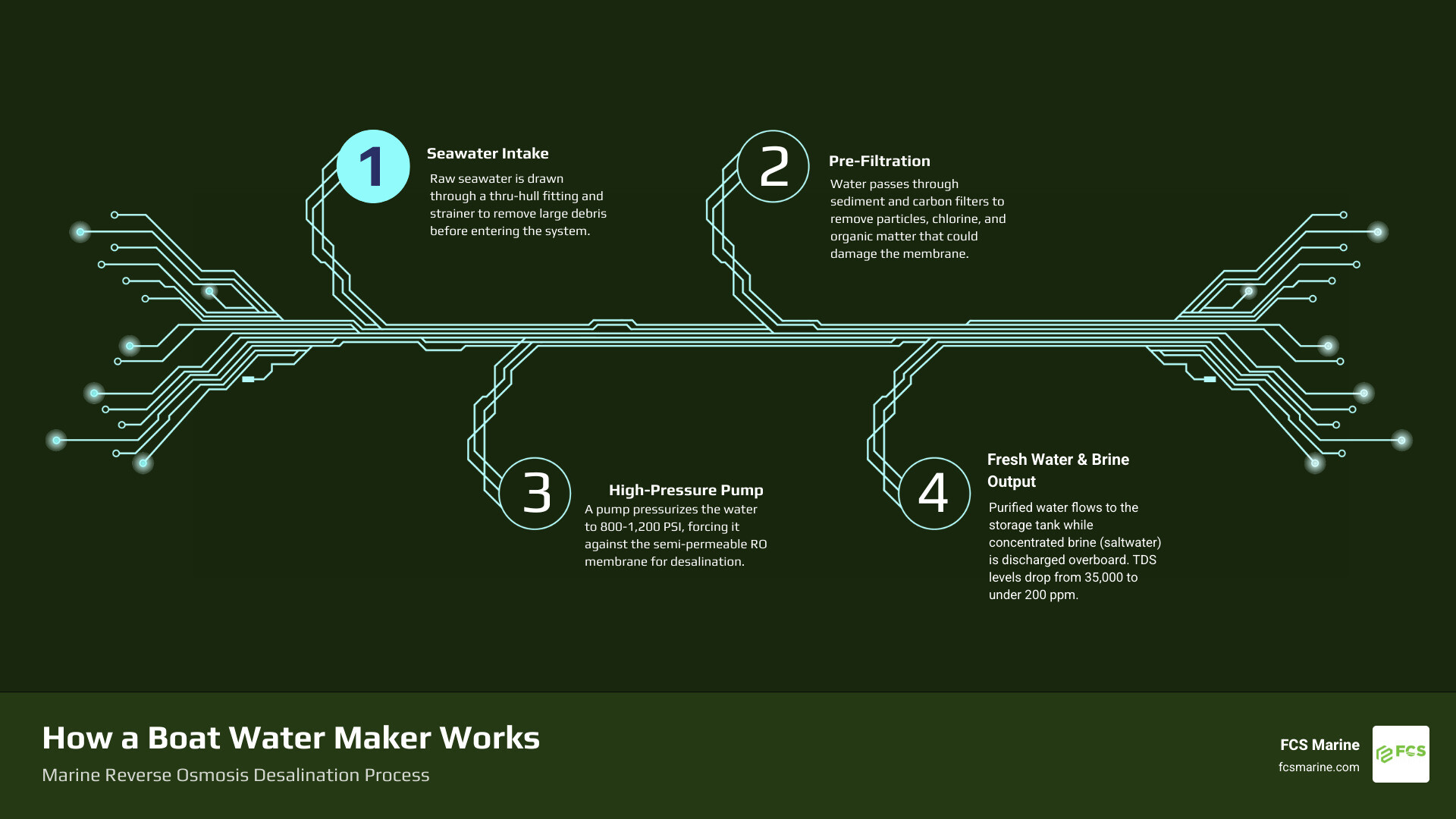
Boat water maker terminology:
Understanding Marine Desalination: How a Boat Water Maker Works
At the heart of every modern boat water maker is a process called marine reverse osmosis. To understand why these systems are highly specialized pieces of engineering, it helps to understand the physical forces at play.
Seawater is packed with dissolved mineral salts, bacteria, and organic matter. To separate pure water from this concentrated brine, the system uses a high-pressure pump to force seawater through a semi-permeable reverse osmosis membrane.
This membrane acts as an incredibly fine molecular sieve. It allows water molecules to pass through while blocking up to 99% of dissolved salts, viruses, and bacteria. The rejected salt and impurities are washed away as concentrated brine and discharged overboard, while the purified product water is routed directly to your freshwater holding tanks.
Because reverse osmosis requires overcoming natural osmotic pressure, the high-pressure pump must generate substantial force—typically between 800 and 1,000 PSI (pounds per square inch) for seawater. Managing this high pressure efficiently is what separates entry-level watermakers from premium, energy-efficient models.
For a deeper look at how reverse osmosis operates on a fundamental level, check out our guide on Demystifying the Reverse Osmosis Water Filter for Beginners.
Comparing the Main Types of Marine Desalinators
Choosing the right marine desalinator depends heavily on your vessel’s electrical infrastructure, engine setup, and how you use your boat. Marine watermakers generally fall into four primary categories:
12V/24V DC Systems
These low-voltage systems are highly popular among sailing yachts, catamarans, and vessels designed to run primarily on solar power and battery banks. By utilizing energy-recovery pumps, modern DC watermakers can produce fresh water with minimal electrical draw.
For example, the compact Katadyn PowerSurvivor 40E draws a mere 4.8 amps of 12V DC power while producing about 1.6 gallons per hour (GPH). If you need higher output, the Spectra 180 draws 8.6 amps at 13V DC while producing nearly 9.5 GPH. The main trade-off with DC units is that they generally produce water at a slower rate, meaning they must run for longer periods to fill large tanks.
110V/220V AC Systems
If your vessel runs a generator or has a robust inverter setup powered by a large lithium battery bank, an AC-powered watermaker is often the most practical choice. These systems utilize heavy-duty AC motors to drive high-capacity high-pressure pumps.
Systems like the Boat Watermakers series Just Water 230 Volt 1,1 kW 75 and 120 l/h provide rapid water production, delivering 75 to 120 liters (approximately 20 to 32 gallons) per hour. AC systems allow you to top off massive holding tanks in just an hour or two of generator run time, making them ideal for larger sportfishers, motor yachts, and busy charter vessels.
Engine-Driven Systems
Engine-driven watermakers utilize a high-pressure pump mounted directly to your vessel’s main propulsion engine, driven by a belt-and-pulley system similar to an alternator or air conditioning compressor. Because they draw mechanical power directly from your engine, they eliminate the need to run an auxiliary generator.
These systems are incredibly powerful and can produce massive volumes of water quickly. They are highly efficient because they bypass the energy losses associated with converting mechanical energy to electricity and back again. The primary limitation is that you must run your main engine (either while cruising or idling in neutral) to produce water.
Manual Emergency Desalinators
These are hand-operated, highly compact survival watermakers, such as the Katadyn Survivor series. They do not require any electrical power and are designed to be stowed in a ditch bag or liferaft. While they only produce a small amount of water (the Survivor 35, for example, produces about 35 gallons per day through manual pumping), they are critical, US Coast Guard-approved life-saving equipment for offshore voyagers.
Sizing and Powering Your Onboard Desalination System
Selecting the correct boat water maker requires balancing your crew’s daily water consumption with your vessel’s available power budget.
Calculating Daily Freshwater Needs for Your Boat Water Maker
As a general rule, a typical cruiser or yacht guest uses between 5 and 10 gallons of fresh water per day. This baseline covers drinking, cooking, handwashing, and quick marine showers. If your vessel is equipped with high-demand appliances like a washing machine, dishwasher, or a transom washdown system for rinsing off salt water, your daily usage can easily double or triple.
When sizing your system, aim to meet your vessel’s entire 24-hour freshwater demand within a 3 to 5-hour daily run window. Running a watermaker for 12 hours a day is noisy, increases wear on the pumps, and forces you to manage your power consumption over an extended period.
- Example Sizing Scenario: If you have a crew of 4 using 10 gallons per person, your daily demand is 40 gallons. To produce 40 gallons in a 4-hour run window, you need a system rated for at least 10 GPH (or 240 Gallons Per Day).
Power Configurations for a Boat Water Maker
Power consumption is measured in watts per gallon—the electrical energy required to produce a single gallon of fresh water. This metric reveals the vast engineering differences between various brands:
- Spectra 180 (DC): Draws 8.6 amps at 13V (approx. 111 watts) to produce 9.5 GPH. This equates to an incredibly efficient 11.8 watts per gallon.
- PowerSurvivor 40E (DC): Draws 4.8 amps at 12V (approx. 58 watts) to produce 1.6 GPH, consuming 39 watts per gallon.
- Village Marine Little Wonder (DC): Produces 5.8 GPH while drawing 16.7 amps at 13V, which translates to 37.4 watts per gallon.
- Caribbean Technology YM-200 (DC): Produces 10.2 GPH but draws a hefty 38 amps at 13V, consuming 48.4 watts per gallon.
Spectra achieves its class-leading efficiency by utilizing patented Clark Pump technology. The Clark Pump is an innovative energy-recovery wet-end that uses the high-pressure waste brine stream to help stroke the piston of the feed pump, recycling the pressure energy that would otherwise be wasted.
For vessels looking to completely bypass electrical battery drain, systems like AguA Watermakers — Intelligent marine watermaker with PFC® valve use direct engine-driven setups with smart PressureFlowControl (PFC) valves. This technology maintains a constant, optimized 60 bar (870 PSI) pressure across the membrane, eliminating the pressure spikes and drops (from 30 to 110 bar) common in traditional engine-driven systems, which can quickly ruin expensive RO membranes.
Key Features to Look For: Automation, Footprint, and Purification
When shopping for a marine desalinator, several modern features can drastically improve your ownership experience:
Modular vs. Compact vs. Self-Contained Designs
- Self-Contained / Framed Systems: These units house the pre-filters, high-pressure pump, motor, and membranes inside a single, pre-assembled stainless steel or aluminum frame. They are easier to mount and service if you have a spacious engine room, but they require a large, continuous footprint.
- Modular Systems: These allow you to mount the individual components (the feed pump, filter housings, control panel, and membrane pressure vessels) in separate, tight spaces throughout your bilge or engine compartment. This is highly beneficial for sailboats and mid-sized powerboats with limited open space.
Automation and MFD Integration
Modern premium watermakers have moved far beyond manual needle valves and analog pressure gauges. Systems equipped with advanced digital controllers, such as Spectra Connect, allow you to control, monitor, and run automated freshwater flush cycles directly from your smartphone, tablet, or your helm’s Multi-Function Displays (MFDs).
Double-Pass Purification and Spot-Free Rinses
If you want the absolute highest standard of water purity, advanced systems like the Spot Zero Water Makers & Purifiers – Pure Water Solutions offer a “double-pass” configuration. This setup combines a seawater desalinator with a dockside water purifier.
By running water through two consecutive reverse osmosis passes, it reduces Total Dissolved Solids (TDS) from a typical 200–500 PPM down to under 20 PPM. This ultra-pure, mineral-free water is perfect for drinking, cooking, and performing spot-free yacht washdowns without needing to chamois the hull.
Maintenance, Accessories, and Total Cost of Ownership
A marine watermaker is an investment that requires consistent, proactive maintenance to protect its sensitive components.
- Freshwater Flushing: This is the single most important maintenance task. After every single use, the system must be flushed with fresh, unchlorinated water to clear salt water out of the RO membrane. If salt water sits stagnant inside the membrane, biological growth (algae and bacteria) will quickly foul the system, ruining the membrane and causing a foul “rotten egg” smell. Most modern systems feature an automated freshwater flush cycle that runs every few days.
- Pickling (Long-Term Storage): If you plan to leave your vessel unused for more than a couple of weeks, you must “pickle” the watermaker. This process involves circulating a chemical biocide/preservative solution through the system to prevent biological growth and keep the membrane from drying out.
- Filter Replacements: Pre-filters protect your high-pressure pump and RO membrane from sediment, silt, and plankton. Standard 5-micron and 20-micron pre-filters generally need to be replaced every 2 to 6 months, or after roughly 100 to 150 hours of operation.
- Membrane Lifespan: With proper care, regular freshwater flushing, and seasonal pickling, high-quality marine RO membranes should last between 5 to 7 years (or up to 1,500 operating hours).
- Critical Spares to Keep Onboard: If you are cruising remote areas like the Bahamas, always carry a comprehensive spares kit. This should include replacement pre-filters, high-pressure pump oil, pickling chemicals, spare O-rings, and a handheld TDS meter to verify water quality.
If you want to ensure your watermaker is maintained to factory standards, our team at FCS Marine provides comprehensive onboard water system service across South Florida. We can handle routine filter changes, system flushes, membrane replacements, and winterization/pickling.
Professional Installation vs. DIY in South Florida
While some handy boat owners attempt a DIY watermaker installation, it is a complex project that touches almost every critical system on your boat:
- Plumbing & Thru-Hulls: A watermaker requires a dedicated raw-water intake thru-hull fitting, a sea strainer, high-pressure plumbing rated for over 1,000 PSI, product water lines routed to your freshwater tanks, and a brine discharge outlet above the waterline. A single plumbing mistake can lead to system leaks or, worse, a flooded bilge.
- Electrical Wiring: High-output AC systems require proper circuit breakers, heavy-gauge wiring, and sometimes integration with your generator’s transfer switches. High-draw DC systems require thick cabling (often 4-gauge or larger) to prevent voltage drops that can damage electrical motors.
- South Florida Environmental Factors: The warm, shallow, and highly biological waters of South Florida (especially around coastal marinas and the Intracoastal Waterway) are highly prone to fouling. Proper placement of the intake thru-hull—away from engine exhausts, bilge discharges, and head outlets—is critical to prevent drawing oil, fuel, or blackwater into your system.
For a reliable installation that protects your vessel and preserves your equipment warranties, it is always best to hire a professional marine technician. At FCS Marine, we specialize in high-quality, mobile marine service, bringing our expertise directly to your dock or marina.
If you are also looking to optimize your home’s water quality, you can explore our guide on how to Bring Pure Water Home with These Top Rated RO Systems.
Frequently Asked Questions About Marine Desalinators
Can I run my watermaker in a marina or harbor?
No, we highly discourage running your watermaker while docked in a marina, harbor, or busy inland waterway. These waters contain high concentrations of suspended silt, diesel fuel, oil, street runoff, and organic waste. Petroleum products can permanently ruin an RO membrane in a matter of minutes, and heavy silt will instantly clog your pre-filters. Always wait until you are in clean, open ocean water before starting your watermaker.
How long do RO membranes last?
Under normal operating conditions and with proper maintenance—including regular freshwater flushing after every run and chemical pickling during periods of inactivity—a high-quality marine reverse osmosis membrane will last between 5 to 7 years.
Do I need a generator to run a watermaker?
Not necessarily. If your vessel is equipped with an efficient DC watermaker (such as a Spectra system utilizing a Clark Pump) and a healthy battery bank supported by solar panels or a high-output alternator, you can easily run your system without a generator. However, high-output AC systems producing 30+ GPH will require a generator or a robust marine inverter system.
Service Areas in South Florida
FCS Marine is a family-owned company providing mobile marine service across South Florida. Our factory-trained technicians travel directly to your vessel at private docks, boatyards, and local marinas. We proudly serve:
- Palm Beach County (West Palm Beach, Jupiter, Palm Beach Gardens, Boca Raton)
- Broward County (Fort Lauderdale, Pompano Beach, Dania Beach, Hollywood)
- Miami-Dade County (Miami, Key Biscayne, Coral Gables, Coconut Grove)
- Martin & St. Lucie Counties (Stuart, Jensen Beach, Fort Pierce)
Contact FCS Marine for Professional Marine Service
Don’t let water limitations dictate your cruising schedule or force you back to a crowded dock. Whether you need to install a new boat water maker, troubleshoot an existing reverse osmosis system, or perform routine seasonal maintenance, the team at FCS Marine is ready to help.
Beyond water systems, we are South Florida’s trusted experts in maintaining overall vessel comfort and mechanical health. If your onboard climate control is struggling in the Florida heat, we invite you to learn more about our professional marine air conditioning service to keep your cabins cool, dry, and mold-free.
Contact us today to schedule your on-site service appointment, and let us help you achieve true freshwater independence on the water. For more cruising tips and technical guides, browse our blog.