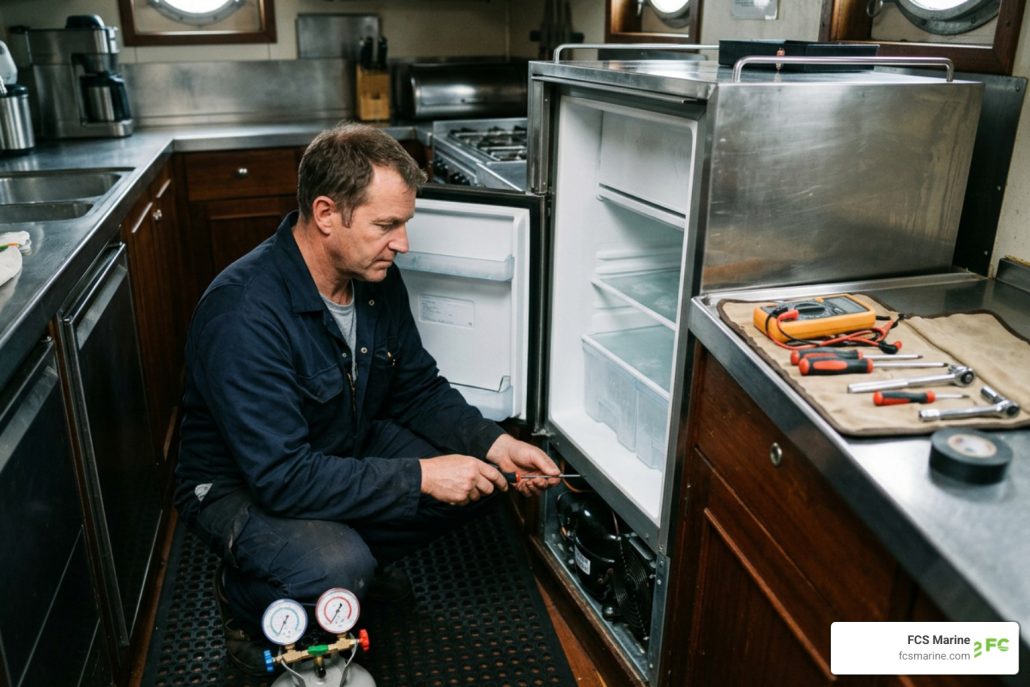
When Your Boat Fridge Fails in South Florida Heat, Every Hour Counts
Marine refrigerator repair is something no yacht owner wants to deal with — especially in the middle of South Florida’s brutal summer heat. But when your galley fridge stops cooling, food spoils fast, provisions are wasted, and the comfort of everyone aboard drops immediately.
Here’s a quick answer if you’re troubleshooting right now:
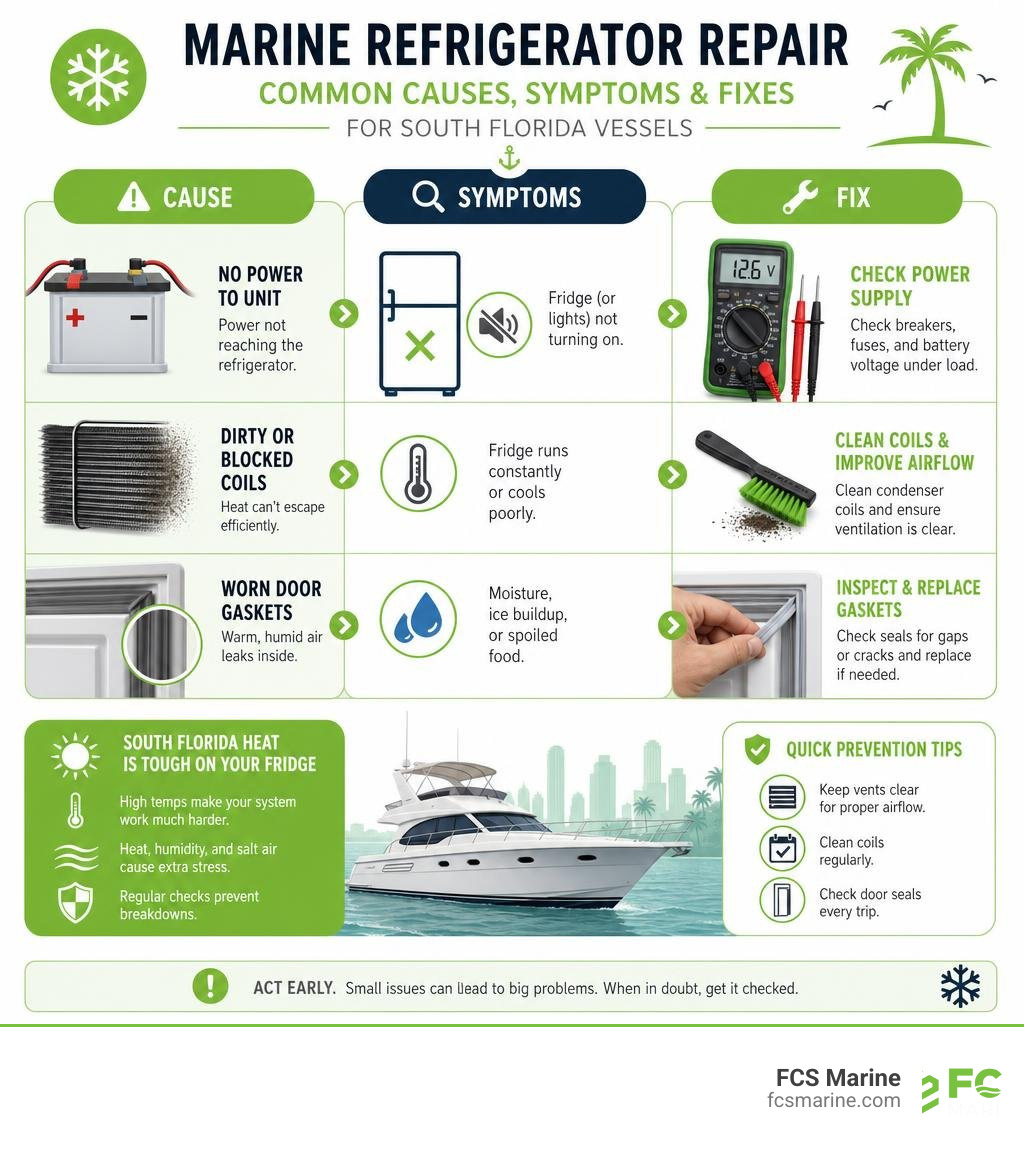
The 3 most common marine refrigerator problems and their fixes:
- No power reaching the unit — Check breakers, fuses, and battery voltage under load
- Condenser coils blocked — Clean coils and ensure ventilation airflow is clear
- Worn door gaskets — Inspect seals for gaps letting in warm, humid air
These three steps resolve the majority of marine fridge issues before a technician is ever needed.
South Florida’s climate is uniquely punishing for onboard refrigeration. Ambient temperatures regularly exceed 90°F, and engine rooms and tight galley cabinets can hit 130°F or more. That forces a marine compressor to work three to four times harder than a household refrigerator ever would. In those conditions, a system that was running fine last season — or that worked perfectly up north — can fail without warning.
Unlike a home fridge, your boat’s refrigeration system runs on 12V or 24V DC power, operates in salt-laden air, deals with constant vibration, and has almost no room to breathe. That combination of heat, corrosion, and restricted airflow makes marine refrigeration one of the most stress-tested systems on any vessel.
For a deeper look at how these systems work and what keeps them running in South Florida conditions, The Ultimate Guide to Boat Refrigerator Repair in South Florida is a great place to start.
The good news? Many marine fridge failures follow a predictable pattern. With the right diagnostic steps, you can identify the problem quickly — and know exactly when to call in a professional before the situation gets worse.
Related content about marine refrigerator repair:
Explain the Core Problem: Marine Refrigeration Failure in South Florida Heat
To understand why your boat’s refrigerator is struggling, you have to look at how it differs from a residential appliance. Home refrigerators operate in climate-controlled kitchens, run on stable AC power, and have plenty of physical clearance for heat rejection.
On a boat, your refrigerator is usually crammed into a tight, custom-built fiberglass enclosure with minimal ventilation. It often relies on 12V or 24V DC battery power, meaning it is highly sensitive to voltage drops. In South Florida, where the summer sun turns cabins and engine rooms into ovens, the compressor is under constant thermal strain.
When ambient temperatures climb, the compressor must work much harder to reject heat from inside the fridge box. If the heat cannot escape, the compressor runs continuously, gets dangerously hot, and consumes an excessive amount of electricity. Because a 12-volt refrigeration system is typically the largest amp draw on a boat’s battery bank, a struggling fridge will quickly drain your house battery bank, eventually triggering a low-voltage shutdown.
Why This Happens on Marine Vessels
The marine environment is incredibly hostile to mechanical and electrical systems. Several unique factors accelerate the wear and tear on your galley refrigerator:
- Saltwater Corrosion: Salt-laden air acts as a catalyst for oxidation. It degrades electrical terminals, corrodes aluminum evaporator fins, and destroys copper tubing, leading to slow refrigerant leaks.
- Constant Vibration: Whether you are idling in the Intracoastal or running through heavy swells offshore, vessel vibration slowly loosens wire connections, chafes refrigerant lines, and stresses compressor mounts.
- Restricted Airflow: Marine cabinets are built to maximize storage space, not ventilation. Dust, pet hair, and salt crust accumulate on the small condenser coils, completely blocking the airflow needed to cool the refrigerant.
- High Humidity: South Florida’s high humidity levels introduce excessive moisture every time you open the fridge door. This moisture rapidly condenses and freezes on the evaporator plate, insulating it and preventing it from cooling the box.
Over time, these factors combine to cause system failure. Understanding these triggers is key to catching issues early. For a complete breakdown of what causes these systems to fail, read our guide on the Common Causes of Marine Refrigeration Failure.
Warning Signs Owners and Captains Should Watch For
You do not have to wait until your drinks are warm and your ice cream is liquid to realize your refrigerator is in trouble. Keep an eye out for these common warning signs:
- Soft Ice Cream or Spoiled Food: The freezer should easily maintain a hard freeze. If ice cream is soft, your system’s cooling capacity has dropped.
- The Compressor Runs Constantly: A healthy refrigerator should cycle on and off. If you hear the compressor humming 100% of the time, it is struggling to reach the set temperature.
- Short-Cycling: If the compressor clicks on, runs for a few seconds, and then immediately shuts off, you are likely dealing with an electrical fault or a high-pressure safety trip.
- Unusual Noises: Excessive buzzing, clicking, rattling, or humming indicates mechanical wear inside the compressor or a failing ventilation fan.
- Heavy Frost Buildup: If the evaporator plates are encased in a thick block of ice, the system cannot transfer heat efficiently.
Normal Operation vs. Failing Refrigerator Symptoms
| Operational Metric | Normal Operation | Failing Refrigerator Symptoms |
|---|---|---|
| Duty Cycle | Runs 30% to 50% of the time | Runs 100% of the time or short-cycles |
| Temperature Stability | Holds steady between 34°F and 38°F | Fluctuates, struggles to stay below 45°F |
| Power Draw | Consistent, low amp draw | High amp draw, drains battery bank rapidly |
| Evaporator Appearance | Light frost dusting | Heavy ice block or completely dry (no cooling) |
| Compressor Temperature | Warm to the touch | Extremely hot or cycling off on thermal overload |
How to Troubleshoot and Repair Your Marine Refrigerator in 3 Steps
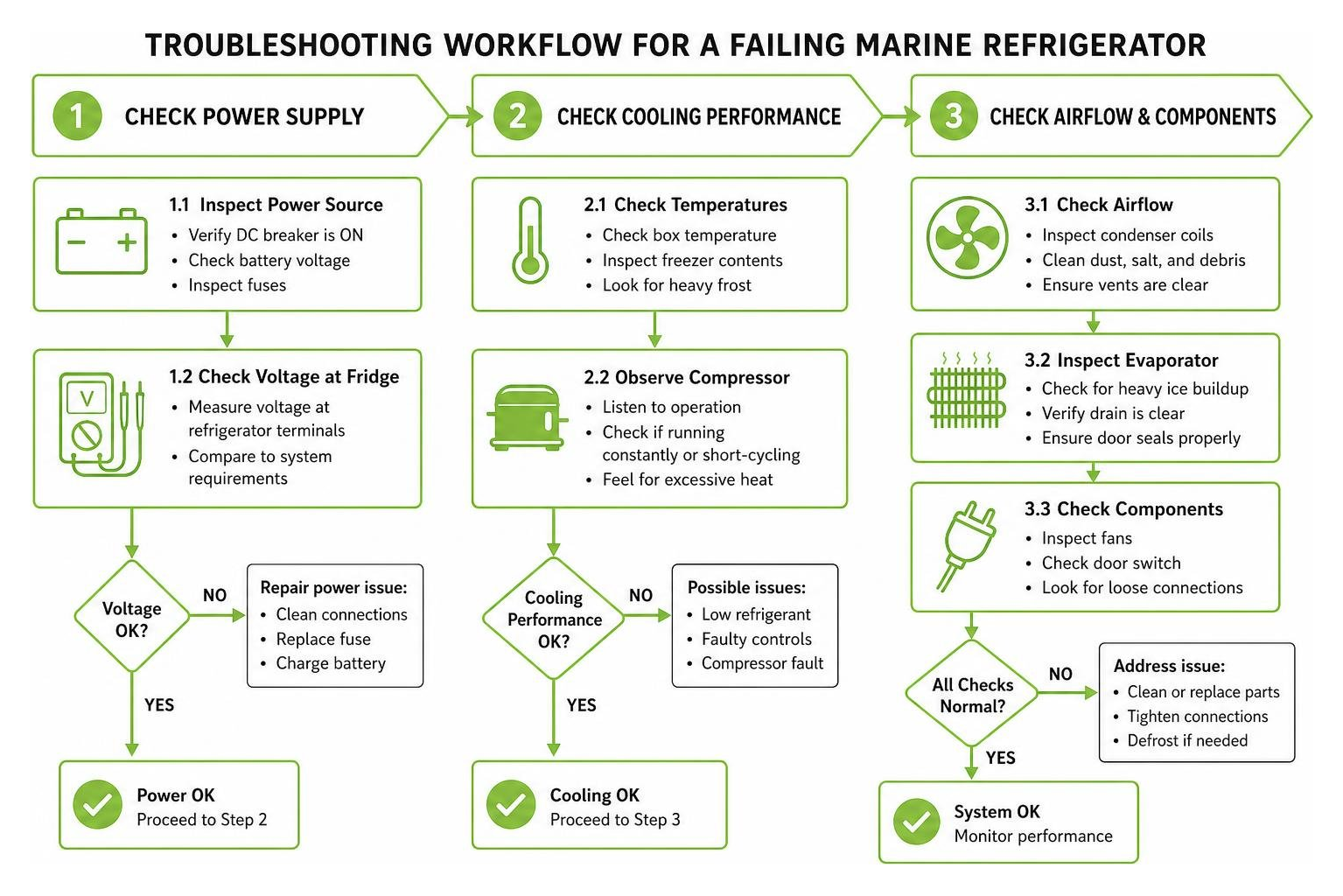
Before you call for a professional technician, you can perform a basic three-step diagnostic check. These steps address the most common causes of cooling failure and are safe for boat owners to perform. Always ensure you disconnect shore power or turn off the dedicated DC breaker before inspecting electrical components.
Step 1: Check Power Supply Before Initiating Marine Refrigerator Repair
The single most common cause of a “dead” boat fridge is a voltage issue. Even if your batteries are fully charged, a small amount of corrosion on a wire terminal can cause a significant voltage drop when the compressor tries to start.
Most marine DC compressors (like the widely used Secop/Danfoss BD35 or BD50 units) have a built-in low-voltage cutoff. If the voltage at the compressor control module drops below 10.4V (for a 12V system) during startup, the compressor will shut down to protect the batteries.
- Locate the main electrical panel and check for a tripped breaker or blown fuse.
- Use a multimeter to measure the voltage directly at the refrigerator’s control module terminals while the compressor attempts to start.
- If the voltage drops significantly under load, inspect all wire connections, ground bars, and battery switches for corrosion or loose crimps.
All marine electrical work should comply with the standards set by the American Boat and Yacht Council (ABYC) to ensure onboard safety. If you find that ice buildup is the root cause of your electrical or thermal struggles, read our article on Why Marine Refrigeration Systems Freeze Up to understand the underlying causes.
Step 2: Clean Condenser Coils to Avoid Costly Marine Refrigerator Repair
A refrigerator works by removing heat from inside the box and releasing it into the surrounding air through the condenser coils. If these coils are covered in dust, pet hair, or salt residue, the heat cannot escape.
- Locate the condensing unit (often tucked under a galley locker, beneath a settee, or in the engine compartment).
- Inspect the small fan next to the coils. Ensure it spins freely and is not blocked by debris.
- Use a soft-bristled brush or vacuum cleaner to gently clean the dirt out of the aluminum fins.
- Ensure that the ventilation grilles cut into your cabinetry are completely clear of stored gear, provisions, or life jackets.
Major manufacturers like Dometic emphasize that proper airflow and ventilation clearance are absolutely critical to the longevity and efficiency of marine cooling units.
Step 3: Inspect Door Gaskets and Seals
In South Florida’s highly humid climate, a failing door seal is a recipe for disaster. If the magnetic gasket on your refrigerator door is torn, compressed, or misaligned, warm, moisture-rich air will continuously leak into the box.
- Inspect the rubber gasket all the way around the door for cracks, tears, or mold growth.
- Perform the “dollar bill test”: Close the refrigerator door on a dollar bill. If you can pull the bill out easily with no resistance, the seal is too weak.
- Clean the gasket with warm, soapy water to remove dirt that might prevent a tight seal.
- If the gasket is permanently compressed or damaged, it must be replaced to keep the humid air out.
Why Professional Marine Service Matters
While basic cleaning and voltage checks are easy to do yourself, complex repairs require professional expertise. Marine refrigeration systems are highly specialized and operate under extreme physical constraints.
Attempting to recharge refrigerant without the proper tools can ruin a compressor. Under federal law, anyone handling or recovering refrigerants must hold an EPA Section 608 certification. Additionally, diagnosing internal compressor mechanical failures, replacing expansion valves, or troubleshooting water-cooled condenser systems (which frequently suffer from high-pressure faults due to marine growth clogging raw water lines) requires specialized diagnostic gear.
Standard residential HVAC technicians often lack the training required to work on low-voltage DC electronics, marine plumbing, and yacht electrical grids. Hiring an uncertified technician risks damaging your high-end yacht galley finishes, voiding manufacturer warranties, or creating electrical hazards on your vessel’s DC bus.
How FCS Marine Can Help
When troubleshooting reveals a deeper issue — such as a refrigerant leak, a failed control module, or a locked compressor — we are here to help. FCS Marine specializes in professional, high-end yacht refrigeration and marine appliance repair.
We provide a fully mobile marine service, meaning our factory-trained technicians come directly to where your vessel is located. Whether your boat is docked at a private residence in Pompano Beach, sitting in a boat yard in Fort Lauderdale, or slipped at a luxury marina in Miami, we perform all diagnostics and repairs on-site. You never have to worry about moving your vessel to get expert service.
We service and support all major marine refrigeration brands, including Vitrifrigo, Isotherm, Frigoboat, Sea Frost, Grunert, Dometic, Norcold, and high-end built-in systems. If you own a luxury yacht outfitted with premium appliances, we also specialize in support for elite brands like Sub-Zero, ensuring your high-end galley systems receive the precise care they require.
Whether you need a quick repair or a complete galley refit, our Marine Refrigeration Services page outlines how we keep your cold storage operating flawlessly.
Preventive Maintenance Tips
The best way to avoid a costly emergency repair is to establish a proactive maintenance routine. We recommend the following steps to keep your system running efficiently:
- Defrost Regularly: Do not let ice build up more than a quarter-inch on your evaporator plates. Turn the system off, let the ice melt naturally (never use a knife or sharp tool to scrape ice, as this will puncture the refrigerant lines), and wipe the box dry.
- Keep the Batteries Charged: Ensure your battery banks are healthy and your alternator or battery charger is delivering stable voltage to prevent low-voltage compressor strain.
- Clear Ventilation Paths: Regularly vacuum the condenser coils and ensure that storage lockers surrounding the compressor unit remain clear of clutter.
- Schedule Professional Inspections: Have a certified marine technician inspect your system every 6 to 12 months (or every 3 months for liveaboards and heavy cruisers in South Florida).
To learn more about what to expect from your system over time, explore our guide on How Long Marine Refrigeration Systems Last. For more tips on keeping your systems running through the hottest months, check out Chill Out: Why Regular Yacht Refrigerator Service Florida Keeps the Party Going.
Service Areas in South Florida
We proudly provide mobile marine service across the entire South Florida region. Our service vans are fully equipped with specialized tools and common marine-grade replacement parts to complete repairs quickly, minimizing your vessel’s downtime.
Our service coverage includes:
- Palm Beach County: Serving West Palm Beach, Jupiter, and Boca Raton.
- Broward County: Serving Fort Lauderdale, Pompano Beach, and Hollywood.
- Miami-Dade County: Serving Miami, Key Biscayne, and Coconut Grove.
- Martin County: Providing specialized appliance and refrigeration support for vessels in Stuart, Jensen Beach, and surrounding areas.
- St. Lucie County: Providing expert local support for boat owners in Fort Pierce and Port St. Lucie.
We regularly service vessels at all major local marinas, commercial boat yards, private docks, and yacht clubs throughout these counties. If your vessel’s air conditioning system is also struggling in the coastal heat, we provide comprehensive climate support to keep your entire cabin cool and comfortable.
Contact FCS Marine for Professional Marine Service
Do not let a warm refrigerator ruin your time on the water. Whether you are dealing with a short-cycling compressor, a heavy ice block in your freezer, or a system that refuses to turn on, FCS Marine is ready to help.
Our team of EPA-certified, highly skilled technicians provides fast, reliable, and professional mobile marine service directly to your dock, marina, or boat yard. Beyond refrigeration, we are South Florida’s trusted experts for marine AC repair, custom yacht insulation, mold remediation, and watermaker services.
Keep your galley cold and your provisions fresh. Contact FCS Marine today to schedule your professional on-site marine service.
Frequently Asked Questions about Marine Refrigerator Repair
Why does my marine refrigerator run constantly but not get cold?
This is typically caused by restricted airflow around the condensing unit, dirty condenser coils, or a slow refrigerant leak. In South Florida’s high heat, if the system cannot reject heat efficiently, the compressor will run continuously without lowering the temperature inside the box. Worn door seals that let warm, humid air leak in can also cause this issue.
How often should a marine refrigeration system be serviced?
In South Florida’s hot and humid marine environment, we recommend having your system professionally serviced every 6 to 12 months. For liveaboards, commercial vessels, or yachts operating year-round, servicing the system every 3 months is ideal to clean the coils, check electrical connections, inspect seals, and prevent sudden failures.
Can a standard residential HVAC technician fix my boat fridge?
It is not recommended. Marine refrigeration systems are highly specialized, often operating on 12V/24V DC power, utilizing water-cooled condensers, or employing custom cold-plate configurations. A residential technician lacks the specialized training, marine-grade parts, and understanding of yacht electrical grids and marine plumbing required to perform safe, long-lasting repairs.
What is the typical cost range for marine refrigerator repair?
Basic diagnostic and routine maintenance service calls typically cost a few hundred dollars. Minor component repairs, such as replacing a thermostat, control module, or ventilation fan, usually range from $200 to $800. Complete system overhauls, custom evaporator installations, or compressor replacements can range from $1,000 to several thousand dollars depending on the size and complexity of the vessel’s system.