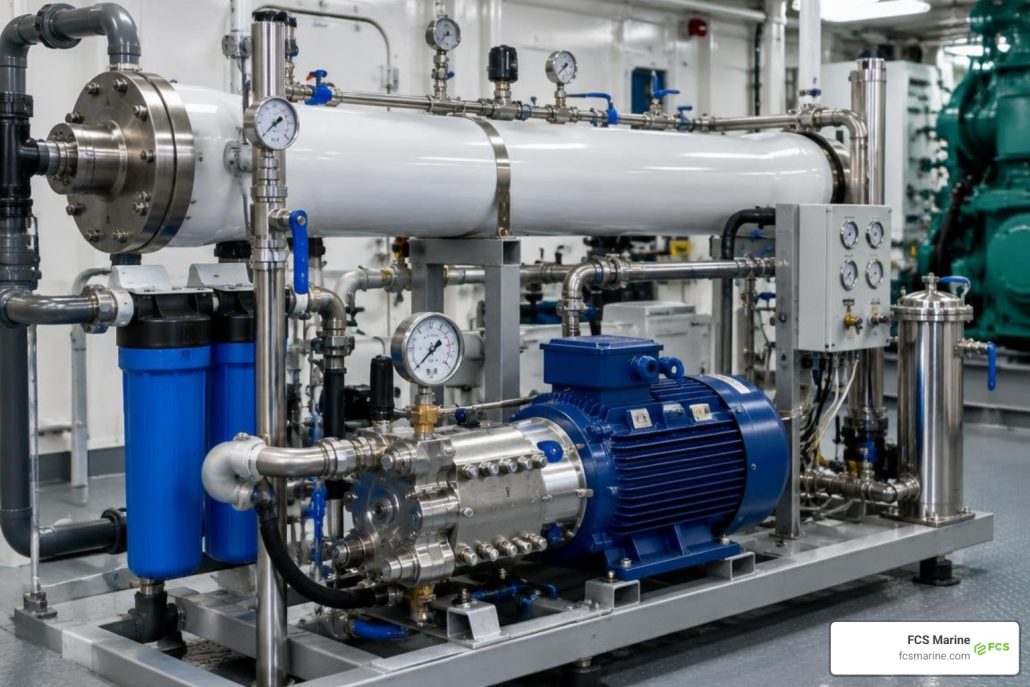
How Marine Reverse Osmosis Desalination Works Onboard
Reverse osmosis (RO) works by overcoming natural osmotic pressure. In nature, when freshwater and saltwater sit on opposite sides of a semi-permeable membrane, freshwater naturally flows toward the concentrated salt side to balance the solution. A marine watermaker reverses this natural dynamic by using a mechanical high-pressure pump to force raw ocean water against the membrane at pressures between 750 and 850 PSI (pounds per square inch).
Under this intense pressure, water molecules are driven through the tight pores of the membrane, which measure roughly 0.0001 microns. Dissolved mineral salts, bacteria, heavy metals, and suspended solids cannot pass through these tight pores. The system separates the intake stream into two distinct lines:
- Product Water (Permeate): Fresh, pure water containing very low levels of dissolved minerals, directed to the vessel’s freshwater storage tanks.
- Brine (Concentrate): Concentrated saltwater carrying rejected minerals and particulate matter, safely discharged overboard through a dedicated thru-hull fitting.
Understanding the mechanics behind this separation is essential for any mariner looking into demystifying the reverse osmosis water filter before cruising offshore.
Essential Components of a Water Maker for Boat Systems
A reliable marine watermaker relies on a chain of precision-engineered mechanical and electrical components working in harmony:
- Intake Thru-Hull and Seacock: Draws raw ocean water from beneath the hull, placed below the waterline in clean, bubble-free flow.
- Low-Pressure Boost Pump: Draws seawater through the raw water strainer and feeds it through the initial filtration stages under low pressure (typically 15 to 30 PSI).
- Pre-Filtration Assembly: Dual-stage or triple-stage filter housings containing 20-micron and 5-micron sediment cartridges to strip silt, sand, and plankton before they reach sensitive internals. Using high-quality marine filters for clean water at sea prevents premature membrane clogging.
- High-Pressure Pump: Built using marine-grade AISI 316 stainless steel or specialized duplex alloys to withstand continuous saltwater exposure while delivering high operating pressures.
- Membrane Pressure Vessel: Heavy-duty fiberglass composite or 316 stainless steel housings engineered to contain high operating pressures while seating the RO membrane element securely.
- Pressure Regulating Valve and Gauges: Analog needle gauges or electronic pressure transducers that allow operators to dial in the exact operating pressure needed for current water salinity and temperature.
- Control Panel and TDS Monitor: Central control interface that displays real-time total dissolved solids in parts per million (PPM), freshwater flow rates, and operating hours.
Desalination Systems vs. Combined Purification and Double-Pass Technology
Standard single-pass marine desalination systems take seawater and strip away approximately 99% of dissolved minerals, dropping raw Atlantic or Caribbean seawater (around 35,000 PPM TDS) down to clean potable water measuring between 150 and 350 PPM TDS.
Advanced double-pass systems take this technology a step further. In a double-pass or combined watermaker-and-purifier system, product water generated from the primary seawater RO stage is immediately routed through a secondary, lower-pressure RO membrane stage. This process eliminates “TDS creep”—a minor rise in dissolved solids that naturally occurs across membranes during startup and shutdown cycles.
Double-pass and hybrid dockside purification units can also treat municipal dock water while tied up in port, removing chlorine, pesticides, hardness minerals, and microplastics. The resulting product achieves ultra-pure water with total dissolved solids under 20 PPM. This ultra-pure water delivers a spotless deck rinse that dries without mineral deposits, saving hours of chamois drying on delicate gelcoat, brightwork, and clear marine enclosures.
Sizing and Selecting a Water Maker for Boat Use
Choosing the correct capacity for your vessel prevents running electrical systems down or running out of water during remote itineraries. Evaluating practical production numbers alongside tank capacity is key when reviewing a yacht water maker comparison.
As a baseline, allocate 5 to 10 gallons (19 to 38 liters) of fresh water per person per day for conservative cruising, covering drinking, cooking, dishes, and quick marine showers. For vessels equipped with washing machines, dishwashers, and active dive compressors, plan for 25 to 35 gallons (95 to 132 liters) per person per day.
To minimize mechanical wear and keep energy use predictable, select a watermaker capable of meeting your vessel’s total daily freshwater requirement within a 2-to-4-hour run window, rather than running a small unit continuously throughout the day.
AC vs DC Power Draw for a Water Maker for Boat Cruising
Marine desalination systems fall into two electrical categories: high-output AC-powered units designed for vessels with onboard generators or large inverter banks, and high-efficiency 12V/24V DC units built for sailing catamarans and monohulls prioritizing energy conservation.
| Feature / Metric | 12V / 24V DC Systems | 110V / 230V AC Systems |
|---|---|---|
| Primary Power Source | House battery banks (AGM / Lithium) | Diesel generator, shore power, large inverters |
| Power Consumption | 100W – 350W (Energy Recovery) | 700W – 3,000W+ (Direct Drive) |
| Typical Production Rate | 4 – 15 GPH (15 – 57 LPH) | 12 – 70+ GPH (45 – 265+ LPH) |
| Current Draw | 8 – 30 Amps @ 12V DC | 4 – 14 Amps @ 230V AC |
| Pumping Mechanism | Energy-recovery hydraulic intensifier | Direct-drive 316 SS plunger pump |
| Vessel Fit | Sailing vessels, sub-45ft cruisers | Motor yachts, sportfish, catamarans, superyachts |
When configuring direct-current setups, take time to review sizing and installing 12 volt marine water makers to calculate cable runs, breaker sizing, and battery replenishment strategies accurately.
Daily Production Sizing and Energy Management
Balancing freshwater output with available onboard electrical generation ensures you maintain battery health while keeping tanks full:
- Weekend and Coastal Cruising (25–38 ft): Compact modular AC units producing 12 to 20 GPH (45 to 75 LPH) with low 0.7 kW power draws pair well with small portable or compact diesel generators.
- Offshore Cruising Couples (38–50 ft): Energy-recovery DC units producing 8 to 15 GPH can run directly from expansive solar arrays and lithium battery banks during peak sun hours without firing up an auxiliary engine.
- Active Motor Yachts and Sportfish (45–70+ ft): High-output AC systems producing 30 to 70 GPH (113 to 265 LPH) powered by onboard generators replenish large tank capacities in an hour or two while running air conditioning and refrigeration systems concurrently.
Marine Installation Considerations in South Florida Waters
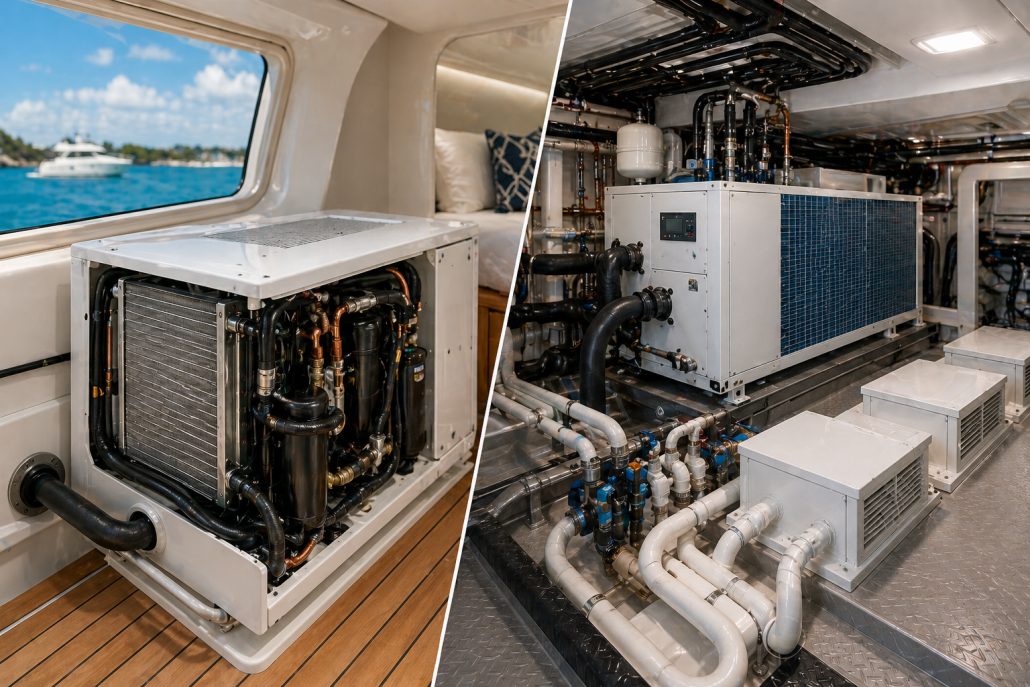
Installing a marine reverse osmosis system in South Florida requires careful planning around spatial limitations, plumbing paths, and raw water quality. Our subtropical waters present distinct operational challenges, including elevated water temperatures, suspended sediment from tidal inlets, and year-round biological growth.
To ensure trouble-free operation, integrate your watermaker within the broader plumbing architecture outlined in this essential guide to boat water systems. Key mechanical installation steps include:
- Dedicated Raw Water Intake: Avoid teeing into existing engine or generator cooling lines whenever possible. Aeration or pressure drops from shared strainers can starve the watermaker’s boost pump and trigger low-pressure shutdowns.
- Low-Profile Thru-Hull Placement: Position the raw water pickup well below the dynamic running waterline, forward of engine exhausts, bilge discharges, and head outlets to prevent ingesting oily or contaminated water.
- Vibration and Noise Dampening: Mount high-pressure motor and pump assemblies onto flexible marine vibration isolators. Isolate rigid plumbing lines with high-pressure flexible braided hoses to eliminate structural drone through bulkheads and cabin soles.
- Modular vs. Compact Frame: For tight machinery rooms, modular watermakers allow you to mount the pre-filter bracket, high-pressure pump, membrane vessels, and control panel in separate accessible locations throughout the bilge and utility bays.
Environmental Demands, Water Scarcity, and Quality Differences
While municipal water along Florida coastlines meets regulated standards under the State of Florida environmental standards, marina dock water frequently carries heavy mineral hardness, pipe scale, and fluctuating chlorine levels. The U.S. EPA drinking water regulations establish national primary standards for public water systems, but they do not account for the condition of aging marina plumbing or the biological growth that can occur inside dock hoses left in the South Florida sun.
Standard mechanical sediment and carbon block filtration removes suspended particles and taste-altering chlorine, but allows dissolved salts, heavy metals, and microscopic pathogens to pass right through into your holding tanks.
True marine reverse osmosis stands as the most comprehensive onboard purification barrier. By using high mechanical pressure against a semi-permeable membrane, an RO watermaker strips up to 99% of total dissolved solids, dissolved chemicals, and microscopic particulates. This delivers pure, neutral drinking water that reduces your reliance on single-use plastic bottles, whether navigating sensitive marine environments or coastal shallows. For vessels cruising through South Florida’s busy inlets and anchorages, the NOAA marine water quality guidance highlights why reducing onboard contaminant discharge and plastic waste matters for long-term ocean stewardship.
Maintenance, Membrane Care, and Operating Longevity
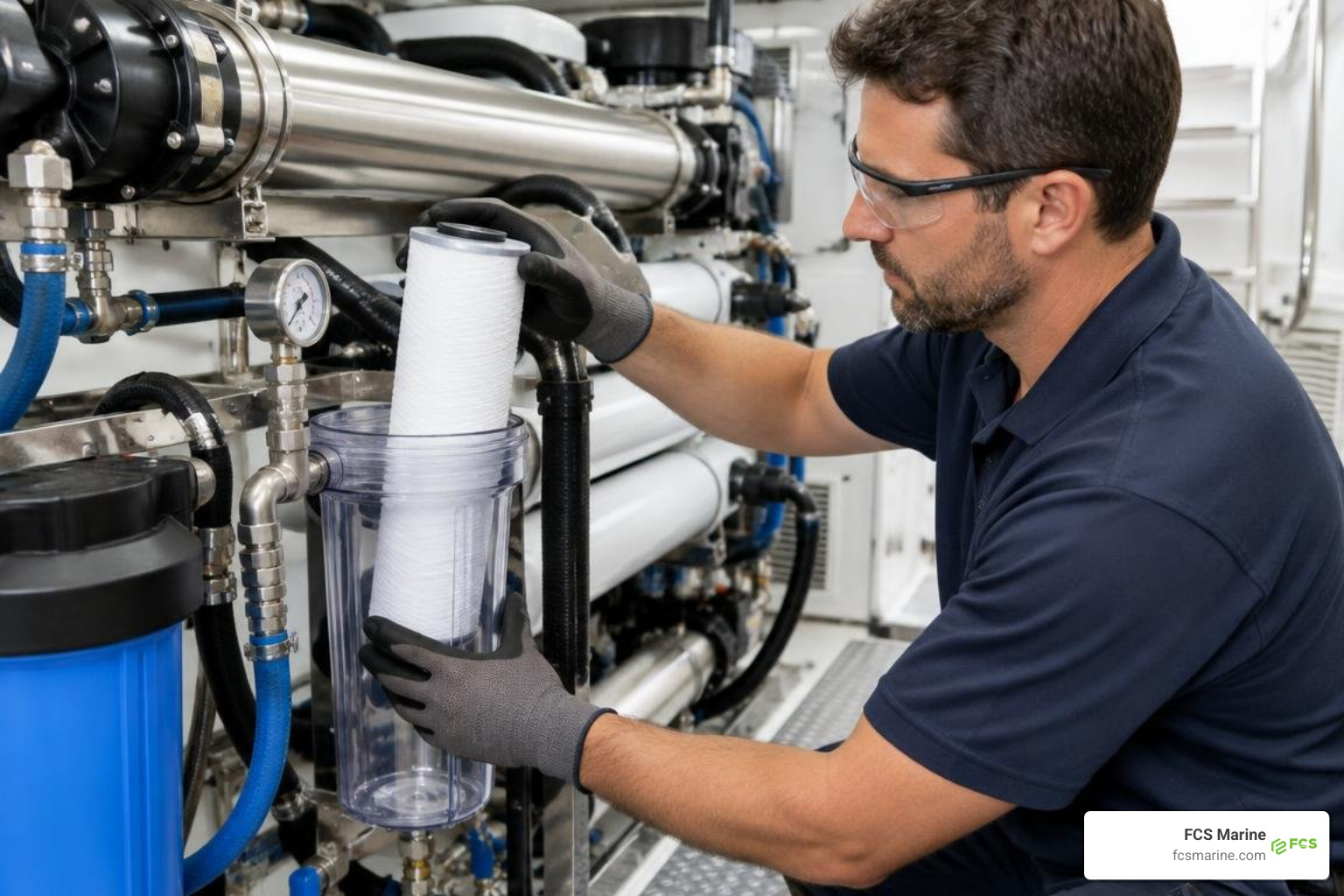
Marine reverse osmosis membranes are durable composite structures, but they are vulnerable to sediment fouling, chlorine degradation, and biological colonization when left unserviced.
Fresh Water Flushing and Pre-Filter Schedules
The single most critical step in extending reverse osmosis membrane life is executing a clean freshwater flush after every operating cycle. Stagnant seawater left inside a membrane vessel allows marine organisms to die, decay, and produce anaerobic bacteria that foul the membrane surface with biological slime within 7 to 10 days.
- Automated Fresh Water Flush: An automated flush system routes dechlorinated water from the boat’s freshwater tank through the membrane for 3 to 5 minutes at shutdown, washing away concentrated brine. This cycle should repeat automatically every 7 to 14 days when the vessel sits idle at the dock.
- Carbon Flush Filter: Always route flush water through an active carbon filter cartridge to remove residual chlorine from tank water. Chlorine permanently oxidizes and degrades thin-film composite RO membranes.
- Pre-Filter Replacements: Regularly inspect and replace the 20-micron and 5-micron sediment pre-filters. If the intake vacuum gauge indicates elevated resistance or supply pressure drops below 10 PSI at the high-pressure pump inlet, change the cartridges immediately.
Pickling, Chemical Cleaning, and System Preservation
When your vessel will sit without freshwater flushing for more than two weeks, the watermaker must be chemically preserved, a process known as “pickling”:
- System Flush: Thoroughly flush the system with clean, unchlorinated product water.
- Preservative Circulation: Circulate a food-grade solution of sodium metabisulfite through the pre-filters, high-pressure pump, and membrane vessels using a closed-loop bucket and valving manifold.
- Valving Isolation: Close off the intake and discharge valves to lock the chemical preservative inside the membrane housing, preventing biological growth and fungal formation for up to 6 to 12 months.
- Alkaline and Acid Cleanings: If mineral scaling or organic fouling causes product output to drop by 15% or TDS to rise under standard operating pressure, run dedicated alkaline cleaners (for biological slime and oils) followed by mild acid cleaners (for calcium and scale deposits) to restore membrane performance.
Frequently Asked Questions About Marine Watermakers
How much power does a typical boat watermaker consume?
Power consumption varies based on system design and capacity. Compact 12V/24V DC energy-recovery units typically consume between 100W and 350W, drawing 8 to 28 amps at 12V DC while producing 4 to 15 GPH. Direct-drive AC watermakers require between 700W and 2,000W (drawing 3.5 to 10 amps on 230V AC lines) and deliver 15 to 70+ GPH, making them ideal for running alongside auxiliary generators.
What is the difference between standard water filtration and reverse osmosis?
Mechanical sediment and carbon filtration traps suspended particles like rust and silt down to a specific micron size and reduces chlorine, but does not remove dissolved salts, heavy metals, or dissolved mineral compounds. Reverse osmosis uses semi-permeable membranes under high pressure to extract up to 99% of all dissolved solids, salts, chemicals, and contaminants, producing laboratory-grade potable drinking water.
How often do marine reverse osmosis membranes need replacement?
With regular freshwater flushing, proactive pre-filter changes, and proper chemical preservation during layups, a quality marine RO membrane typically lasts between 5 and 8 years. Premature failure usually stems from running chlorinated water through the membrane, drawing oily harbor water into the intake, or allowing stagnant saltwater to sit in the vessel without flushing.
Professional Mobile Water System Service and Maintenance
Keeping an offshore desalination system operating smoothly requires routine inspection of high-pressure seals, calibration of TDS sensors, thorough chemical cleaning, and sound electrical connections. A failing high-pressure pump seal or a scaled membrane can quickly leave your crew without drinking water during a crossing.
At FCS Marine, we specialize in comprehensive marine maintenance, traveling directly to your vessel across South Florida. Our mobile service vans provide on-site diagnostics, repairs, and installations at marinas, boat yards, private docks, and local yacht clubs.
Whether your vessel needs professional onboard water system service, routine marine air conditioning repair, refrigeration maintenance, yacht insulation, or mold remediation, our technicians bring the necessary tools and replacement components directly to your slip.
If your watermaker is suffering from high TDS levels, low operating pressure, pre-filter fouling, or requires commissioning before your next offshore itinerary, reach out to our team today to schedule complete on-site marine service in Palm Beach County, Broward County, Miami-Dade County, Martin County, or St. Lucie County.