Why a Reliable Boat Fridge Repair Service Matters in South Florida’s Heat
If you need a boat fridge repair service right now, here is what you need to know:
Quick Answer: What to Do When Your Boat Fridge Stops Working
- Check the DC breaker and power supply first — many failures are simple electrical issues.
- Look for obvious signs: frost buildup, compressor clicking, or the unit running constantly without cooling.
- Do not attempt to recharge refrigerant yourself — this requires EPA 608 certification.
- Call a professional marine refrigeration technician who can come directly to your vessel’s location.
- Minimize opening the fridge to preserve any remaining cold air while you wait for service.
Picture this: it is July in South Florida, the temperature on deck is pushing 95°F, and your boat’s galley fridge has stopped cooling overnight. Provisions for a weekend trip are spoiling. Guests are on their way. And the closest marine refrigeration technician is — where, exactly?
This is not a rare situation for yacht owners, captains, and liveaboards along the South Florida coast. Marine refrigeration systems in tropical climates work significantly harder than the same units would in cooler regions. Engine rooms in South Florida vessels regularly exceed 130°F, and ambient temperatures rarely drop enough to give these systems a break. The result is faster wear, more frequent failures, and — when something goes wrong — an urgent need for professional help.
Marine refrigerators are not household appliances. They run on 12V or 24V DC power, use small refrigerant charges (often as little as 70ml of R134a), and rely on specialized components like Danfoss compressors and either air-cooled, water-cooled, or keel-cooled condensers. A general HVAC technician or a DIY approach can easily cause more damage to these sensitive systems.
That is where FCS Marine comes in. As a South Florida-based mobile marine service company, FCS Marine travels directly to your vessel — whether it is docked at a Fort Lauderdale marina, a private dock in Miami, or a boatyard in Palm Beach — to diagnose and repair marine refrigeration problems on-site.
This guide covers everything you need to know: common failure causes, warning signs, repair versus replacement decisions, maintenance tips, and how to get fast, professional help when your boat fridge stops working in the South Florida heat.
Common Causes of Marine Refrigeration Failure
When a marine refrigerator stops cooling, the temptation is often to assume the entire system is dead. However, most issues stem from a few specific, marine-related vulnerabilities.
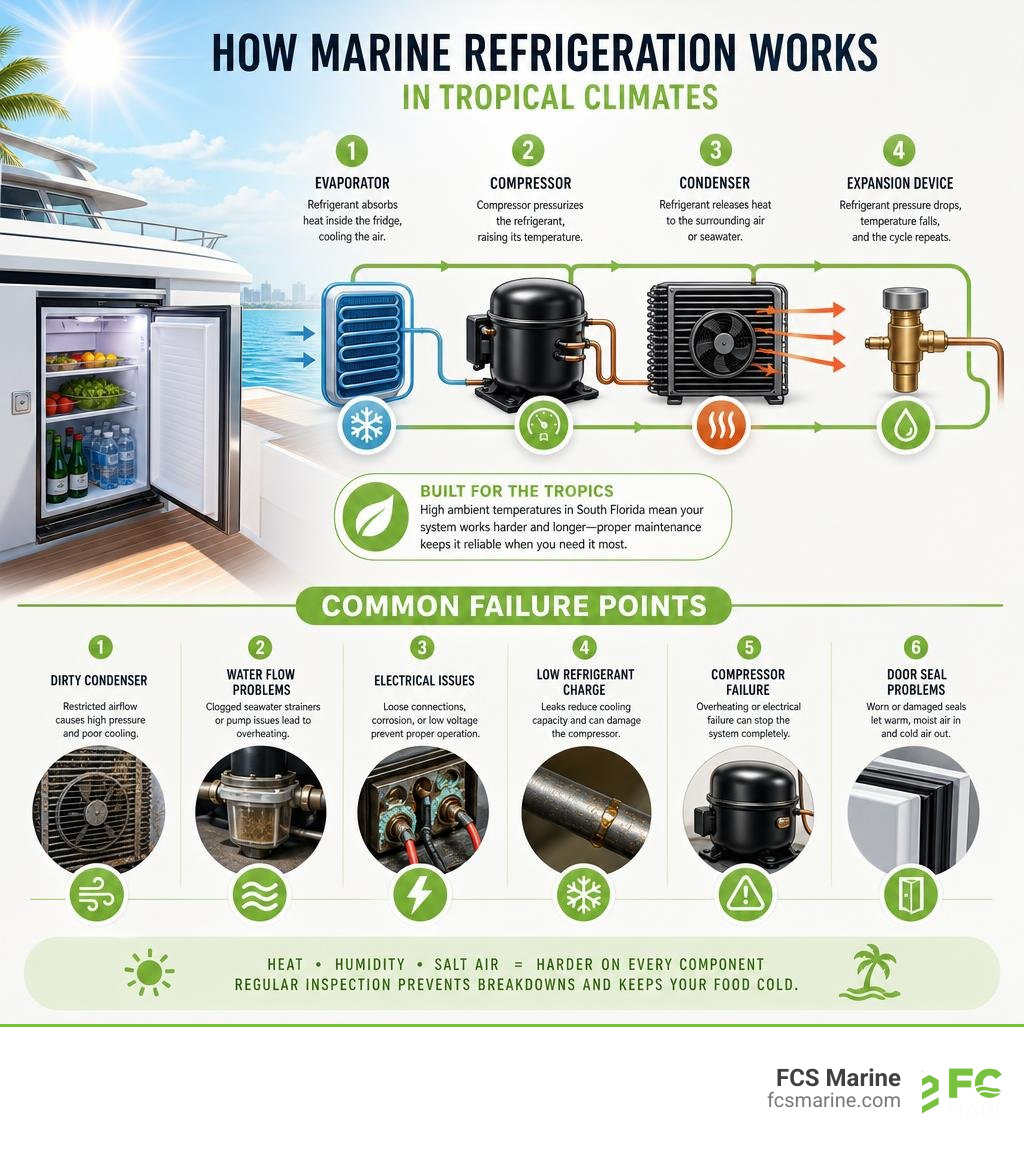
Understanding the Common Causes of Marine Refrigeration Failure is the first step toward getting your galley back to temperature. According to industry-standard marine refrigeration troubleshooting guidelines, the most frequent culprits include:
- Slow Refrigerant Leaks: Marine 12V/24V systems typically hold an incredibly small amount of refrigerant—often only about 70ml (2.4 oz) of R134a. Because the charge is so small, even a microscopic leak will quickly drop pressure below operational levels. These slow leaks typically require the system to be professionally re-gassed every 5 to 7 years.
- Dirty Condenser Coils: Dust, pet hair, and salt spray quickly coat air-cooled condenser coils. When insulated by grime, the condenser cannot shed heat, forcing the compressor to run continuously until it overheats and shuts down.
- Compressor Failure: The Danfoss BD35F is the undisputed workhorse of the marine refrigeration world. While incredibly durable, it can fail prematurely if forced to run constantly under extreme heat stress, or if the electrical supply drops below the required voltage.
- Salt Air Corrosion: Saltwater and high humidity are highly corrosive. Over time, salt air degrades electrical terminals, corrodes copper tubing, and ruins the delicate solder joints on control modules.
- Failed Door Seals: A cracked or misaligned gasket allows warm, humid South Florida air to constantly seep into the box. This leads to heavy frost buildup, uneven temperatures, and high energy bills.
Air-Cooled vs. Water-Cooled Marine Refrigeration Systems
How your system rejects heat plays a massive role in how it behaves in tropical waters and how it should be serviced. When systems struggle to shed heat, they run inefficiently, which is a primary reason Why Marine Refrigeration Systems Freeze Up.
| System Type | How It Works | Pros | Cons & Maintenance Needs |
|---|---|---|---|
| Air-Cooled | Uses a small 12V fan to blow air across a finned condenser coil, venting heat into the cabin or locker. | Simple, reliable, low installation cost, and zero plumbing connections. | Struggles when ambient cabin or engine room temperatures exceed 90°F. Coils require frequent vacuuming. |
| Water-Cooled | Circulates raw seawater through a coaxial condenser to carry heat away from the compressor. | Highly efficient in hot climates; keeps the compressor running cool even in hot engine rooms. | High maintenance. Requires zinc anode replacement, seawater strainers, and back-flushing to clear marine growth. |
| Keel-Cooled | Passes refrigerant through an external bronze shoe (like a Frigoboat system) mounted on the outside of the hull. | Zero noise, no raw-water pumps, high efficiency, and no moving parts on the condenser side. | Expensive to install; requires hauling the boat to service or replace external fittings. |
In South Florida, air-cooled systems are often pushed past their design limits. When cabin temperatures rise, upgrading to a water-cooled or keel-cooled system—or adding auxiliary ventilation—is a common service request we handle at FCS Marine.
Warning Signs Your Boat Fridge Needs Professional Service
Before your ice cream melts completely, your marine refrigerator will usually drop a few hints that it is struggling. Captains and owners should watch for these warning signs:
- The Compressor Clicks but Won’t Start: If you hear a faint “click” every few minutes from the compressor area, but the motor never spins up, the system is likely suffering from low voltage or a failing electronic control module.
- The Unit Runs Constantly: A healthy marine fridge should cycle on and off. If yours is running 24/7 and the food is only moderately cold, you are likely dealing with low refrigerant or a heavily insulated, dirty condenser.
- Heavy Frost or Ice Buildup: Rapid ice buildup on the evaporator plate usually points to a faulty door seal or a malfunctioning defrost cycle, letting humid coastal air inside.
- Unusual Noises: Buzzing, rattling, or clicking sounds from the compressor compartment often indicate loose mounting brackets, failing fan motors, or mechanical wear inside the compressor itself.
- Rapid Battery Drain: If your house battery bank is depleting much faster than normal while at anchor, an inefficient, struggling refrigerator compressor is the most common energy hog.
While checking your DC breaker panel and cleaning visible dust off your air filters are excellent DIY first steps, diagnosing low refrigerant charges or electrical faults requires professional tools and gauges.
Why Professional Marine Refrigeration Service Matters
It can be tempting to call a residential appliance technician or try a quick DIY fix. However, marine systems are highly specialized. Residential technicians rarely understand the nuances of low-voltage DC electrical systems, nor do they carry the correct marine-grade spare parts.
Furthermore, handling refrigerants legally and safely requires an EPA Section 608 Technician Certification. A professional boat fridge repair service ensures that your system is diagnosed accurately without risking damage to your vessel’s complex electrical grid.
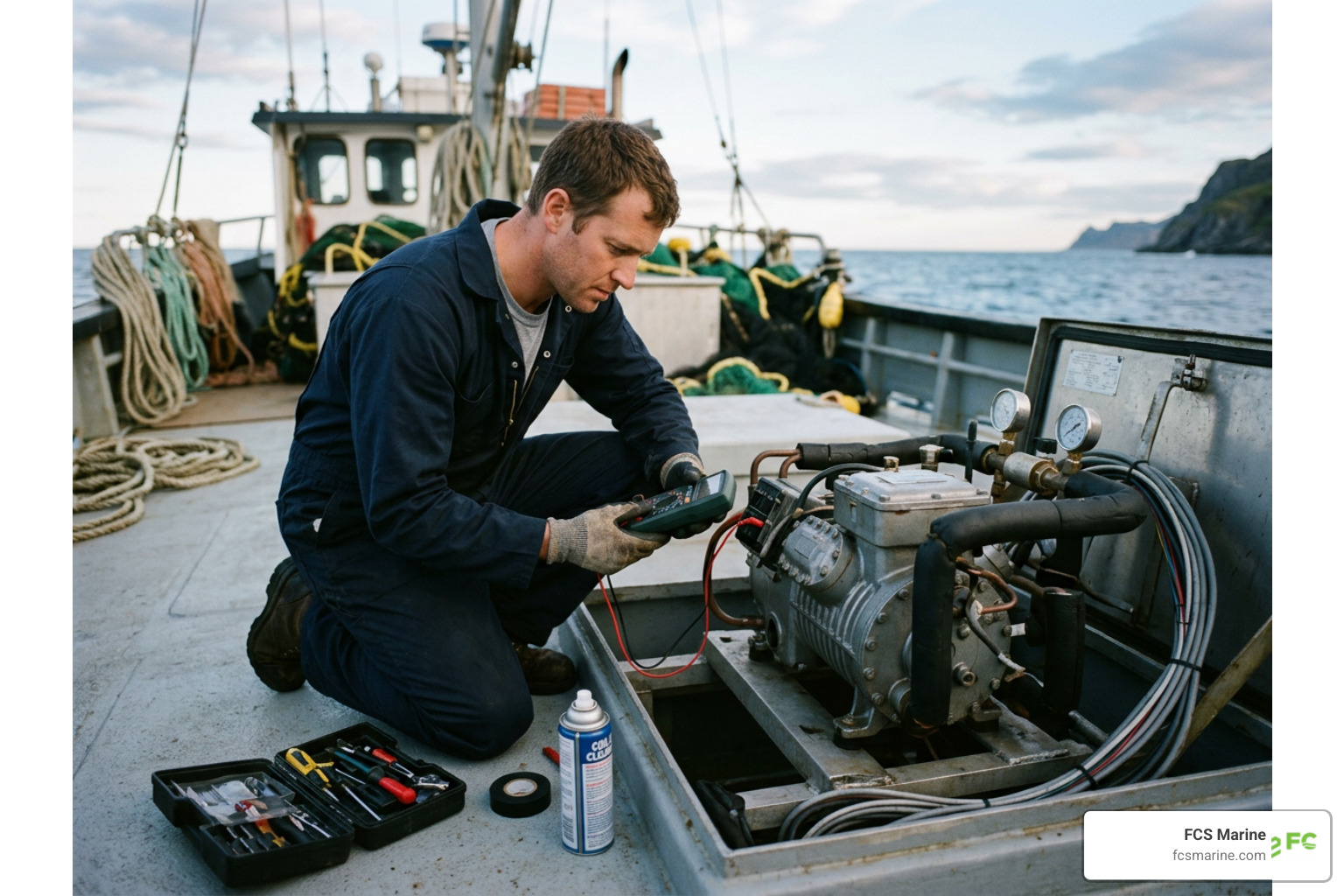
Whether you need specialized marine refrigeration repair in Broward County or high-end marine services down in Miami-Dade, working with marine-certified professionals is critical. For those in the northern reaches of our service area, finding expert help in St. Lucie County ensures that luxury galley systems receive the precise care they demand.
At FCS Marine, our technicians are fully EPA-certified and deeply experienced with major marine brands, including Vitrifrigo, Isotherm, Frigoboat, Sea Frost, Dometic, and Norcold. We bring specialized diagnostic tools directly to your slip, ensuring repairs are completed safely and efficiently.
What to Expect from an Emergency Boat Fridge Repair Service
When your refrigeration fails right before a major cruise, you cannot wait weeks for a yard slot. That is why we offer an Emergency Marine Refrigeration Repair service designed to resolve issues directly at your dock.
When you contact us for emergency service, here is what to expect:
- Mobile Dispatch: We coordinate a time to send an experienced technician directly to your vessel’s location—whether at a local marina, a private dock, or a boatyard.
- On-Board Diagnostic: Our technician performs a comprehensive evaluation, checking battery voltage, amp draw, compressor control modules, refrigerant pressures, and condenser efficiency.
- Transparent Estimate: We provide a clear, upfront estimate detailing the required parts and labor before any repair work begins.
- On-Site Repair: Our service vehicles carry a deep inventory of common marine parts (including Danfoss controllers, fans, and marine-grade wiring), allowing us to complete most repairs in a single visit.
- Performance Verification: We test the system’s temperature pull-down and power draw to ensure everything is operating at peak efficiency before we leave.
Our goal is to minimize your downtime and protect your provisions, saving you the hassle of moving your vessel.
Repair vs. Replacement: Cost and Lifespan Analysis
When faced with a failing refrigerator, every boat owner asks the same question: Is it better to repair it or replace it entirely?
To make an informed decision, it helps to understand How Long Marine Refrigeration Systems Last. While a complete custom marine refrigeration installation can cost anywhere from $3,500 to $7,000 USD due to the labor-intensive carpentry and custom insulation required, individual component repairs are highly cost-effective.
- When to Repair:
- The compressor is running well, but the control module (electronic unit) has failed (a common, easily replaceable part).
- The system has a small refrigerant leak that can be located, sealed, and re-gassed.
- The condenser fan or water pump is dead, but the rest of the sealed system is intact.
- The door seals are worn out or the thermostat has lost calibration.
- When to Replace:
- The compressor itself is mechanically locked or shorted internally.
- The evaporator plate is severely corroded, punctured, or leaking internally in multiple places.
- The system is more than 10–12 years old and has suffered multiple component failures.
- The cabinet insulation has degraded, causing the box to sweat constantly regardless of compressor health.
Marine Fridge Lifespan and Component Durability
A high-quality marine compressor like the Danfoss BD35F can easily last 14+ years if it is kept clean, receives stable voltage, and is not subjected to constant overheating. However, other components in the system often have shorter lifespans:
- Water-Cooled Condensers: These often fail within 5 to 8 years due to internal corrosion from raw seawater, scale buildup, or galvanic action if sacrificial zinc anodes are not maintained.
- Sealed System Leaks: Because marine systems are constantly subjected to engine vibration and hull pounding, copper lines can rub together, creating tiny leaks that deplete the tiny 70ml refrigerant charge.
- Electrical Connections: Corroded terminals can cause voltage drops. If a 12V system drops below 10.4 volts at startup, the compressor’s built-in safety circuit will shut it down immediately to protect your batteries.
Preventive Maintenance Tips to Extend Marine Fridge Lifespan
Preventative maintenance is the secret to avoiding a costly mid-summer breakdown. By taking a few simple steps, you can keep your system running efficiently and extend its operational lifespan.
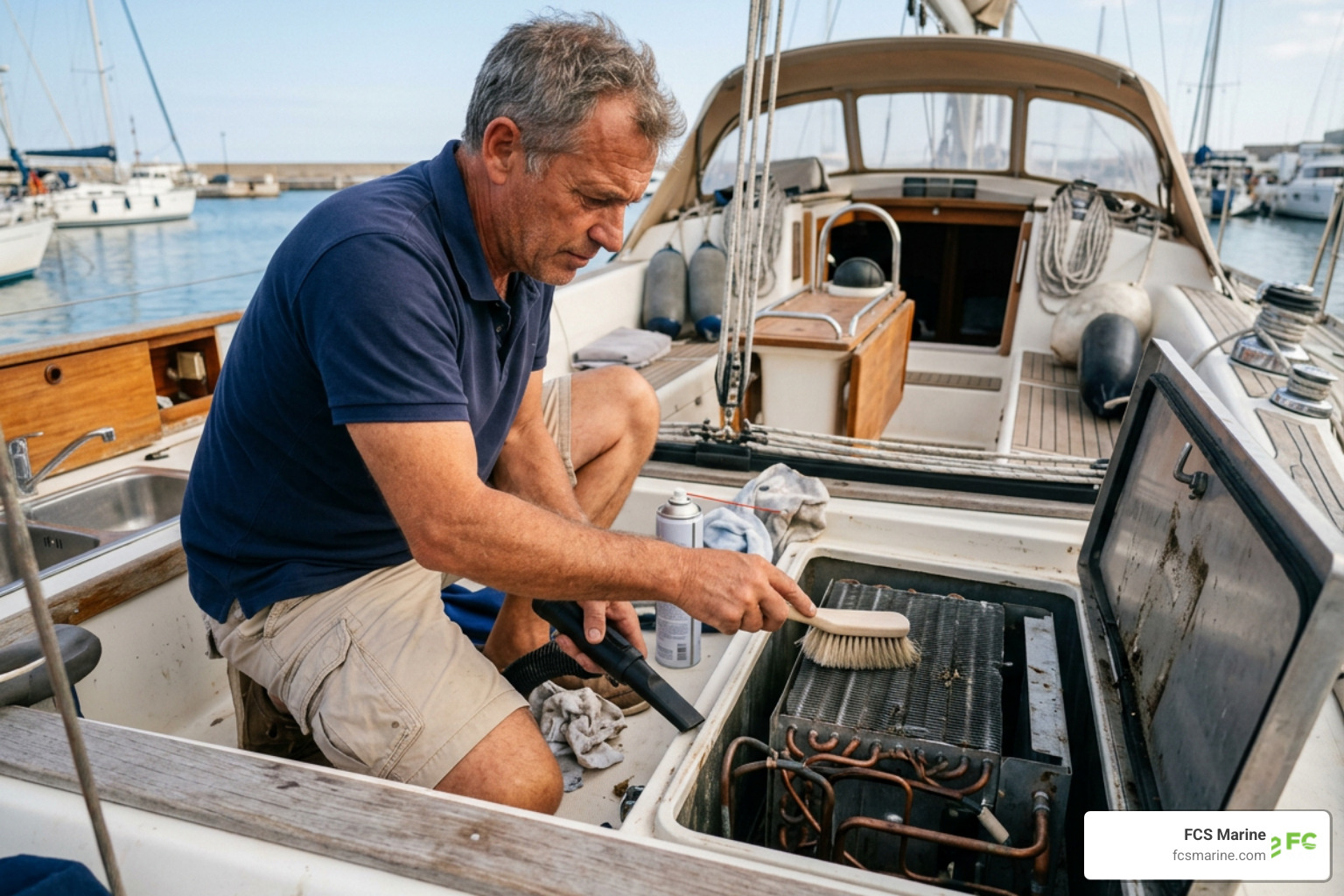
- Clean the Condenser Coils Regularly: For air-cooled units, vacuum the dust and pet hair off the condenser fins every 3 months. For water-cooled units, back-flush the seawater lines with a mild descaling solution annually to remove marine growth.
- Inspect and Clean Door Gaskets: Wipe down your door seals with warm, soapy water. To test your seal, close the door on a dollar bill; if you can pull the bill out easily without resistance, your gasket needs adjustment or replacement.
- Monitor Your Zinc Anodes: If you have a water-cooled condenser, inspect and replace the sacrificial zinc anodes every 6 months to protect the condenser from galvanic corrosion.
- Maintain Stable Voltage: Ensure your battery terminals are clean and tight. Low voltage forces the compressor to draw more amps, generating excess heat and shortening its lifespan.
- Keep the Box Ventilated: Ensure the area around your compressor has adequate airflow. If the compressor is stuffed into a tight, unventilated locker, consider installing a small 12V exhaust fan to help vent the hot air.
Service Areas in South Florida
FCS Marine provides professional, mobile marine refrigeration services directly to your vessel’s location. We save you the trip to the boatyard by bringing our fully stocked service vehicles straight to your dock or marina. Our primary service areas include:
- Broward County: Fort Lauderdale, Pompano Beach, and surrounding local marinas.
- Miami-Dade County: Miami, Coconut Grove, Key Biscayne, and private docks.
- Palm Beach County: West Palm Beach, Jupiter, and Boca Raton.
- Martin & St. Lucie Counties: Stuart, Port St. Lucie, and local boatyards.
Wherever your boat is moored along the South Florida coast, our experienced marine technicians are ready to assist.
Contact FCS Marine for Professional Marine Service
Do not let a warm refrigerator ruin your time on the water. Whether your galley fridge is running constantly, blowing warm air, or completely silent, the team at FCS Marine is here to help. We specialize in comprehensive yacht maintenance, including marine AC repair, professional mold remediation, water purification, and expert Marine Refrigeration repair.
With our fast, mobile service and a strong satisfaction guarantee, we make sure your boat’s systems are running perfectly before you leave the dock.
Contact FCS Marine today to schedule your professional marine refrigeration service!
Frequently Asked Questions About Marine Fridge Repair
How often should a boat refrigerator be serviced in South Florida?
Due to our year-round heat and high humidity, we recommend having your marine refrigeration system professionally inspected and cleaned every 3 to 6 months. For liveaboards or charter vessels operating 24/7, quarterly maintenance—including condenser cleaning and electrical connection checks—is essential to prevent unexpected breakdowns.
Why is my marine refrigerator running constantly but not cooling?
This is almost always caused by a restricted airflow issue (such as dirty condenser coils), a slow refrigerant leak, or degraded door seals that allow warm air to continuously enter the box. Because marine systems hold very little refrigerant, even a tiny leak will cause the compressor to run indefinitely without ever reaching food-safe temperatures.
Can a residential HVAC technician repair my boat fridge?
While some basic refrigeration principles are the same, we highly advise against hiring a residential technician. Marine systems operate on 12V/24V DC power, use specialized marine-grade components, and often rely on complex water-cooled or keel-cooled systems. A residential technician may misdiagnose electrical faults or use non-marine-grade parts, which can damage your boat’s electrical grid and create safety hazards.