Why Boat Wall Insulation in Miami-Dade Is More Complicated Than It Looks
If you’re dealing with boat wall insulation Miami-Dade questions, here’s the short answer first:
Quick Reference: Key Things to Know
| Topic | What You Need to Know |
|---|---|
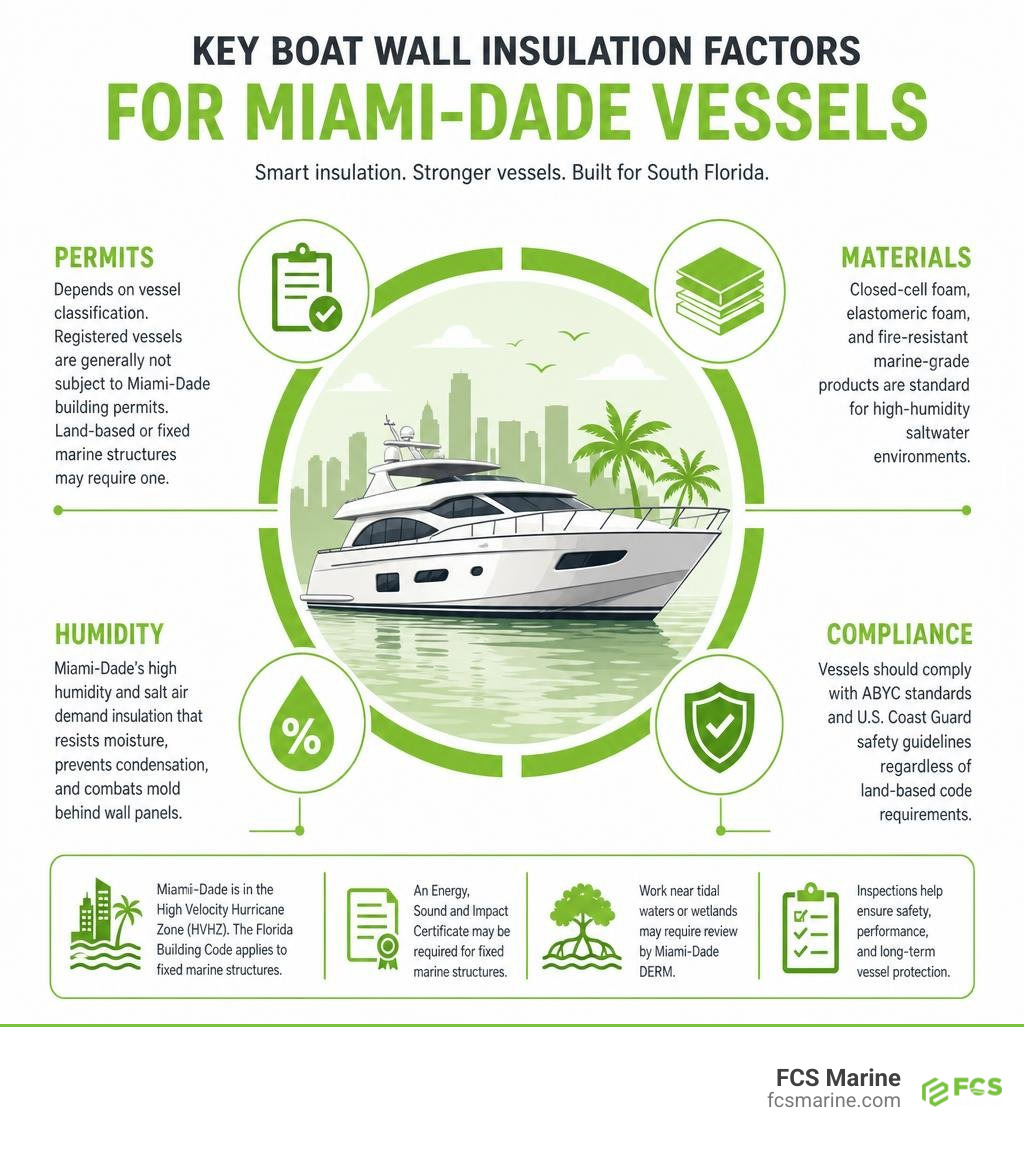
| Permit requirement | Depends on vessel classification — registered vessels are generally not subject to Miami-Dade building permits; land-based or fixed marine structures may require one |
| Florida Building Code | Applies to fixed marine structures in the High Velocity Hurricane Zone (HVHZ); an Energy, Sound and Impact Certificate may be required |
| Environmental permits | Work near tidal waters or wetlands in Miami-Dade may trigger DERM review |
| Approved materials | Closed-cell foam, elastomeric foam, and fire-resistant marine-grade products are standard for high-humidity saltwater environments |
| Inspection standards | Vessels should comply with ABYC standards and U.S. Coast Guard safety guidelines regardless of land-based code requirements |
Now for the fuller picture.
South Florida’s marine environment is relentless. Ambient humidity regularly exceeds 80%. Salt air accelerates material degradation. And the heat inside an uninsulated yacht bulkhead during a Miami-Dade summer can make your onboard systems work twice as hard — while quietly allowing condensation and mold to grow behind wall panels where you can’t easily see them.
Yacht owners and captains in Miami-Dade often start asking about boat wall insulation after noticing one of two things: their marine AC is struggling to maintain cabin temperatures, or they’re finding moisture — or worse, mold — behind interior panels and inside bulkhead voids. Both problems frequently trace back to inadequate or deteriorated wall insulation.
The regulatory side adds another layer of confusion. Because vessels occupy a gray zone between maritime law and local building codes, many boat owners aren’t sure which rules apply, which department to call, or whether they even need a permit at all.
That’s exactly what this guide is designed to clarify.
FCS Marine provides professional on-location yacht insulation services across Miami-Dade County and the broader South Florida region — coming directly to where your vessel is located to assess, recommend, and install the right solution.
Boat wall insulation miami dade word roundup:
Navigating Regulatory Codes for Boat Wall Insulation Miami Dade
When vessel captains and owners reach out regarding boat wall insulation Miami Dade projects, their primary confusion usually stems from local permitting jurisdiction. Understanding whether municipal building codes or maritime standards apply to your vessel depends on how your vessel is classified and where it rests.
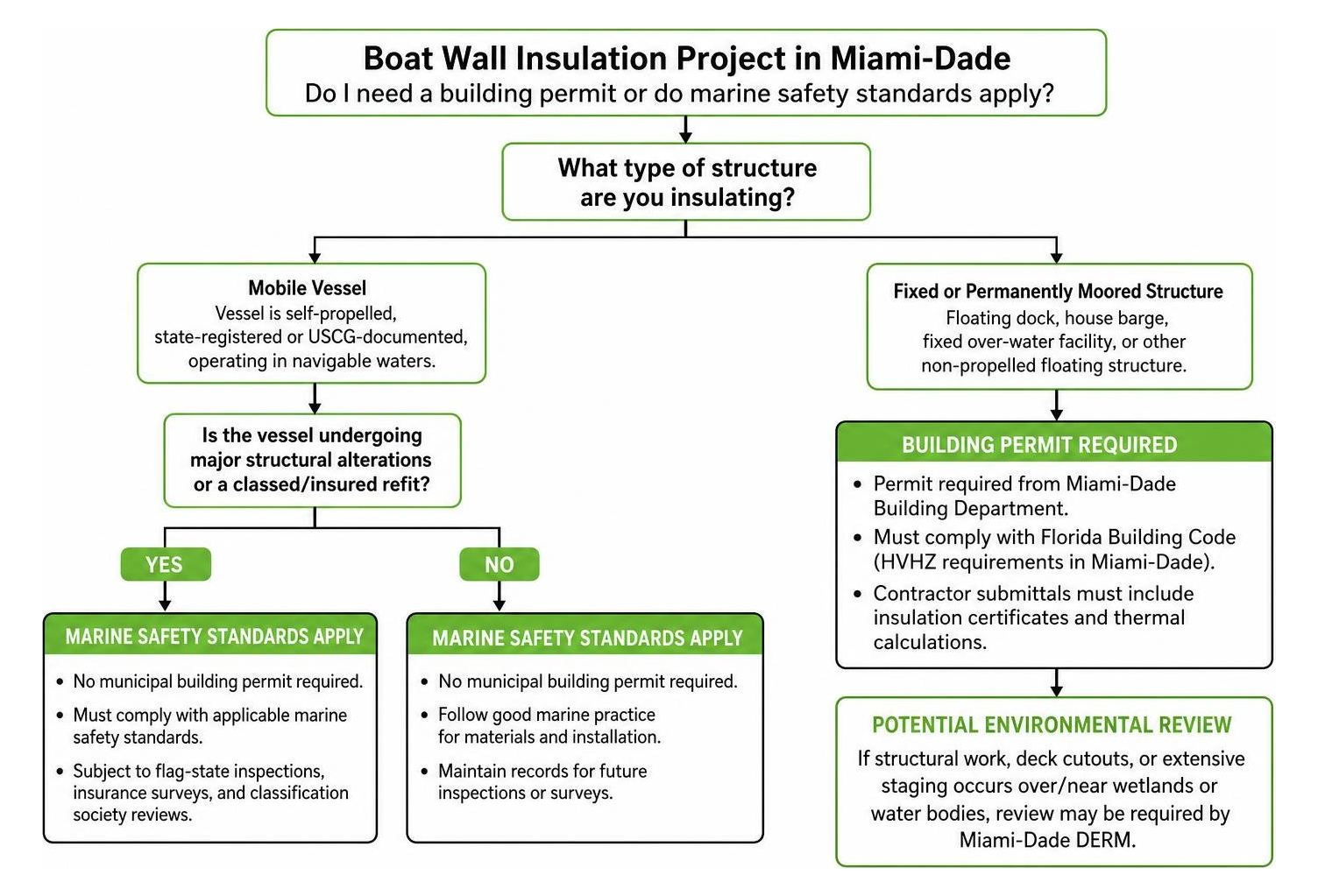
In our experience across Miami-Dade County, standard state-registered or USCG-documented recreational and commercial vessels operating in navigable waters fall outside standard land-based municipal building permit systems. However, if you are insulating a permanently moored floating dock structure, house barge, or fixed over-water facility, municipal jurisdiction under the Miami-Dade Building Department takes over.
For land-based marine structures or permanently moored non-propelled floating structures, projects must strictly adhere to the Florida Building Code, specifically the stringent High Velocity Hurricane Zone (HVHZ) requirements active in Miami-Dade and Broward counties. Under these municipal codes, contractor submittals must include detailed insulation certificates (such as the Energy, Sound and Impact Certificate) and complete thermal calculations.
For standard mobile vessels and motor yachts, while building permits are not filed with city hall, vessel refits are subject to strict marine standards enforced during flag-state inspections, insurance surveys, and classification society reviews.
Environmental and Structural Requirements for Boat Wall Insulation Miami Dade
If your vessel or marine facility is undergoing major structural work or interior retrofits while docked in Miami-Dade tidal waters, local environmental protection agencies may get involved. The Miami-Dade Division of Environmental Resources Management (DERM) regulates activities taking place over or adjacent to county water bodies and coastal wetlands.
While interior insulation retrofits tucked neatly behind bulkheads usually do not require a DERM Class I environmental permit, associated structural modifications, deck cutouts, or extensive dockside staging in environmentally sensitive coastal zones can trigger DERM review.
Furthermore, marine insulation installed aboard active vessels must comply with established U.S. Coast Guard Safety Standards. USCG guidelines mandate that thermal and acoustic insulation used in engine compartments, bulkheads, and cabin walls meet strict fire-retardant and smoke-generation thresholds. Installing residential-grade fiberglass or non-certified spray foam aboard a vessel can lead to failed safety inspections, voided marine insurance policies, or severe fire hazards at sea.
Marine Inspection Guidelines for Boat Wall Insulation Miami Dade
Whether your vessel is undergoing routine maintenance at a Miami boatyard or undergoing a complete cabin interior overhaul at a private dock, proper installation practices must align with American Boat and Yacht Council (ABYC) recommendations and USCG marine safety standards.
During marine insurance surveys or ABYC compliance audits, inspectors scrutinize marine wall insulation projects for several key criteria:
- Fire Resistance and Flame Spread: Insulation materials located adjacent to electrical runs, engine spaces, or galley bulkheads must feature self-extinguishing or fire-rated properties.
- Moisture and Fungal Resistance: Materials must not absorb ambient humidity or promote fungal growth behind bulkheads.
- Structural Vapor Barrier Integrity: Vapor barriers must be continuously sealed to prevent saltwater vapor from contacting raw hull surfaces or structural aluminum and fiberglass framing.
- Electrical and Mechanical Clearance: Insulation must maintain clear physical boundaries around electrical conduits, breaker panels, and exhaust runs to avoid trapping excessive heat around wiring harness bundles.
Managing Humidity, Mold, and Condensation in South Florida Bulkheads
South Florida presents one of the most challenging climate environments for vessel maintenance in North America. High outdoor temperatures combined with relentless humidity mean that uninsulated vessel bulkheads act as thermal bridges between hot exterior ocean air and cooled interior cabins.
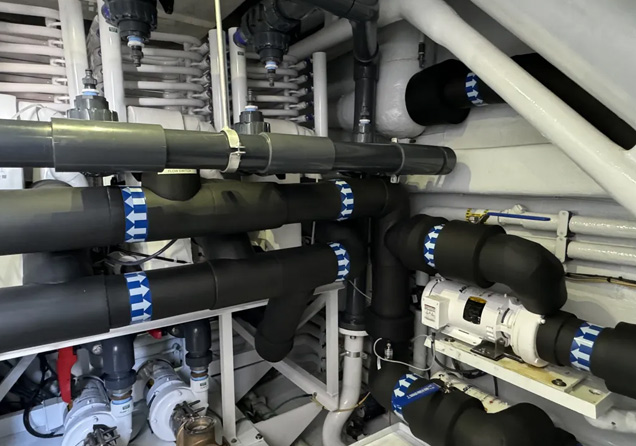
When warm, moisture-laden air hits a cool hull surface cooled by interior AC systems—or when humid ambient air touches cold marine air conditioning chilled-water piping behind wall panels—the temperature drops below the dew point. The immediate result is persistent pipe sweating and bulkhead condensation.
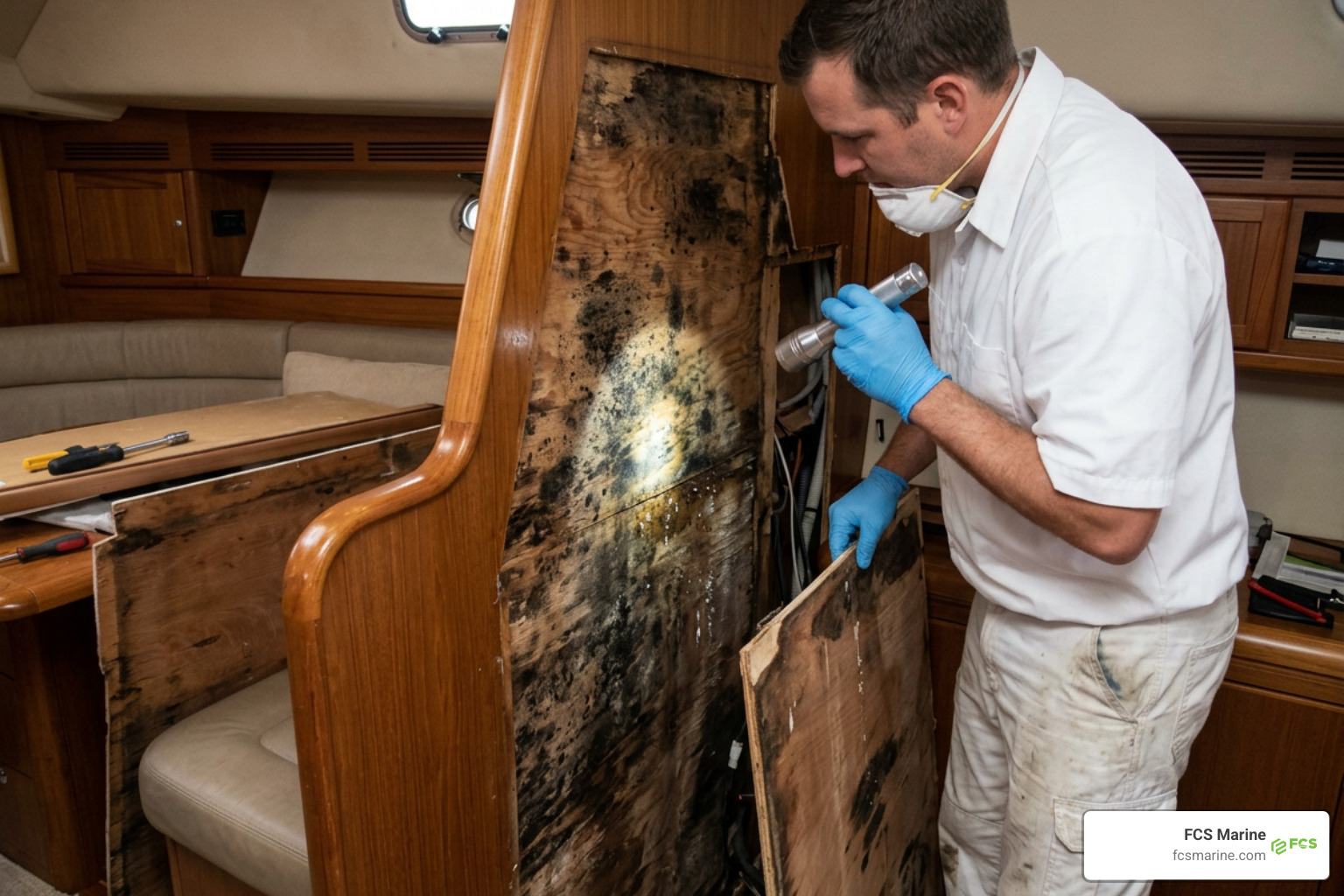
When moisture remains trapped behind closed headliners, marine plywood bulkheads, and decorative wall upholstery, hidden mold colonizes within weeks. This creates severe indoor air quality issues, persistent musty cabin odors, and eventual structural rot or delamination of interior joinery.
Proper yacht insulation solves this by stopping heat transfer at the vessel hull and establishing an unbroken vapor barrier. By stabilizing interior bulkhead surface temperatures above the dew point, proper marine-grade insulation stops sweat before it starts, protecting your interior joinery and eliminating the damp conditions mold needs to thrive.
Approved Insulation Materials for High-Humidity Marine Environments
Selecting the right thermal and acoustic material is critical for long-term vessel performance in saltwater conditions. Residential materials like un-faced fiberglass batts or open-cell spray foam absorb ambient moisture like a sponge, quickly creating an unseen water trap against your vessel’s structural frame.
To meet both South Florida climate demands and federal safety recommendations, such as the EPA Moisture Control Guidelines, marine contractors specify non-wicking, closed-cell materials.
| Material Type | Thermal Performance (R-Value) | Moisture & Mold Resistance | Fire & Smoke Rating | Best Marine Application |
|---|---|---|---|---|
| Closed-Cell Elastomeric Foam | High (~R-4 to R-6 per inch) | Exceptional; non-wicking vapor barrier | Marine-certified flame retardant | Chilled-water lines, hull frames, tight wall cavities |
| Marine-Grade Rockwool / Mineral Wool | Moderate to High (~R-4 per inch) | High; hydrophobic treatments prevent absorption | Non-combustible (Extreme fire safety) | Engine room bulkheads, galley partitions, machinery spaces |
| Rigid Polyurethane Board (Marine Foil-Faced) | High (~R-6+ per inch) | Excellent vapor barrier when joints are taped | Fire-rated formulations available | Flat hull sides, main cabin bulkheads, large deckheads |
| Closed-Cell Polyurethane Spray Foam | Superior (~R-6.5 per inch) | Excellent moisture seal when properly applied | Requires marine-rated ignition/fire barrier coatings | Irregular hull voids, bow sections, non-conforming spaces |
By pairing closed-cell elastomeric foam or foil-faced rigid panels with specialized marine sound barriers (like mass-loaded vinyl), vessel owners gain both high thermal efficiency and significant noise reduction from engine rooms and generator spaces.
Frequently Asked Questions About Marine Insulation
Do I need a building permit for boat wall insulation in Miami-Dade?
For standard state-registered or federally documented yachts, boats, and commercial vessels docked at marinas, boatyards, or private residences, local municipal building permits are generally not required for interior wall insulation retrofits. Maritime safety standards (USCG and ABYC) govern vessel systems. However, permanently moored floating residential or commercial land-based structures fixed to dock infrastructure fall under Miami-Dade County Building Department jurisdiction and require standard building permits and energy compliance certificates.
What insulation material works best for vessel bulkheads in South Florida?
Closed-cell elastomeric foam and marine-grade foil-faced closed-cell polyurethane panels are widely considered the gold standard for South Florida vessel bulkheads. These materials provide exceptional thermal resistance (R-value), do not absorb saltwater moisture, act as built-in vapor barriers, and suppress vibration and machinery noise in living spaces.
How does proper wall insulation prevent marine mold growth?
Proper marine wall insulation eliminates thermal bridging between hot exterior hulls and air-conditioned cabin interiors. By preventing interior wall surfaces and hidden bulkhead voids from falling below the atmospheric dew point, condensation cannot form. Without standing moisture or high relative humidity behind wall panels, mold spores cannot germinate and spread through your vessel’s air conditioning system.
Professional Mobile Service and Compliance
Navigating marine insulation retrofits, material selection, and humidity control does not require navigating complex city permit offices or hauling your vessel to a distant shipyard.
At FCS Marine, our specialized mobile marine team comes directly to where your vessel rests across South Florida—whether you are docked at a marina in Fort Lauderdale, a boatyard in Pompano Beach, or a private dock in Miami-Dade, Palm Beach, Martin, or St. Lucie County.
We specialize in full-service vessel climate control and interior protection, providing expert on-site evaluations for yacht insulation, marine air conditioning repair, refrigeration, hidden mold remediation, and watermaker maintenance. Explore The Ultimate Guide to Yacht Insulation to learn more about how thermal barriers protect luxury vessel interiors.
Keep your vessel comfortable, dry, quiet, and fully protected against South Florida’s harsh tropical climate. Contact FCS Marine today to schedule your professional mobile marine insulation service.