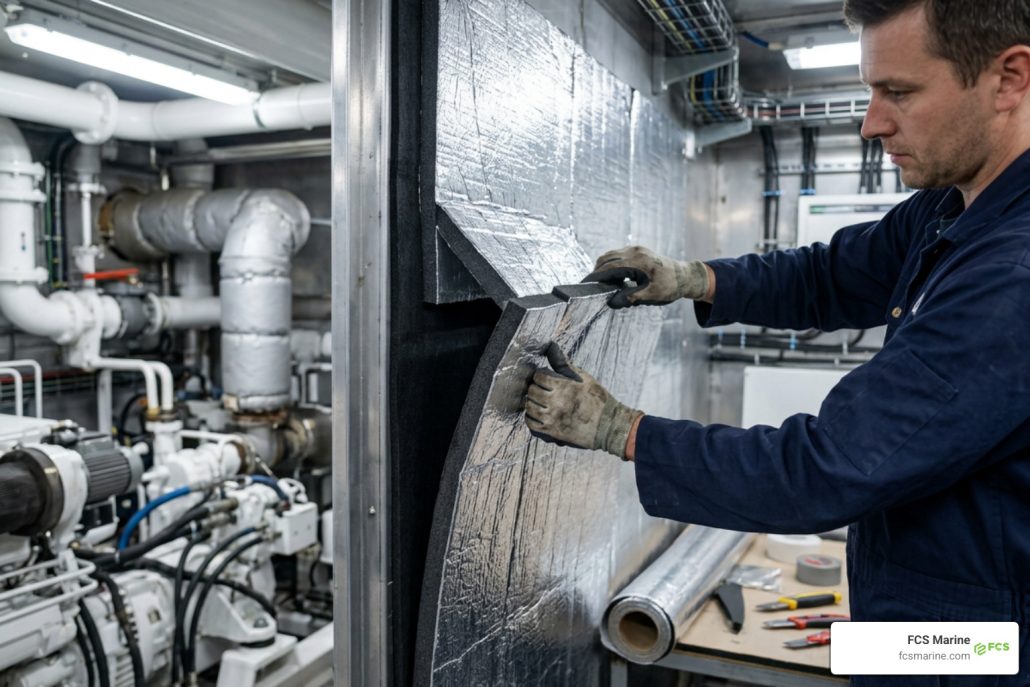
Understanding Marine Vessel Noise and Thermal Dynamics
Marine machinery produces a complex mix of acoustic and thermal energy that travels through multiple physical pathways before reaching your salon, staterooms, or bridge deck. Addressing this challenging environment requires managing both high-intensity acoustic decibels and excessive heat generation at the source. Routine engine room cooling maintenance helps minimize ambient stress on onboard machinery, but heavy physical barriers remain necessary to isolate sound pathways and radiant thermal loads effectively.
Airborne Sound vs. Structure-Borne Hull Vibration
Engine compartments generate two distinct forms of acoustic energy that require dedicated suppression techniques:
- Airborne Noise: Combustion clatter, turbocharger whine, air intake rush, and mechanical gear meshing radiate directly into the compartment air. These pressure waves bounce off uninsulated fiberglass, composite, or aluminum bulkheads, amplifying the overall sound pressure before penetrating adjacent living quarters.
- Structure-Borne Vibration: The mechanical movement of the crankshaft, transmission, and spinning shaft assemblies sends physical vibrations directly into the engine beds, stringers, and hull laminates. This kinetic energy travels throughout the vessel framework, turning large hull sections, bulkheads, and interior joinery into resonant sounding boards that emit low-frequency rumble.
Lowering overall cabin sound levels requires treating both paths simultaneously. Adding dense mass barriers and specialized sound-absorbing cores controls airborne sound, while compliant elastomeric engine mounts and flexible shaft couplings isolate mechanical vibration before it can excite the structural framework of the hull.
Thermal Loads and Engine Bay Heat Buildup
Exhaust manifolds, turbo housings, and dry exhaust runs emit intense radiant energy that quickly builds up in enclosed marine spaces. Without effective thermal barriers, structural bulkheads absorb this immense heat and conduct it directly into adjoining cabins, working against interior air handlers. Strategies for preventing cabin overheating must include high-temperature boundary insulation alongside adequate compartment ventilation to keep surface temperatures safe and interior spaces comfortable during long voyages.
Selecting the Best Materials for Engine Room Insulation
Selecting appropriate yacht insulation materials involves balancing acoustic absorption, transmission loss mass, thermal reflection, fire resistance, and overall weight profile across the vessel.
| Material Type | Primary Function | Temperature Limit | Sound Transmission Loss (STC) | Moisture & Oil Resistance |
|---|---|---|---|---|
| Hydrophobic Melamine Foam | Airborne sound absorption | Up to 400°F (204°C) | Moderate (Absorption core) | High (water-repellent treated) |
| Mass-Loaded Vinyl (MLV) | Sound blocking (mass barrier) | Up to 180°F (82°C) | High (STC 26–32 alone) | High (impermeable polymer) |
| Foil-Faced Polyurethane Foam | Mid/high-frequency absorption | Up to 220°F (104°C) | Moderate (Pair with mass) | Moderate (face protected, edges vulnerable) |
| Ceramic Fiber Blanket | High-heat thermal barrier | Up to 2000°F (1093°C) | Low (Thermal focus) | High (non-combustible, inorganic) |
| Mineral Wool / Rockwool | Fire barrier & acoustic absorption | Up to 1200°F (649°C) | High (Dense matrix) | Moderate (requires vapor barrier) |
| Multi-Layer Composite Sandwich | Decoupling + Blocking + Absorption | Up to 250°F+ (121°C+) | Very High (Broadband control) | High (with sealed mylar/foil faces) |
Acoustic Foams, Mass-Loaded Vinyl, and Composite Panels
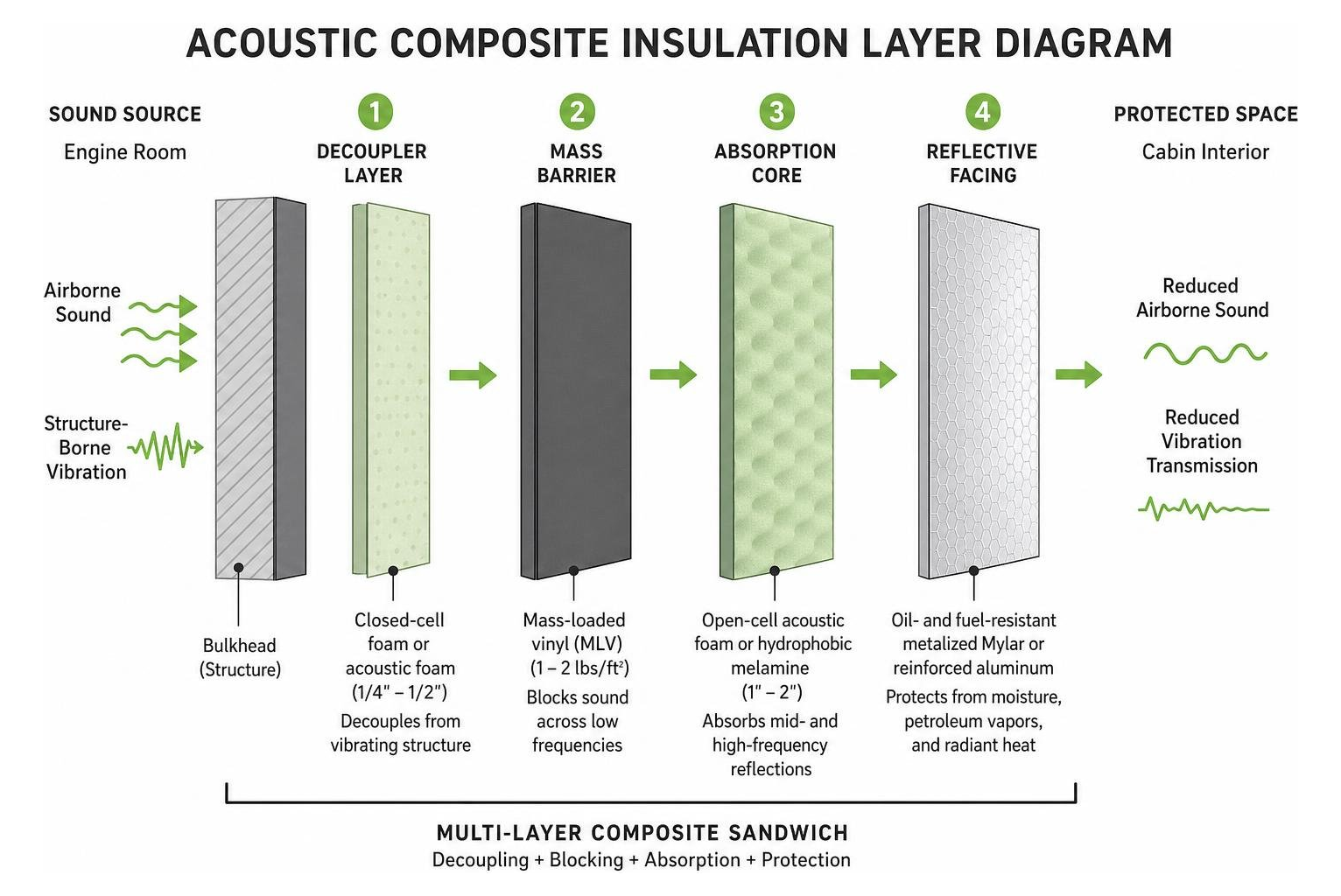
Modern acoustic engineering favors engineered multi-layered composite panels. Rather than relying on a single material layer, these systems use a functional composite sandwich construction to address diverse frequency ranges:
- Decoupler Layer: A 1/4-inch to 1/2-inch layer of closed-cell foam or acoustic foam placed directly against the bulkhead decouples the mass barrier from the vibrating structure, preventing mechanical vibration transfer.
- Mass Barrier: A dense core of mass-loaded vinyl (typically weighing 1 to 2 lbs per square foot) blocks sound waves across low-frequency ranges. While lead sheeting was historically used for this purpose, modern non-toxic mineral-loaded polymers provide comparable transmission loss without health or environmental hazards.
- Absorption Core: A 1-inch to 2-inch outer layer of open-cell acoustic foam or hydrophobic melamine captures mid- and high-frequency reflections inside the compartment, deadening standing sound waves.
- Reflective Facing: An oil- and fuel-resistant metalized Mylar or reinforced aluminum skin protects the foam matrix from moisture, petroleum vapors, and radiant heat.
High-Temperature Fire Barriers and Safety Ratings
Engine compartments require materials that will not support combustion, spread flame, or release toxic gases when subjected to high temperatures. Marine-rated insulation components should meet strict standards such as ISO 4589-3, ASTM fire ratings, or USCG requirements. Scientific research on multi-layered engine room bulkhead thermal performance demonstrates that incorporating air gaps between insulating layers and structural panels significantly reduces heat transfer during extreme high-temperature events, helping preserve the structural integrity of boundary bulkheads and compartment fire walls.
Marine Compartment Acoustic Engineering and Decoupling
Sound operates much like pressurized water: it escapes through the path of least resistance. Acoustic flanking occurs when airborne noise bypasses insulated bulkheads via unsealed gaps, conduit runs, air ducts, or lightweight access hatches.
A comprehensive vessel soundproofing plan treats every boundary systematically:
- Wire Chases and Penetrations: Bundle penetrations must be sealed with marine-grade acoustic caulking, intumescent putties, or dense elastomeric boots.
- Hatch Gaskets: Engine access hatches require heavy, closed-cell neoprene or silicone bulb gaskets to form an airtight seal when latched.
- Decoupled Fastening: Rigid fasteners that pass completely through an insulation panel into a bulkhead can create acoustic bridges. Utilizing specialized mounting pins with vibration-damping washers isolates the panel from structural vibrations.
Step-by-Step Best Practices for Engine Room Insulation Installation
Achieving lasting acoustic and thermal performance requires meticulous surface preparation and mechanical installation, complementing routine engine room cooling maintenance procedures:
- Surface Degreasing: Strip old degraded adhesive, clean off heavy oil residues, and thoroughly wipe down the fiberglass or metal bulkheads with marine solvents to ensure a clean bonding surface.
- Template Fabrication: Use stiff cardboard or heavy craft paper to trace precise shapes around stringers, pipes, brackets, and hull contours before cutting expensive composite panels.
- Mechanical Pin Attachment: Fasten insulation hanger pins directly to the bulkhead using high-strength structural marine epoxy. Space hangers roughly 9 to 12 inches apart across all planes to prevent sagging over time.
- Adhesive and Panel Mounting: If using pressure-sensitive adhesive (PSA) backed panels, press them firmly over the pins onto the bulkhead, securing the core with locking retaining washers.
- Edge and Seam Taping: Seal all panel joints, exposed foam edges, and fastener penetrations using reinforced aluminum or metalized Mylar tape. This step is essential to prevent engine oil mist from absorbing into the internal acoustic foam.
Warning Signs of Deteriorating Engine Room Insulation
Marine insulation operates in a demanding environment subject to intense thermal cycles, diesel fumes, and moisture. Over a typical 5-to-10-year lifespan, exposure to heat cycling and engine vibrations takes a measurable toll on insulation integrity.

Watch for these common signs that an insulation retrofit is due:
- Foam Dusting and Crumbling: Polyurethane foams lose their elasticity over time, shedding dry particles into bilge areas and air intakes.
- Foil Delamination: When the protective metallic face peels away, the open-cell core underneath absorbs moisture and diesel vapors.
- Panel Sagging: Loose adhesives allow heavy composite panels to pull away from overhead decks and bulkheads, opening sound leaks.
- Increased Cabin Noise and Heat: A noticeable increase in salon floor temperature or elevated cruising noise indicates failing barriers.
Professional Marine Insulation Installation in South Florida
Operating vessels throughout Palm Beach County, Broward County, Martin County, St. Lucie County, and Miami-Dade County means dealing with elevated heat and humidity year-round. Uninsulated or failing engine compartments force marine air conditioning systems to run continuously to combat thermal bridging through salon soles and stateroom bulkheads. Implementing proper acoustic barriers and reflective heat shields is a critical component in preventing cabin overheating when ambient waters and tropical air push onboard climate equipment to its limits.
FCS Marine provides complete on-site yacht service across South Florida, including Fort Lauderdale and Pompano Beach. We travel directly to your vessel’s location, handling complex acoustic retrofits and composite insulation upgrades without requiring you to move your yacht to a shipyard.
Frequently Asked Questions About Vessel Soundproofing
How long does marine compartment insulation typically last?
Quality marine insulation generally lasts between 5 and 10 years. Its operational life depends on operating hours, engine compartment temperatures, ventilation quality, and exposure to oil mist or water leaks. Regular seasonal inspections help identify localized delamination before entire panels fail.
What is the difference between sound absorption and sound blocking?
Sound absorption materials (such as open-cell polyurethane or hydrophobic melamine foam) trap acoustic energy within their porous structures to reduce reverberation inside the engine space. Sound blocking materials (such as heavy mass-loaded vinyl or lead barriers) prevent sound waves from physically passing through bulkheads by adding dense mass. High-performance engine rooms require both working together.
Can you install new acoustic barriers over existing factory foam?
Installing new composite panels directly over old, degraded foam is generally not recommended. If the original foam is crumbling or saturated with oil residues, the new adhesive and pins will fail to bond securely. Removing old materials down to clean fiberglass or aluminum ensures reliable adhesion, prevents trapped moisture, and maximizes available compartment clearance.
Conclusion
Upgrading your vessel’s thermal and acoustic envelope protects cabin comfort, enhances onboard communication, and reduces the operational load on your interior climate systems. Proper planning, high-quality composite materials, and careful sealing of all penetrations ensure long-lasting quiet cruising throughout South Florida’s waters.
When you need mobile marine service in South Florida, FCS Marine comes to where the vessel is located. Contact us today to evaluate your engine compartment and schedule professional yacht insulation tailored precisely to your vessel.