Why Boat Water Filtration Is the Most Overlooked System on Your Vessel
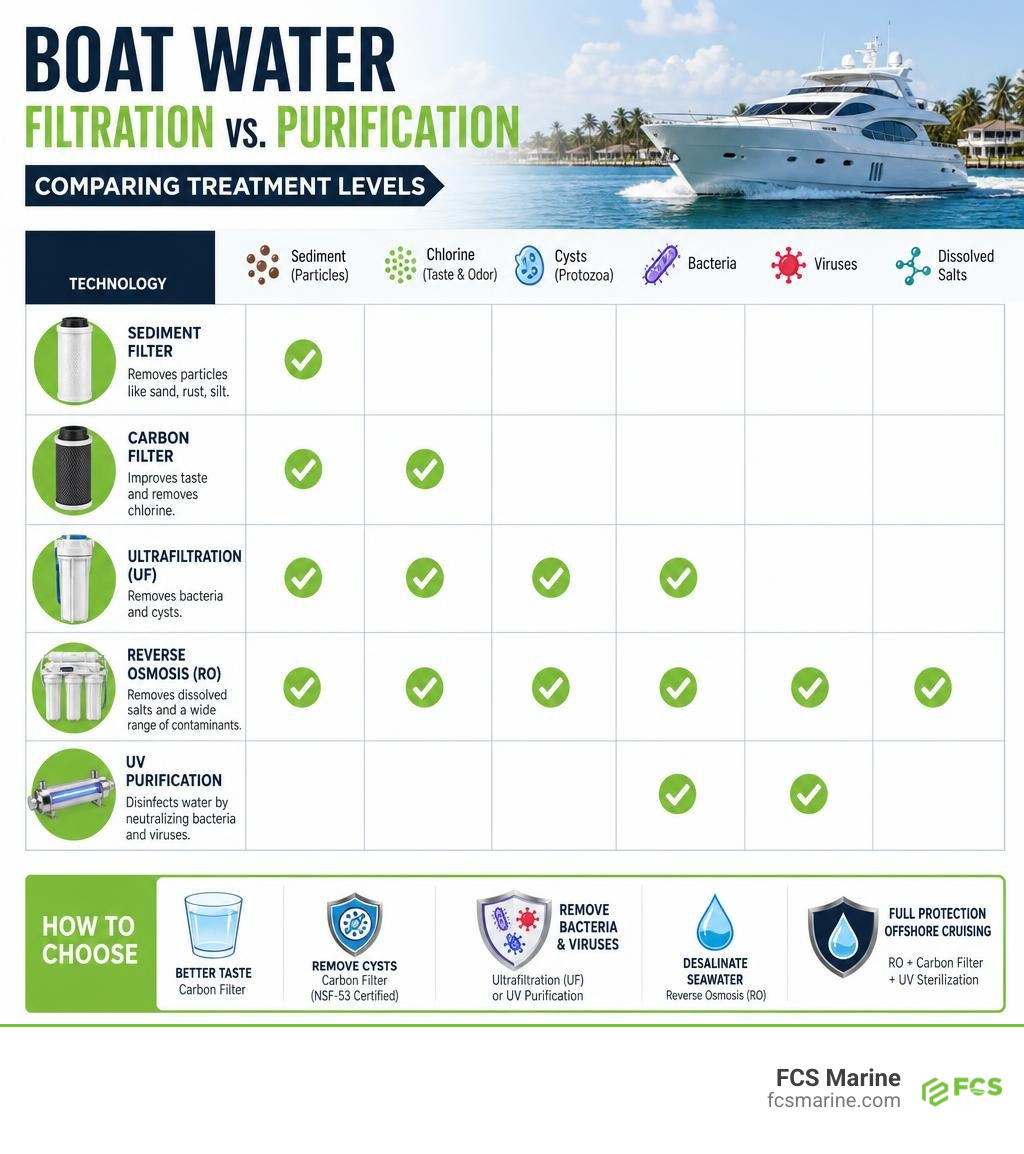
Boat water filtration is one of the most critical onboard systems — and one of the most neglected. Here is a quick breakdown of what you need to know before choosing a system:
| Goal | Recommended Solution |
|---|---|
| Better taste, remove chlorine | 0.5-micron carbon block filter |
| Remove cysts and protozoa | 0.5-micron carbon block (NSF-53 certified) |
| Remove bacteria and viruses | Ultrafiltration membrane or UV purification |
| Desalinate seawater | Reverse osmosis (RO) watermaker |
| Full protection, offshore cruising | RO + carbon block + UV sterilization |
Most boat owners assume that water stored in a sealed onboard tank is safe to drink. It is not. Water sitting in any closed vessel — even a sealed fiberglass tank — is an ideal environment for bacteria like Legionella, along with algae, mold, and fungi to multiply over time. Add dockside water of questionable quality, long passages between water sources, and South Florida’s warm climate, and the risk compounds fast.
The difference between filtration and purification matters here. A basic filter removes particles and improves taste. A purification system eliminates biological threats. Choosing the wrong one for your cruising area and usage pattern is not just inconvenient — it is a genuine health risk for everyone aboard.
At FCS Marine, we provide professional onboard water system service for yacht owners, captains, and vessel operators across South Florida, and we come directly to where your vessel is located.
Important boat water filtration terms:
Marine Water Quality: Filtration vs. Purification
Understanding the difference between filtration and purification is essential for keeping your crew safe. Physical filtration relies on a physical barrier to strain out suspended solids, sediment, and larger microorganisms. Biological purification, on the other hand, actively neutralizes or removes microscopic pathogens like bacteria, viruses, and cysts, making the water microbiologically safe to drink.
When cruising coastal U.S. waters, such as local South Florida routes around Fort Lauderdale, Palm Beach, or Miami, you are primarily filling your tanks with treated municipal water. In these areas, a high-quality boat water filtration setup focusing on sediment removal and carbon block chemical absorption is often sufficient to remove chlorine, improve taste, and catch any pipe-borne debris.
However, as soon as you venture into international waters or remote cruising grounds in the Bahamas, physical filtration is no longer enough. Untreated or poorly treated dock water can carry dangerous pathogens. Water stored in closed vessels for extended periods becomes a breeding ground for bacteria like Legionella, algae, and mold. To protect your guests, you need a true marine water purification system that acts as a reliable biological barrier.
For complete peace of mind, our team at FCS Marine offers comprehensive Onboard Water System Service to assess your cruising needs and design a multi-stage system that handles both filtration and purification.
Key Components of an Effective Boat Water Filtration System
An effective onboard water system is built on a series of specialized components, each performing a distinct role to protect your plumbing, appliances, and health.
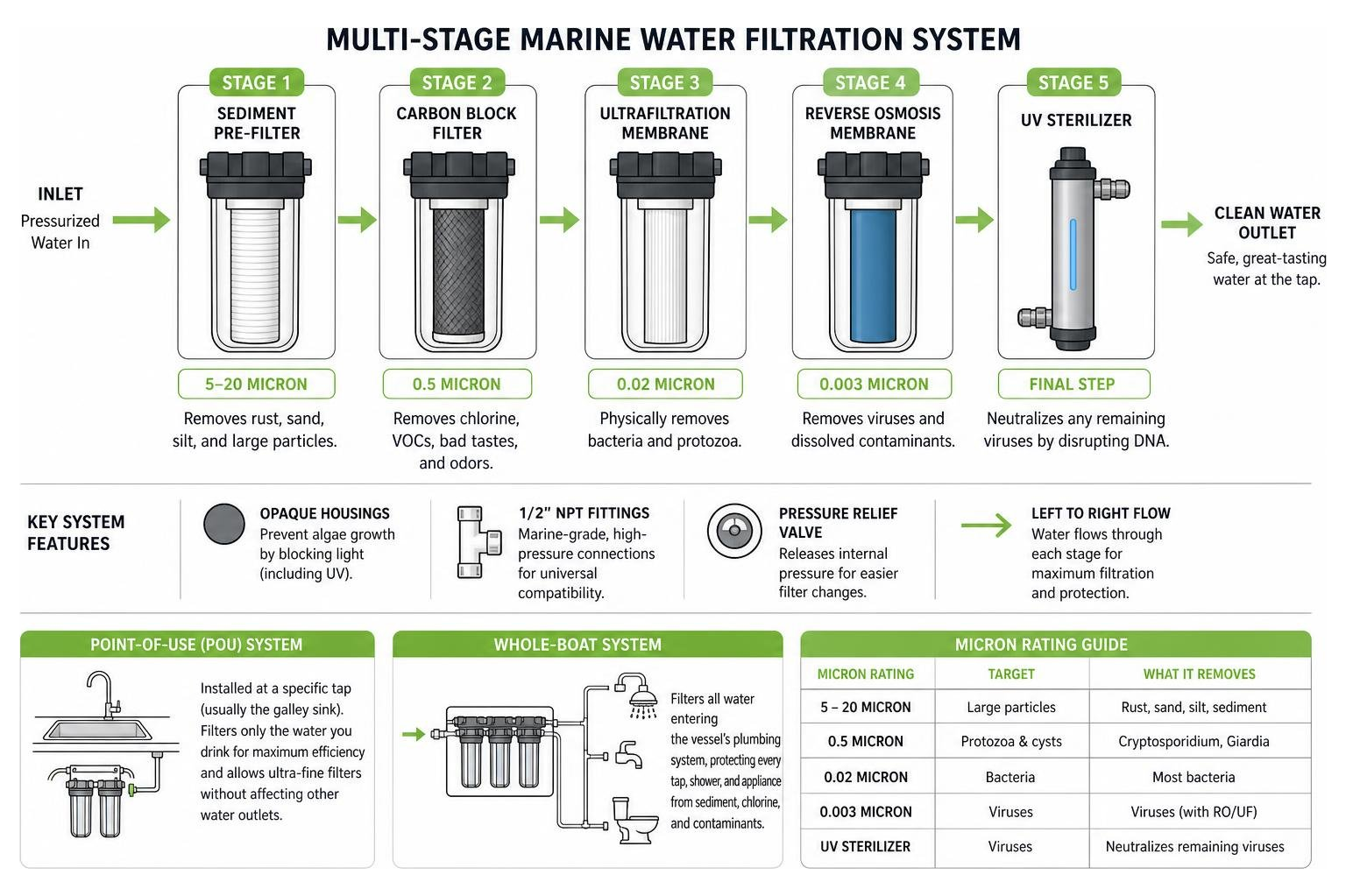
- Sediment Pre-Filters: These are your first line of defense. Typically rated from 5 to 20 microns, they catch large particles like rust, sand, and silt before they can clog your finer downstream filters or damage your freshwater pump. Pleated polyester sediment filters are highly recommended because they can occasionally be rinsed and reused.
- Carbon Block Filters: Positioned after the sediment pre-filter, a 0.5-micron carbon block filter is virtually 100% effective in removing chlorine. It also eliminates volatile organic compounds (VOCs), bad tastes, and foul odors.
- Housing Selection: For marine environments, always use opaque filter housings. Avoid clear housings; while they make it easy to see a dirty filter, they let in ambient light (including UV light) which rapidly encourages algae growth inside the housing.
- NPT Fittings: Standardize your system on robust 1/2-inch NPT (National Pipe Thread) fittings. These marine-grade, high-pressure connections are universally compatible, making it much easier to source replacement parts or adapt to existing yacht plumbing.
- Pressure Relief Valve: Opt for filter housings that feature a built-in pressure relief button. This simple feature releases the internal system pressure, making it infinitely easier to unscrew the housing bowl during filter changes without splashing water into your bilge.
Point-of-Use vs. Whole-Boat Water Filtration
A major design decision is choosing between point-of-use (POU) filtration and a whole-boat system.
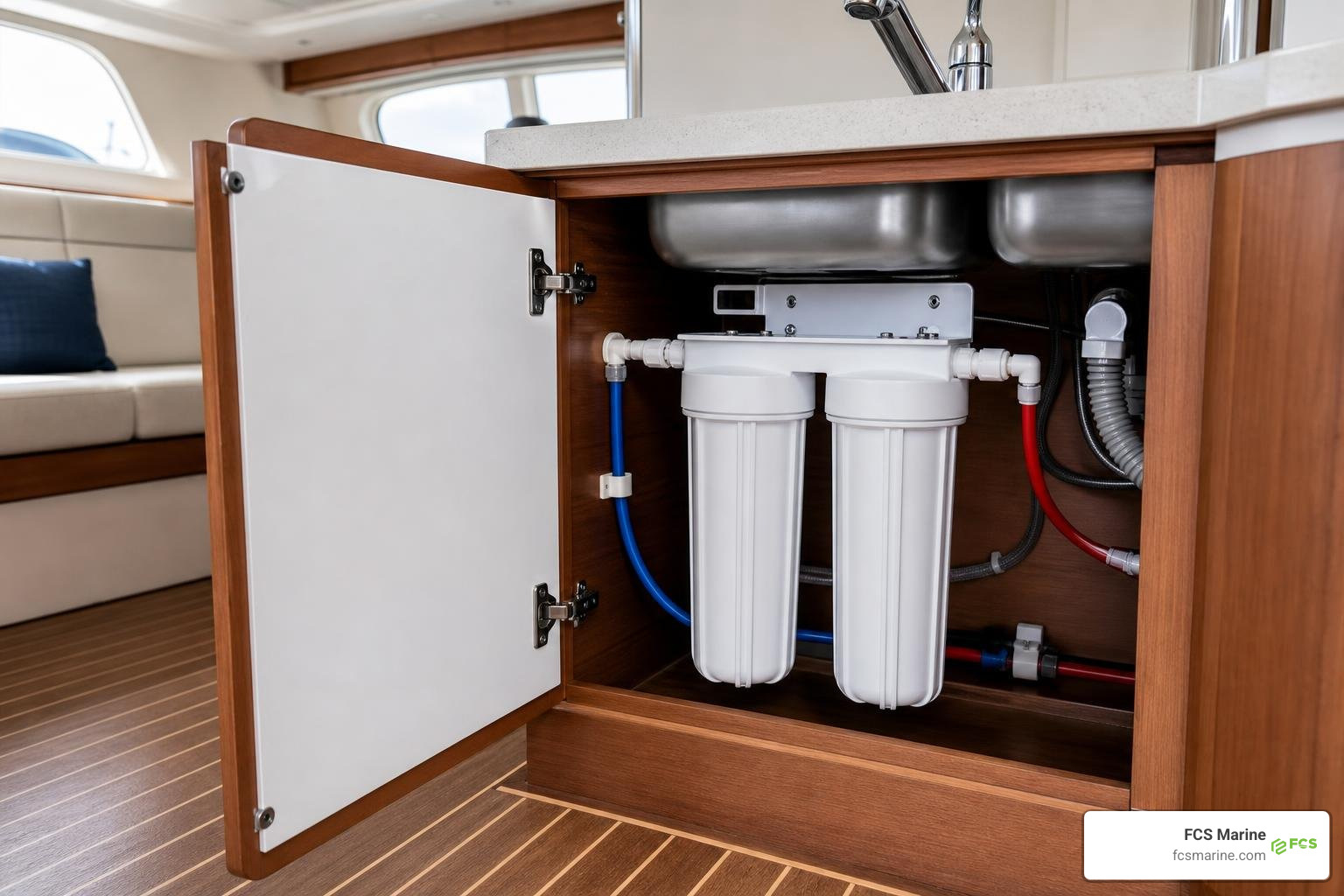
Point-of-use systems are installed directly at a specific tap — usually a dedicated drinking water faucet at the galley sink. These systems are highly efficient because you only filter the water you actually consume, allowing you to use ultra-fine, high-resistance filters without affecting the flow rate of your showers or head.
Whole-boat systems filter every drop of water entering the vessel’s pressurized plumbing network. While this protects your entire plumbing system and appliances from sediment and chlorine, it requires heavy-duty, multi-bore filters capable of delivering high flow rates (often up to 9.8 gallons per minute) to prevent severe pressure drops when multiple taps are running simultaneously.
Selecting the Right Micron Rating for Pathogen Removal
The micron rating of a filter determines the size of the particles it can physically trap. For biological safety, matching the micron rating to the target pathogen is critical:
- Protozoa and Cysts (e.g., Cryptosporidium, Giardia): These parasites are relatively large but highly resistant to chlorine. A 0.5-micron carbon block filter will positively block protozoa and cysts, providing a vital safety barrier.
- Bacteria: Most bacteria range from 0.2 to 2 microns. Standard carbon filters will not reliably trap them all. To remove bacteria physically, you need an ultrafiltration membrane rated at 0.02 microns or finer.
- Viruses: Viruses are incredibly small (typically 0.01 to 0.1 microns). True physical capture of viruses requires specialized ultrafiltration or reverse osmosis membranes with pore sizes down to 0.003 microns absolute. Alternatively, a UV sterilization system installed as the very last component before the faucet can neutralize viruses by disrupting their DNA.
Comparing Marine Water Treatment Technologies
Choosing between universal cartridge systems and proprietary filtration setups involves balancing convenience, cost, and global part availability.
| Feature | Universal 10-Inch Cartridges | Proprietary Marine Systems |
|---|---|---|
| Standard Dimensions | 10″ x 2.5″ (Actual length 9.75″) | Brand-specific, custom shapes |
| Replacement Cost | Low ($5 to $20 per cartridge) | High ($80 to $200+ per cartridge) |
| Global Availability | Excellent (Found in almost any hardware store) | Poor (Requires shipping from specific marine dealers) |
| Space Efficiency | Moderate (Standard industrial housings) | Excellent (Compact, custom-molded footprints) |
| System Connection | Standard NPT plumbing threads | Quick-connect, brand-specific fittings |
While proprietary systems often offer elegant, compact designs that fit into tight galley spaces, they lock you into single-brand pricing. If you are cruising remote areas, finding a replacement cartridge for a proprietary system can be nearly impossible. Standardizing on universal 10-inch housings ensures you can always find a replacement filter, no matter where your travels take you.
Carbon Block vs. Granular Activated Carbon (GAC)
When selecting carbon filters for your boat, always choose solid carbon block filters over Granular Activated Carbon (GAC) cartridges.
GAC filters contain loose carbon granules. Because the water can easily channel through loose granules, GAC filters have lower contact time, making them less effective at complete chlorine removal. Furthermore, GAC filters are prone to shedding fine carbon particles into your freshwater lines and can easily breed bacteria in the spaces between the granules when the system sits idle.
In contrast, solid carbon blocks (ideally made from high-density coconut shell carbon) force water through a uniform, dense matrix. This ensures maximum chlorine adsorption, improves taste, and prevents internal bacterial nesting.
Ultrafiltration Membranes and Structured Matrix Systems
For off-grid vessels seeking a chemical-free, power-free purification solution, ultrafiltration (UF) and structured matrix systems are excellent choices.
Systems utilizing a Membrane Water Filter run water through hollow-fiber membranes. These systems can remove up to 99.9999% of all pathogens, including bacteria, protozoa, and viruses, using only your onboard freshwater pump’s pressure. These robust membranes are highly sustainable, lasting up to ten years with proper backflushing and periodic maintenance.
Similarly, structured matrix systems, such as the General Ecology Seagull IV X-1F, combine physical micro-filtration, chemical adsorption, and micro-electrochemical attraction. With a density of 0.4 microns and a flow rate of 3.8 liters per minute (1 US gallon per minute), these systems meet strict EPA standards for microbiological purifiers without relying on electrical power or chemical additives.
Reverse Osmosis and Portable Watermakers
For vessels traveling offshore or spending extended time away from the dock, reverse osmosis (RO) is the gold standard of water treatment. Unlike standard filtration, which only catches suspended solids, RO purification filters down to 0.0001 microns, removing up to 99% of all dissolved solids.
Advanced systems, like the Spot Zero Water Makers & Purifiers – Pure Water Solutions, utilize a patented double-pass reverse osmosis process. This technology can reduce total dissolved solids (TDS) from a dockside baseline of 200 ppm down to less than 20 ppm, eliminating pump cycling and TDS creep to deliver spot-free water for rinsing your vessel and pristine drinking water. To learn more about how this technology works, check out our guide on Demystifying the Reverse Osmosis Water Filter for Beginners.
For smaller vessels or crews wanting a simpler, non-permanent installation, portable 12V watermakers are an ideal alternative. Systems like the Scout 12V Watermaker – Australian Made – LEDI Watermakers draw less than 220W (16-20A at 12V), making them highly compatible with standard marine battery banks and solar-supported setups.
System Integration, Power, and Maintenance
Integrating a water purification system into your yacht’s plumbing requires careful planning, marine-grade materials, and an understanding of South Florida’s unique water conditions.
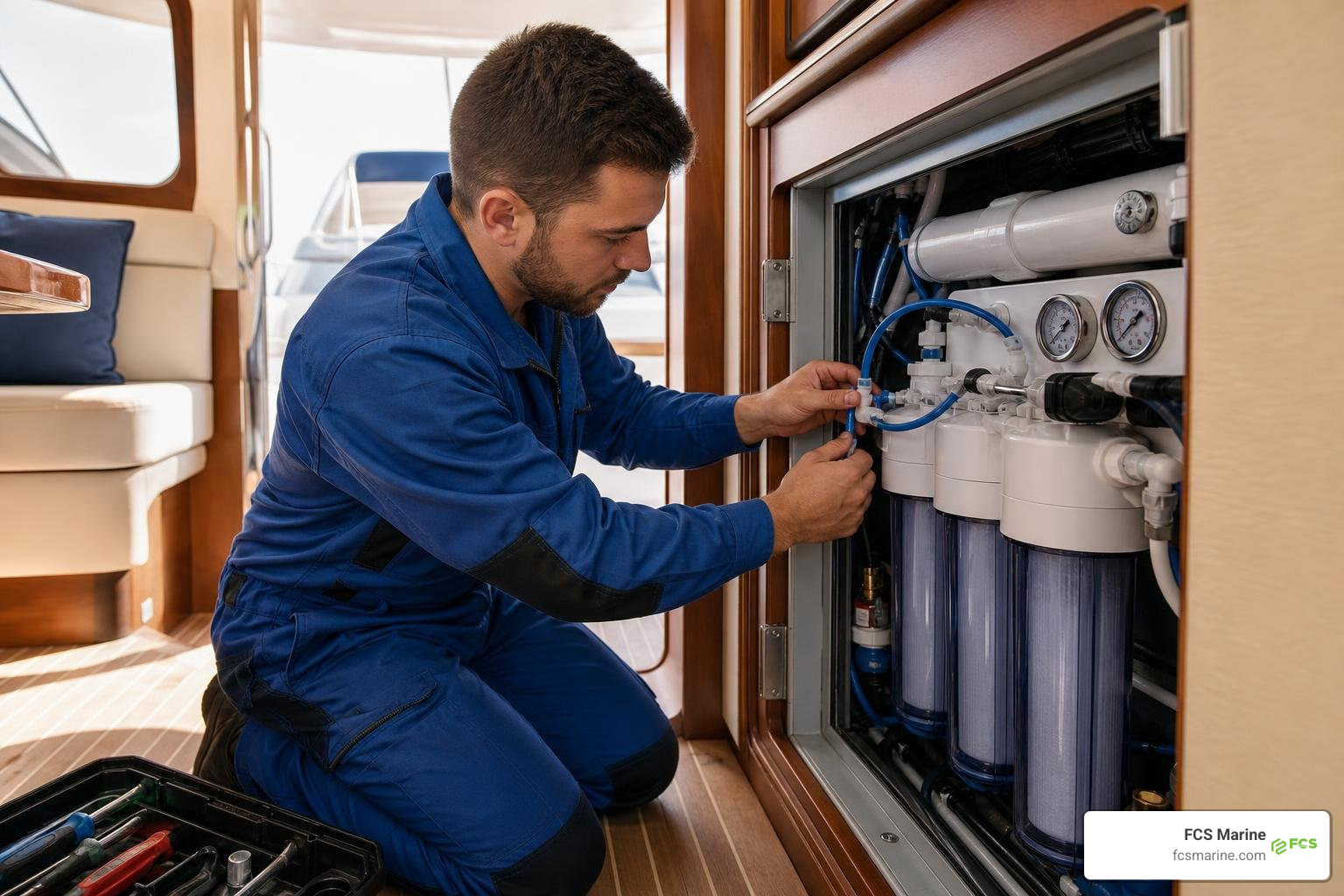
South Florida municipal water is notoriously hard, containing high levels of calcium and dissolved minerals. This hardness can cause scale buildup in your water heater, plumbing lines, and watermaker membranes. When designing your system, we use high-quality, push-to-connect fittings and semi-rigid polyethylene tubing to ensure leak-free operation under varying system pressures.
Integrating Boat Water Filtration with Onboard Watermakers
If your yacht is equipped with a seawater watermaker, proper filtration integration is vital.
First, watermakers require dedicated pre-filtration — typically a 5-micron pleated sediment filter — to protect the high-pressure pump from ocean debris.
Second, if your watermaker features an automatic freshwater flush system, you must install a high-capacity 0.5-micron carbon block filter in the flush line. Seawater RO membranes are highly sensitive to chlorine; even trace amounts of chlorine from dock water will permanently ruin a membrane.
For owners looking to generate battery-safe water dockside, running your RO watermaker output through a post-treatment deionization (DI) filter will strip out any remaining minerals, saving you from hauling heavy plastic jugs of distilled water.
Power Demands and Pump Compatibility
Your vessel’s electrical and plumbing capacity should dictate your filter selection:
- No-Power Systems: Carbon block filters, structured matrix purifiers, and ultrafiltration membranes require zero electrical power. They rely entirely on the mechanical pressure generated by your existing 12V or 24V DC freshwater pump.
- Powered Systems: Active UV sterilization systems require a constant power source (typically 12V DC) to power the sterilizing lamp. These must be wired to run only when the freshwater pump is active to prevent overheating.
- Pump Compatibility: Fine 0.5-micron filters create significant flow resistance. If your galley is equipped with a manual foot pump or hand pump, pulling water through a fine carbon block can require exhausting physical effort. For manual pumps, a coarser sediment filter or a larger 10-inch high-flow carbon block is highly recommended to minimize resistance.
Maintenance, Disinfection, and Winterization Procedures
To keep your water tasting pristine and free of pathogens, adhere to a strict maintenance schedule:
- Filter Cartridge Replacement: Replace sediment pre-filters whenever you notice a drop in water pressure. Replace carbon block filters at least once every 12 months, or sooner if you notice a change in water taste. Carbon loses its chemical absorption capacity long before it physically clogs.
- Pressure Monitoring: Install pressure gauges before and after your filter housings. A rising pressure differential is a clear, objective indicator that your filters are loading up and need to be changed.
- Tank Disinfection: Disinfect your freshwater tanks at least once a year by performing a mild chlorine shock treatment. Run chlorinated water through all lines (bypassing your carbon filters), let it sit, and then flush the system thoroughly.
- Winterization: If storing your boat for the winter, always remove all water filter cartridges. Drain the housings completely and run food-grade (RV) pink antifreeze through the plumbing lines to prevent freeze damage. Never allow antifreeze to come into contact with active carbon or RO membranes.
Frequently Asked Questions about Marine Water Systems
How often should I replace my boat’s water filter cartridges?
Under normal usage, standard carbon block and sediment filters should be replaced every 3 to 6 months. However, if you are cruising in areas with high sediment or water turbidity, filters may clog in as little as a month. Always change carbon filters at least once a year, as the carbon media degrades over time and can become a breeding ground for bacteria if left in service too long.
Can I use a manual foot pump with a 0.5-micron filter?
While it is physically possible, it is not recommended. A 0.5-micron carbon block filter creates high flow resistance. Using a manual foot pump (especially a dual-stroke pump) with such a fine filter requires significant physical effort, often taking up to 30 seconds of continuous, heavy pumping just to fill a single glass of water. For manual galley pumps, stick to coarser sediment filters or larger, high-flow housings.
Why should I filter water that has already gone through a reverse osmosis watermaker?
Although reverse osmosis membranes reject up to 99% of dissolved solids and pathogens, they are not rated as absolute microbial barriers on boats. Over time, internal seal wear, high-pressure bypass, or microscopic membrane tears can allow trace contaminants to pass through. Post-filtration with a sub-micron carbon block or a UV sterilizer provides a critical “belt-and-suspenders” safety barrier before the water reaches your glass.
Professional Marine Water Services in South Florida
At FCS Marine, we understand that clean, safe, and great-tasting water is fundamental to your comfort and safety on the water. As a family-owned South Florida company, we specialize in comprehensive yacht maintenance services, including water purification, Services, and marine air conditioning service.
We provide top-tier mobile marine service across Palm Beach County, Broward County, Miami-Dade County, Martin County, and St. Lucie County. Whether your vessel is docked at a luxury marina in Fort Lauderdale, a private slip in Pompano Beach, or a boatyard in Miami, our professional technicians come directly to your location to diagnose, install, and service your onboard systems.
Keep your water pure and your vessel running perfectly. Bring Pure Water Home with These Top Rated RO Systems and ensure your onboard water systems are professionally maintained. Contact FCS Marine today to schedule your on-site yacht service!