
A Warm Boat Fridge in Delray Beach Is More Than an Inconvenience
If you need boat fridge repair in Delray Beach, here’s what you need to know right away:
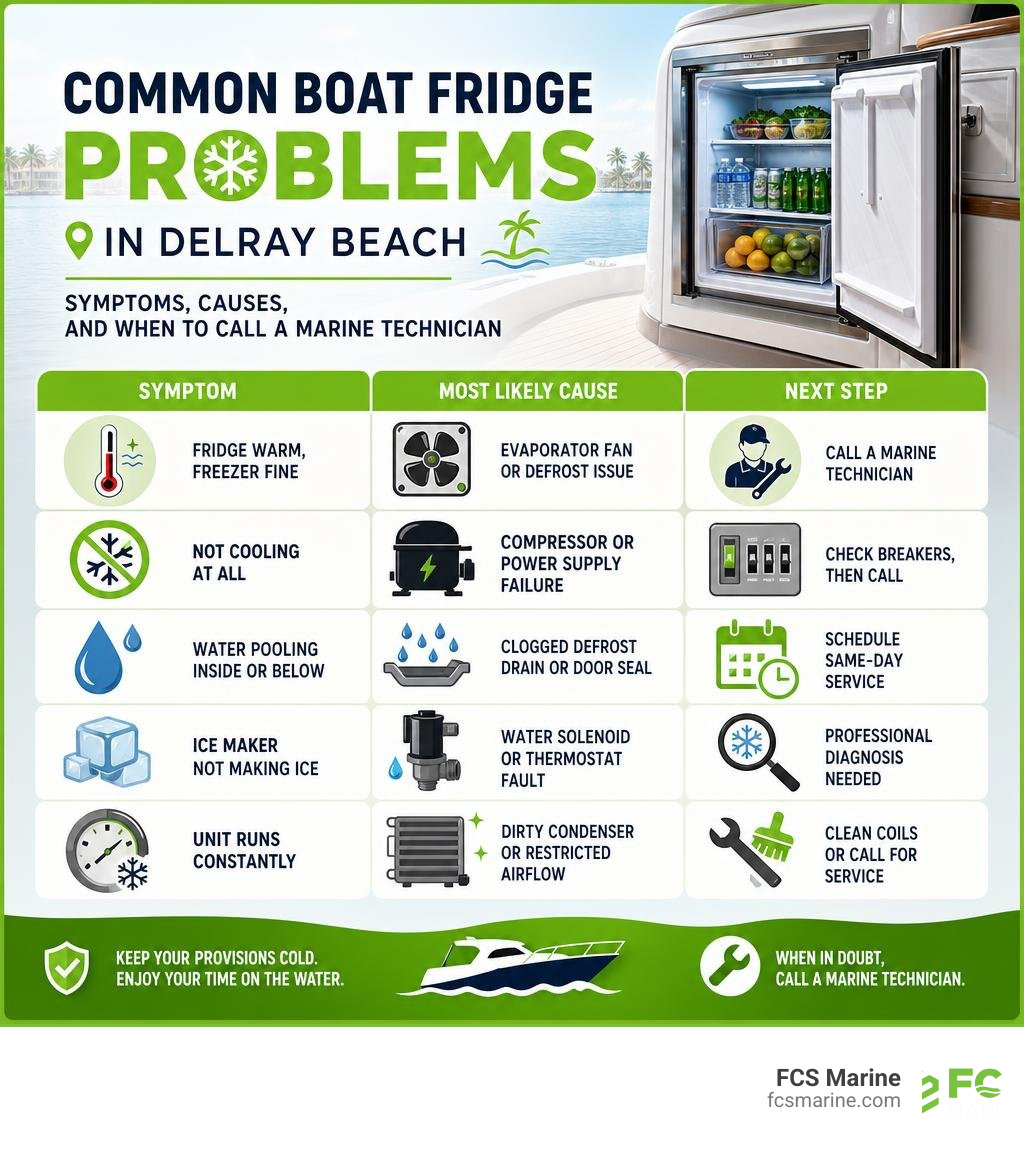
| Symptom | Most Likely Cause | Next Step |
|---|---|---|
| Fridge warm, freezer fine | Evaporator fan or defrost issue | Call a marine technician |
| Not cooling at all | Compressor or power supply failure | Check breakers, then call |
| Water pooling inside or below | Clogged defrost drain or door seal | Schedule same-day service |
| Ice maker not making ice | Water solenoid or thermostat fault | Professional diagnosis needed |
| Unit runs constantly | Dirty condenser or restricted airflow | Clean coils or call for service |
South Florida’s marine environment is tough on onboard refrigeration. Saltwater air, high humidity, relentless heat, and the constant vibration of a vessel at sea all push marine refrigeration systems harder than most people realize. A fridge that worked fine last season can fail quickly when those conditions add up.
For Delray Beach boat owners, a failing galley fridge isn’t just an annoyance — it means spoiled provisions, wasted money, and a disrupted trip. On a fishing boat, it can mean losing your catch. On a cruising yacht, it can mean cutting a trip short.
The good news is that most boat refrigerator problems follow a recognizable pattern, and many can be diagnosed and fixed without moving the vessel. FCS Marine provides professional marine refrigeration repair and comes directly to where your vessel is located — whether that’s a slip at a Delray Beach marina, a private dock, or a boatyard in Palm Beach County.
This guide walks through the most common causes of a warm boat fridge, how to identify warning signs early, and when it’s time to call in a professional marine technician.
Boat fridge repair Delray Beach word guide:
Why Marine Refrigeration Systems Fail in South Florida
Marine refrigerators operate under conditions that residential units never have to face. In South Florida, these environmental factors are multiplied by our intense climate. Understanding these factors can help you prevent premature system failure.
- Salt Air Corrosion: The coastal salt load in East Delray Beach is incredibly corrosive. Over time, salt air degrades electrical connections, corrodes condenser coils, and wears down fan motors. Standard residential-grade metals can fail in months, which is why marine systems require specialized coastal-grade condenser parts and marine-grade wiring.
- High Humidity and Moisture: South Florida’s high humidity forces your refrigerator to work twice as hard. Moisture-laden air enters the unit every time the door is opened, leading to heavy frost accumulation on the evaporator coils. This frost blocks proper airflow and can cause the system to freeze up entirely. To learn more about this specific issue, check out our article on Why Marine Refrigeration Systems Freeze Up.
- Constant Vibration and Vessel Movement: Unlike a stationary home refrigerator, a boat fridge is subjected to constant movement and engine vibration. This vibration can slowly loosen electrical terminals, stress copper refrigerant lines, and lead to microscopic refrigerant leaks.
- Voltage Drops: Boat electrical systems can be highly variable. Whether you are switching from shore power to generator power or running on a 12V/24V DC battery bank, voltage fluctuations are common. A drop in voltage causes the compressor to pull more amperage, leading to overheating, tripped breakers, or a burned-out start relay.
- Restricted Airflow and Dirty Condensers: Galley spaces are notoriously tight. Marine refrigerators are often installed in cramped cavities with minimal ventilation. When dust, pet hair, or marine debris builds up on the condenser coils, the heat cannot escape. This restricted airflow forces the compressor to run constantly, leading to short-cycling and eventual failure. You can read more about these common issues in our guide on the Common Causes of Marine Refrigeration Failure.
Warning Signs Your Vessel Needs Boat Fridge Repair Delray Beach
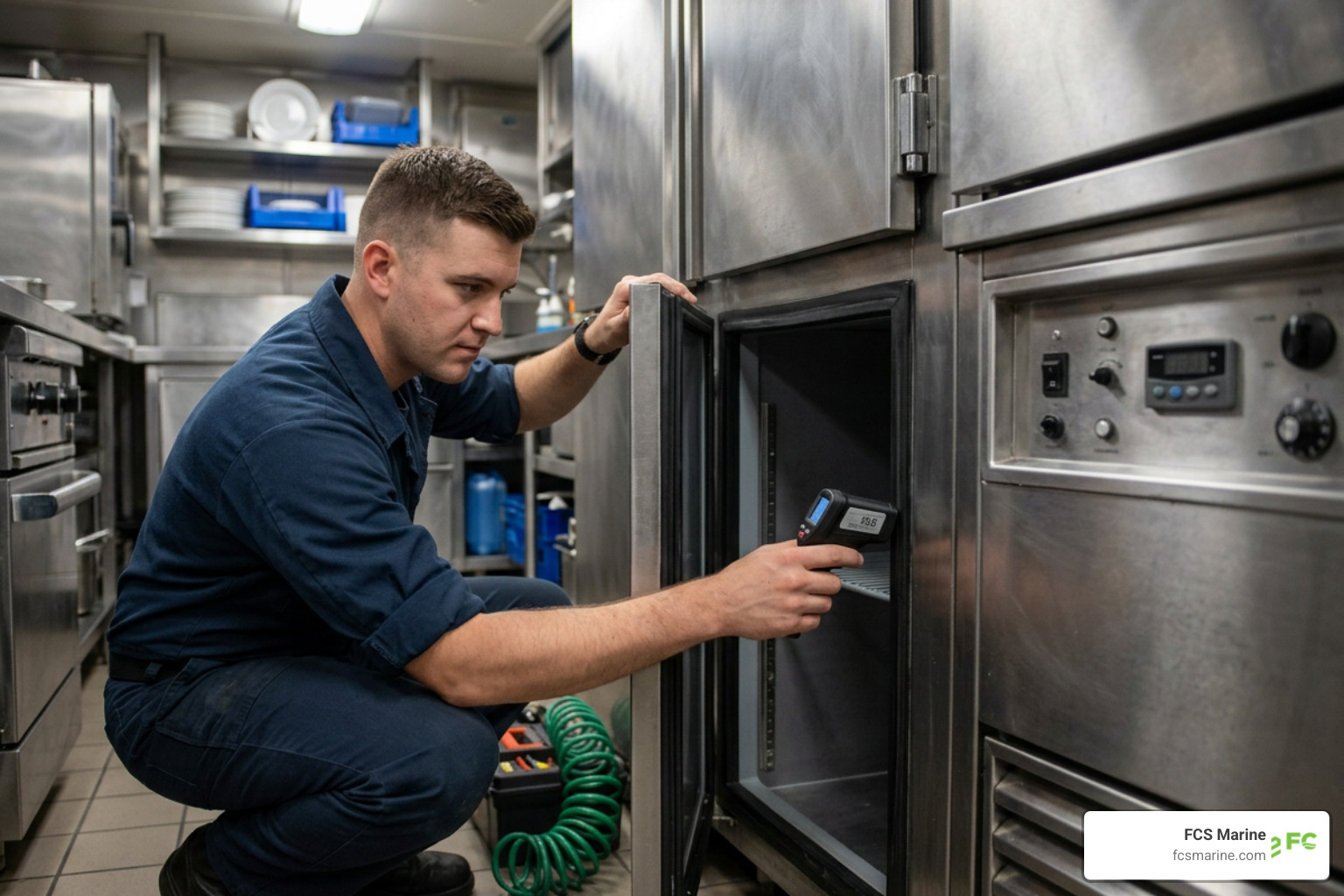
Catching a refrigeration issue early can save you from a warm galley and hundreds of dollars in spoiled food. Before your system stops cooling completely, it will usually display several warning signs that indicate it is time to schedule a boat fridge repair Delray Beach service.
- Short-Cycling: If you notice your compressor turning on and off every few minutes, the system is short-cycling. This is often caused by a faulty thermostat, an electrical voltage drop, or a safety switch triggering due to high pressure from a dirty condenser.
- Unusual Compressor Noise: While marine refrigerators are never completely silent, a sudden change in noise level is a clear warning sign. Loud clicking, buzzing, or vibrating noises usually point to a failing compressor start relay or worn-out internal compressor mounts.
- Heavy Frost Accumulation: If you find yourself defrosting your freezer every couple of weeks, you likely have an air leak. A failing door gasket allows warm, humid air to enter the box constantly, creating rapid frost buildup that eventually blocks the evaporator fan.
- Water Leaking or Pooling: Water pooling at the bottom of the unit or draining into your bilge is often a sign of a clogged defrost drain or a compromised door seal. In marine applications, poor condensation management can lead to water damage in nearby wood cabinetry or mold growth in tight galley spaces.
- Warm Shelves with a Cold Freezer: If your ice cream is frozen solid but the drinks on your refrigerator shelves are lukewarm, your system’s internal airflow is restricted. This is typically caused by a failed evaporator fan motor or a frozen evaporator coil.
If you are experiencing any of these warning signs, it is best to address them before they lead to complete system failure. For a deeper dive into system lifespans and maintenance, read our guide on How Long Marine Refrigeration Systems Last and explore The Ultimate Guide to Boat Refrigerator Repair in South Florida.
Troubleshooting a Warm Boat Refrigerator: Step-by-Step
Before calling out a technician to your vessel, there are several basic troubleshooting steps you can perform to narrow down the issue.
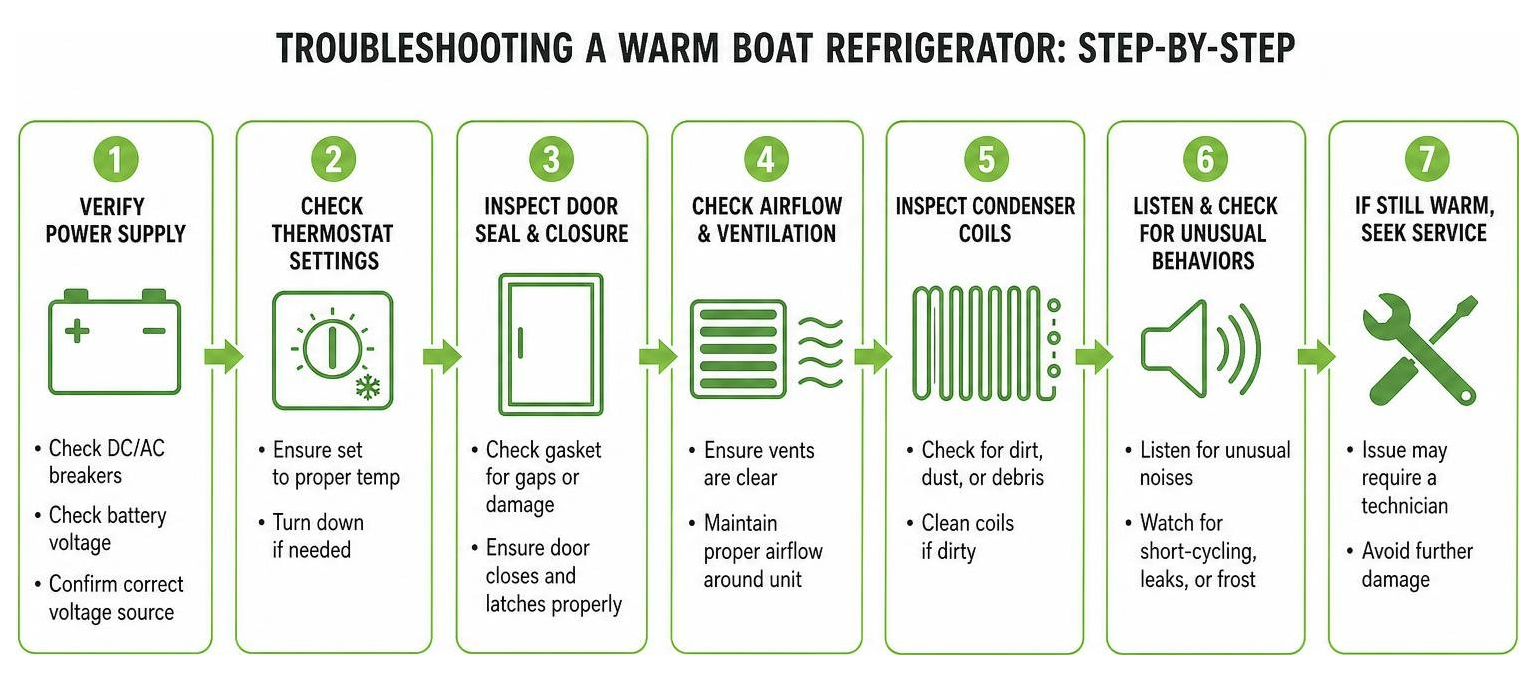
Step 1: Verify the Power Supply
Marine refrigerators typically run on dual-voltage systems (12V/24V DC when underway and 120V AC when connected to shore power or running a generator).
- Check your vessel’s main DC breaker panel and AC distribution panel to ensure the refrigerator breakers are turned on.
- If the unit is running on DC batteries, check for a voltage drop. A battery bank with low charge may supply enough power to run the cabin lights but fail to provide the high starting amperage required by the compressor.
Step 2: Inspect the Thermostat and Controls
Ensure the thermostat dial has not been bumped or set to the off position. If your unit has a digital controller, check for any error codes. On systems like the Adler Barbour Cold Machine, a flashing LED on the controller can pinpoint electrical or compressor faults immediately.
Step 3: Perform the “Dollar Bill Test” on Door Gaskets
A compromised door seal is one of the most common causes of poor cooling. To test your gaskets:
- Place a dollar bill or a thin piece of paper between the door gasket and the refrigerator frame.
- Close the door and pull the bill.
- If it slides out easily with no resistance, your gasket is not sealing properly. Clean the gasket with warm water and soap, or contact us to replace it.
Step 4: Check for Restricted Airflow and Clean the Condenser Coils
Locate the condenser coils (usually at the back or bottom of the unit). If they are coated in dust or salt residue, the system cannot shed heat. Use a soft brush or a vacuum to carefully clean the coils. Ensure that any ventilation grates or fans designed to pull air through the galley cabinetry are clear of obstructions.
Step 5: Ensure ABYC Electrical Compliance
If you are inspecting wiring or replacing fuses, always ensure your work complies with the American Boat and Yacht Council (ABYC) electrical standards. Marine electrical systems must be properly insulated and fused to prevent short circuits, galvanic corrosion, or onboard fires.
Why Professional Mobile Marine Service is Essential
While basic troubleshooting can help you identify simple power issues or dirty coils, most marine refrigeration repairs require specialized expertise and tools. Attempting a complex DIY repair on a marine sealed system can lead to permanent damage or unsafe operating conditions.
- Specialized Marine Tools: Diagnosing a refrigerant leak or compressor failure requires specialized gauges, vacuum pumps, and electronic leak detectors designed to work in tight boat galleys.
- Marine-Grade Parts Matching: Standard household appliance parts will not survive long in a marine environment. Professional marine technicians use high-quality, corrosion-resistant, marine-grade replacement parts designed to handle salt air and constant vibration.
- On-Site Diagnostics: FCS Marine provides mobile marine service, meaning we come directly to your vessel’s location. There is no need to go through the hassle of removing a heavy, built-in refrigerator from your cabin and transporting it to a shop.
- Electrical and Sealed System Safety: Working with dual-voltage AC/DC electrical systems requires a deep understanding of marine wiring. Additionally, handling modern refrigerants requires proper licensing and equipment to avoid environmental hazards and system contamination.
Regular maintenance is the key to keeping your galley running smoothly. To find out why regular upkeep is so important, read our article Chill Out: Why Regular Yacht Refrigerator Service Florida Keeps the Party Going. If your system breaks down unexpectedly, we also offer Emergency Marine Refrigeration Repair to get your galley cold again quickly.
Frequently Asked Questions About Boat Fridge Repair Delray Beach
How much does boat fridge repair Delray Beach typically cost?
The cost of repairing a boat refrigerator depends on the specific failure. Minor repairs, such as clearing a clogged defrost drain, replacing a door gasket, or swapping out a faulty thermostat, generally range from $140 to $340.
More complex repairs, such as replacing a compressor start relay, a fan motor, or repairing a sealed system leak, can range from $250 to $650+. All sealed system repairs must be performed by certified technicians in strict compliance with EPA Refrigerant Management Regulations to ensure safe handling and recovery of refrigerants. For an accurate, on-site diagnostic and estimate, contact FCS Marine.
What areas do you cover for mobile boat fridge repair Delray Beach?
We provide mobile marine service across Palm Beach County, Broward County, Miami-Dade County, Martin County, and St. Lucie County. In and around Delray Beach, our technicians service vessels at all local marinas, private docks, yacht clubs, and boatyards. Whether your boat is docked near the Atlantic Dunes Park area, along the Intracoastal Waterway, or stored in a local facility, we travel directly to your vessel’s location. You can learn more about our local service coverage on our Palm Beach County Location page.
Can you repair marine ice makers and chilled water systems?
Yes! In addition to standard galley refrigerators and freezers, we repair and service marine ice makers, cockpit refrigerators, and chilled water systems. Common ice maker issues, such as failed water solenoid valves, broken timing gears, or faulty thermostats, can be diagnosed and repaired dockside.
We can also assist with custom refrigeration fabrication and water purification systems to ensure your vessel is fully equipped for your next voyage. For more details on these specialized systems, read Don’t Let Your Drinks Sweat with These Marine Refrigeration Services.
Keep Your Galley Cool with FCS Marine
When you are out on the water in South Florida, you shouldn’t have to worry about warm drinks or spoiled food. FCS Marine is a family-owned company specializing in complete yacht maintenance services, including marine AC repair, refrigeration, insulation, mold cleaning, and water purification.
Our unique advantage is fast, professional marine service delivered directly to your vessel’s location. We back all of our work with a satisfaction guarantee, ensuring your onboard systems operate reliably when you need them most. Whether you need a simple thermostat replacement, a major compressor repair, or specialized marine refrigeration troubleshooting, we are ready to help.
Don’t let a warm refrigerator ruin your time on the water. Check out our full range of Marine Refrigeration Services or Contact Us today to schedule your on-site marine service.