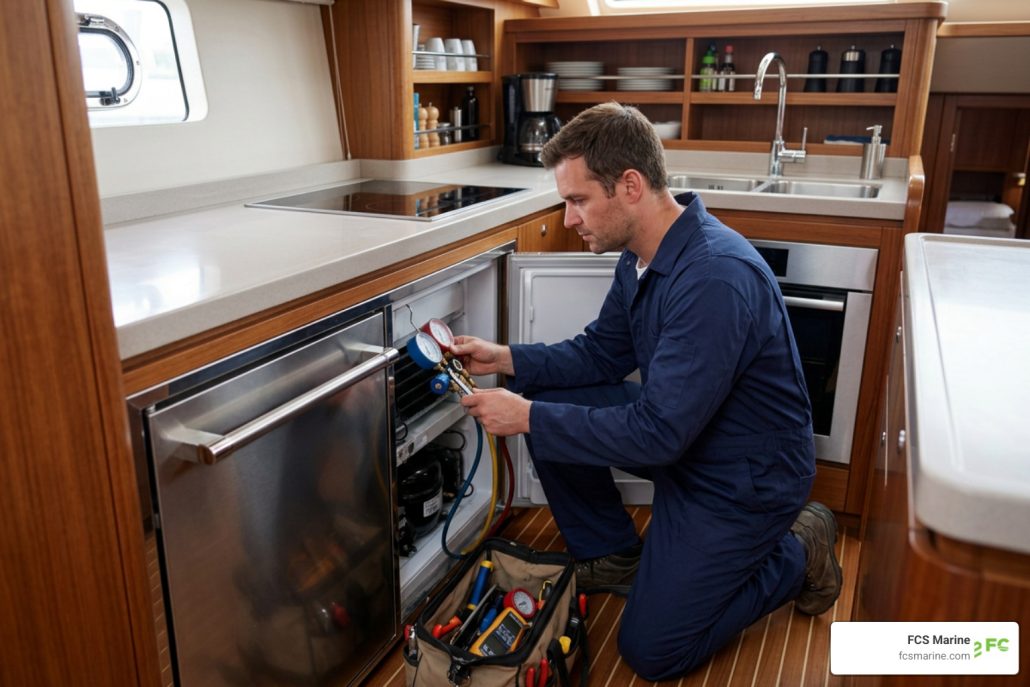
When the Heat Is On, Reliable Marine Refrigeration Service Is Non-Negotiable
Marine refrigeration service is the routine and emergency care that keeps your onboard cooling systems running in one of the harshest environments on earth — saltwater, heat, and constant vibration included.
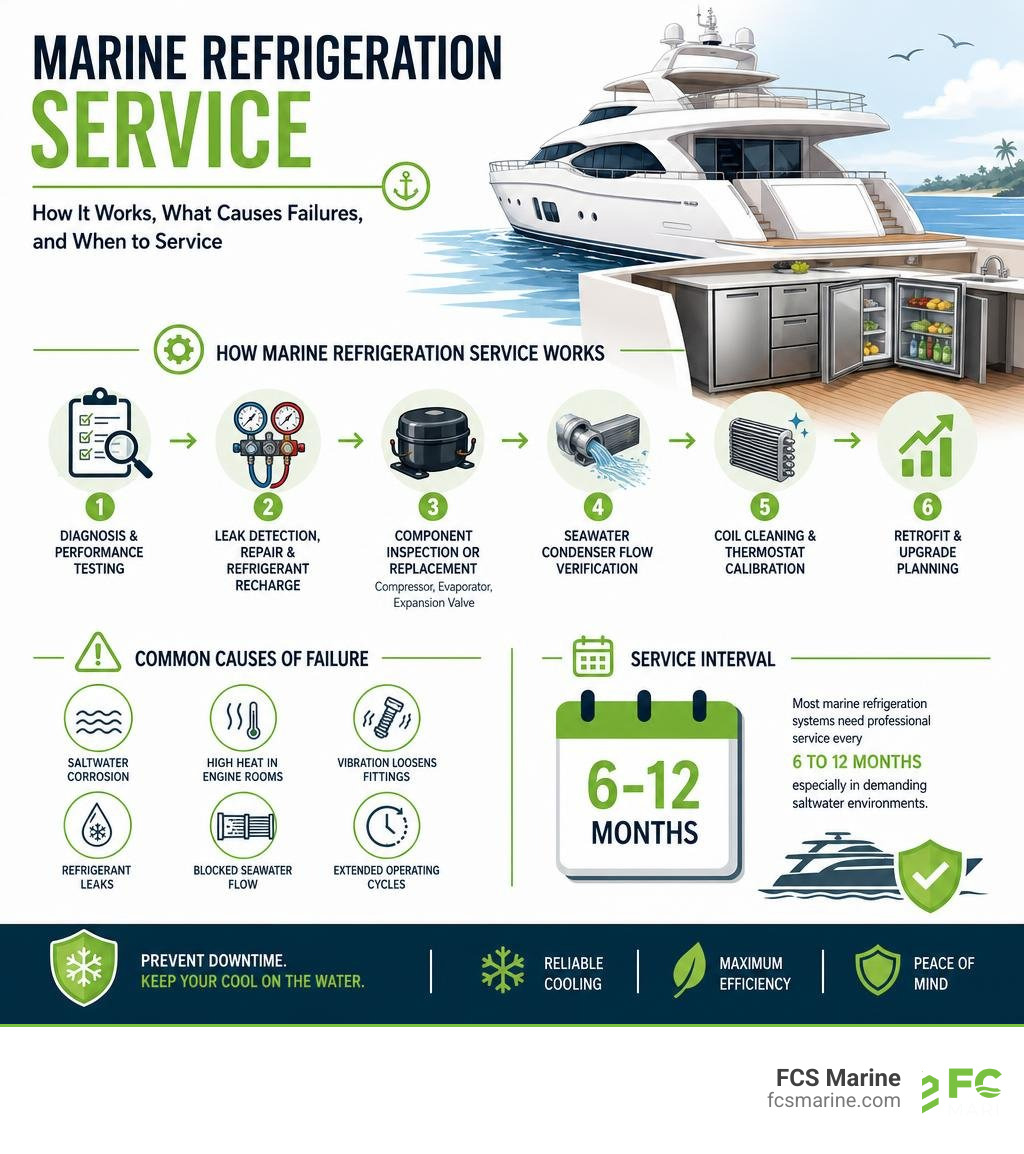
If you need a quick answer, here’s what you should know:
What does marine refrigeration service typically include?
- Diagnostics and performance testing — identifying why cooling has dropped off
- Refrigerant leak detection, repair, and recharge — restoring proper system pressure
- Compressor, evaporator, and expansion valve inspection or replacement — addressing the most common hardware failures
- Seawater condenser flow verification — confirming heat rejection is working correctly
- Coil cleaning and thermostat calibration — improving efficiency and temperature accuracy
- Retrofit and upgrade planning — for older systems that can’t keep up
Most marine refrigeration systems need professional service every 6 to 12 months, especially in demanding saltwater environments like South Florida.
Picture this: you’re two days into a trip offshore, the cooler packed with fresh provisions and drinks for your guests — and then the fridge stops keeping up. Food starts to soften. Drinks go warm. What was supposed to be a highlight becomes a headache.
It’s a more common scenario than most yacht owners expect. Marine refrigeration systems work far harder than a home refrigerator. Ambient temperatures in engine rooms can exceed 130°F. Saltwater corrodes. Vibration loosens fittings. Extended operating cycles push compressors to their limits.
The good news? Most failures are preventable with the right service schedule and a qualified technician who knows marine systems — not just residential ones.
Understanding Onboard Cooling Systems and Marine Refrigeration Service
To understand why your boat’s refrigerator behaves the way it does, we have to look at the unique physics of marine cooling. Unlike your kitchen fridge, which sits in a temperature-controlled house and plugs into an endless supply of cheap AC grid power, a boat fridge operates under strict constraints.
First and foremost is energy consumption. Your 12-volt refrigeration system is most likely the largest amp draw on your battery bank. When you are on the hook or sailing offshore without shore power, every amp-hour matters. Improving cooling efficiency directly impacts how often you have to run your generator or drain your house batteries. If your compressor is struggling due to a minor issue, it will run constantly, quickly draining your battery bank and forcing you to burn fuel.
This is why specialized marine refrigeration service is so critical. A professional technician doesn’t just make the box cold; they optimize the system to pull the minimum number of amps possible. This involves checking the thermal insulation of your cabinet, verifying that the DC power cables are sized correctly to prevent voltage drops, and ensuring the heat-rejection side of the system is working flawlessly. To explore how we can help keep your system running efficiently, you can Learn more about professional marine refrigeration and protect your onboard battery banks.
Common Types of Marine Refrigeration Systems
Not all boat fridges are built the same. Depending on the size of your vessel, your cruising style, and your power budget, you will likely encounter one of these common configurations:
- Evaporator Units (Direct Expansion): These are the most common systems found on small-to-medium recreational boats. They use a standard compressor to pump refrigerant directly through a thin aluminum evaporator plate inside the box. They are lightweight, relatively inexpensive, and cool down quickly, but they offer very little thermal storage. Once the compressor cycles off, the temperature inside the box rises quickly.
- Cold Plates and Holding Plates: These systems are the heavy lifters of marine refrigeration. A holding plate is a thick, sealed stainless steel or bronze tank filled with a eutectic solution (a specialized saltwater or glycol mixture) that freezes at a specific temperature. The refrigerant lines run inside this plate, freezing the solution solid. Once frozen, these plates act like a high-tech block of ice, keeping your galley box cold for up to 12 to 24 hours without the compressor running a single time. This is highly efficient for sailors who only want to run their engine or generator once or twice a day.
- Keel-Cooled Systems: Instead of using air or raw seawater pumped through the boat to cool the condenser, keel-cooled systems use a heat exchanger mounted on the outside of the hull (often integrated into a bronze through-hull fitting). The refrigerant travels down to the keel cooler, where the surrounding ocean water naturally cools it. These systems operate silently, have no water pumps to fail, and draw very little power, making them highly prized by long-distance cruisers.
To help you decide which system is best for your vessel or understand what you currently have onboard, here is a quick comparison:
| System Type | Cooling Method | South Florida Efficiency | Maintenance Needs | Best Use Case |
|---|---|---|---|---|
| Air-Cooled | Air fan over condenser coils | Low (struggles in 90°F+ cabins) | Low (must clean dust from coils) | Weekend cruisers, smaller boats |
| Water-Cooled | Seawater pump through heat exchanger | High (excellent heat rejection) | High (requires pump & strainer care) | Large yachts, sportfishers, hot climates |
| Keel-Cooled | External hull heat exchanger | Very High (silent heat transfer) | Medium (requires hull cleaning/zincs) | Blue-water cruisers, sailboat liveaboards |
Marine vs. Residential Systems: What Makes Marine Cooling Unique?
We are often asked: “Why can’t I just buy a cheap mini-fridge from a big-box store and install it in my boat’s galley?”
While some boaters do this as a temporary fix, residential refrigerators are simply not built to survive the marine environment. First, they lack vibration resistance. A boat bouncing over waves or vibrating under diesel power will quickly fatigue the copper solder joints in a residential fridge, leading to catastrophic refrigerant leaks. Marine-grade systems are engineered with flexible vibration-absorbing mounts and heavy-duty tubing designed to withstand years of pounding.
Second, the marine environment is incredibly corrosive. Salt air will rust out a standard residential compressor shell and electrical terminals in a matter of months. Marine systems use marine-grade stainless steel, copper-nickel alloys, and coated electrical connections to ward off the green monster of corrosion. Furthermore, marine compressors (such as those manufactured by Danfoss/Secop) are designed to run on variable DC power (12V/24V) and can operate at steep angles of heel—crucial for sailboats—whereas residential compressors will fail if tilted for extended periods.
For these reasons, choosing dedicated Professional marine refrigeration solutions is the only way to guarantee long-term reliability when you are far from the dock.
Why Marine Systems Fail: Saltwater, Vibration, and Heat
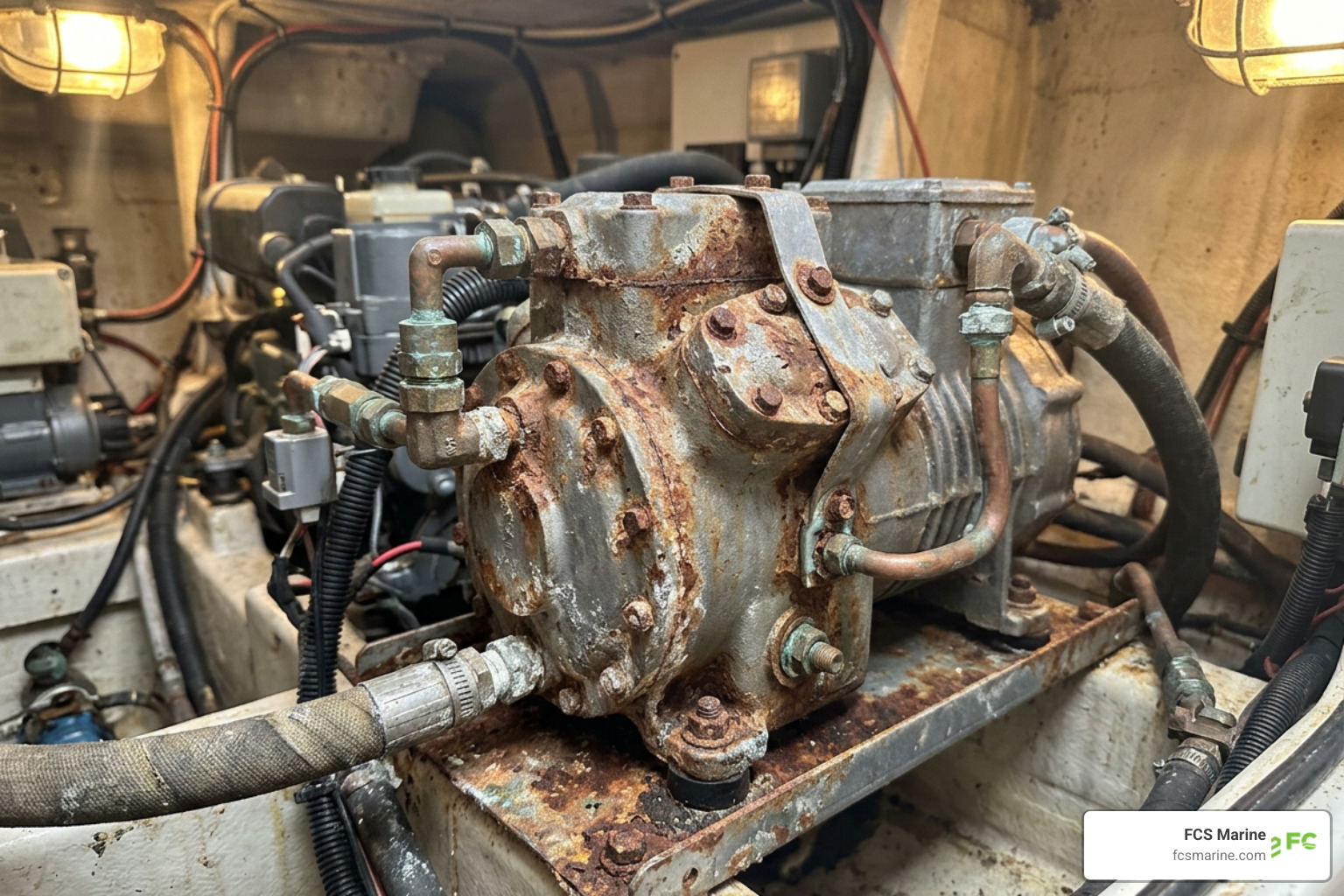
When you operate a boat in South Florida—whether you are docked in Fort Lauderdale, cruising Palm Beach, or heading out from Pompano Beach—your refrigeration system is fighting a constant battle against three major enemies: saltwater, vibration, and extreme heat.
The tropical climate of South Florida means your boat’s interior ambient temperature can easily exceed 90°F, while enclosed engine rooms and machinery spaces can skyrocket to 130°F or more. In these conditions, an air-cooled refrigerator has to work three to four times harder than a standard household unit just to keep your milk from souring. If you want to dive deeper into why these systems struggle, read about the Common causes of marine refrigeration failure to protect your investment.
The Main Causes of Marine Refrigeration Failure
After decades of servicing boats along the coast, we have found that the vast majority of refrigeration breakdowns can be traced to a few common culprits:
- Refrigerant Leaks from Vibration: The constant thrum of diesel engines and the impact of hull-to-water contact create micro-vibrations throughout your vessel. Over time, these vibrations rub copper refrigerant lines against cabinet walls or fatigue solder joints, letting the refrigerant escape.
- Restricted Seawater Condenser Flow: If you have a water-cooled system, your compressor relies on a steady stream of raw seawater to cool the hot refrigerant. Unfortunately, South Florida’s warm, nutrient-rich waters are a breeding ground for marine growth. Barnacles, algae, and silt quickly coat the inside of your condenser coils or clog your sea strainer, restricting water flow. This causes high-pressure faults, system shutdowns, and eventually, compressor failure.
- Electrical Faults and Corrosion: Salt air is highly conductive and corrosive. It loves nothing more than creeping into electrical terminal blocks, thermostats, and control modules. A tiny amount of corrosion on a 12V connection can cause a voltage drop, triggering the compressor’s low-voltage cutout even if your batteries are fully charged.
- Compressor Burnout: When a system is neglected—operating with restricted airflow, low refrigerant, or clogged water lines—the compressor has to run non-stop. This continuous high-temperature operation degrades the compressor’s internal lubricating oil, leading to mechanical lockup or electrical burnout.
How Long Do Marine Refrigeration Systems Last?
A high-quality marine refrigeration system is a significant investment, and naturally, boat owners want to know how long they can expect it to last. Under ideal conditions, a well-maintained marine refrigerator can last anywhere from 10 to 15 years.
However, in the harsh, humid environment of South Florida, that lifespan can easily be cut in half without proactive care. Liveaboard vessels that run their systems 24/7/365 put immense wear on compressors and pumps compared to weekenders who turn their systems off between trips. To learn more about what influences this timeline and how to maximize your system’s life, check out our guide on How long marine refrigeration systems last.
Key Signs Your Boat Fridge Needs Professional Attention

Your boat’s refrigeration system rarely fails completely without warning. Usually, it will drop subtle hints that something is amiss. Recognizing these warning signs early can mean the difference between a simple, inexpensive repair (like cleaning a condenser or replacing a dry-rotted door seal) and an expensive compressor replacement.
Keep an eye out for these common warning signs:
- The compressor runs constantly but the cabinet never quite reaches the proper temperature.
- Your house battery bank drains much faster than usual when you are disconnected from shore power.
- Your ice cream is soft or food in the freezer section is starting to thaw.
- You hear unusual noises such as loud buzzing, clicking, or rattling coming from the machinery space.
Red Flags That Require Immediate Marine Refrigeration Service
Some symptoms are true emergencies that require prompt professional intervention to save your food, your batteries, and your equipment.
If you hear your compressor clicking on and immediately shutting off, this is a classic sign of a failing controller, an electrical overload, or a locked rotor. Running the system in this state can permanently destroy the compressor motor.
Another major red flag is excessive frost or ice buildup on the evaporator plate. While a thin layer of frost is normal, a thick block of ice acts as an insulator, preventing the cold from reaching the rest of the box. This is often caused by a torn door gasket letting humid air in, or a system running low on refrigerant. If your system is iced up, find out Why marine refrigeration systems freeze up to understand the root cause. If your system has stopped cooling entirely in the middle of a cruise, don’t panic—our team is ready to assist with fast, reliable Emergency marine refrigeration repair to get your galley back online.
What to Expect During a Professional Marine Refrigeration Service Tune-Up
When you hire a qualified professional to service your marine refrigeration, they don’t just hook up gauges and add refrigerant. In fact, adding refrigerant without finding the leak is illegal under EPA regulations and will only mask the problem temporarily.
A comprehensive, professional maintenance check should include:
- Visual Inspection: Checking all copper lines for signs of oily residue (which indicates a refrigerant leak), inspecting wire terminals for corrosion, and checking the physical condition of the mounts.
- Condenser Cleaning: Clearing dust, pet hair, and debris from air-cooled condensers, or flushing seawater-cooled condensers with a mild acid solution to remove scale and marine growth.
- Leak Detection: Using electronic leak detectors or nitrogen pressure testing to find microscopic leaks in the evaporator or condenser coils.
- Thermostat and Control Calibration: Verifying that the thermostat is cycling the compressor correctly and that the electronic control module is operating within factory specifications.
- Gasket and Insulation Check: Inspecting the door or lid seals with a flashlight test to ensure no warm, humid air is leaking into the box.
Investing in a regular Professional marine refrigeration tune-up keeps your system running at peak efficiency, saving you fuel, battery power, and costly emergency repair bills down the road.
The Advantages of Mobile Dockside Service
When your yacht’s refrigeration goes down, the last thing you want to do is coordinate hauling your vessel out of the water or trying to uninstall a heavy, complex built-in appliance to take it to a shop.
That is why we specialize in mobile, dockside marine refrigeration service. Our fully equipped service vans travel directly to your marina, private dock, or boatyard across Palm Beach, Broward, Miami-Dade, Martin, and St. Lucie counties. Whether you are docked at a major marina in Fort Lauderdale or keeping your boat behind your home in Pompano Beach, our technicians bring the tools, diagnostic equipment, and common replacement parts directly to your slip.
This dockside approach is incredibly valuable for yacht captains and management companies. It allows us to test the system in its actual working environment—checking the boat’s actual DC voltage under load, verifying the raw water flow through the hull, and ensuring everything integrates perfectly with your vessel’s existing systems. For hassle-free service that comes to you, explore the benefits of FCS Marine dockside service.
We are proud authorized service providers and work closely with major marine brands to ensure your systems are serviced to factory standards. Our technicians are fully trained to handle a wide range of marine cooling systems, ensuring you receive top-tier support directly at your dock.
Frequently Asked Questions about Marine Refrigeration
How often should I schedule routine maintenance for my boat’s refrigerator?
We highly recommend scheduling a professional marine refrigeration service inspection every 6 to 12 months. If you are a liveaboard or cruise extensively in hot climates like South Florida, every 6 months is ideal.
Additionally, you should always perform a quick personal check before embarking on any long-distance trips. Check the sea strainer for debris, make sure the compressor area is clear of stored gear (which blocks airflow), and verify that the door gaskets are clean and sealing tightly. For more common questions and expert boat owner tips, browse our comprehensive FAQs.
Why is my marine refrigeration system freezing up?
A frozen evaporator plate is almost always caused by one of two things: moisture intrusion or poor airflow/insulation.
When warm, humid air leaks into your refrigerator box (usually through a worn-out door gasket or a poorly insulated hatch lid), the moisture in the air instantly condenses and freezes onto the cold evaporator plate. Over time, this ice grows into a thick barrier that stops heat transfer. Alternatively, if your box’s internal fan fails or if the box is packed too tightly with provisions, the lack of airflow will cause the plate to drop below freezing temperatures and ice over. To understand the physics behind this issue, read our detailed article on Why marine refrigeration systems freeze up.
How do technicians diagnose and repair refrigerant leaks on a boat?
Because marine refrigeration systems are closed, hermetic loops, they should never “consume” or lose refrigerant. If your system is low on charge, there is a leak.
Our technicians use highly sensitive electronic leak detectors that can sniff out refrigerant gases down to a fraction of an ounce per year. Once we locate the leak, we pump down the system, cut out the damaged section of copper tubing, and solder in a fresh piece of marine-grade tubing. We then connect a vacuum pump to evacuate all air and moisture from the lines before recharging the system with the exact weight of refrigerant specified by the manufacturer. All of our technicians hold EPA 608 certification, which is legally required to handle and dispose of refrigerants safely; you can learn more about these requirements from the U.S. Environmental Protection Agency’s Section 608 technician certification resources.
We service all major marine brands, including Vitrifrigo, Isotherm, Frigoboat, Dometic, Norcold, and more. Our team has the specialized training and access to OEM parts required to keep these high-end systems running at peak performance.
Conclusion: Keep Your Provisions Fresh with Expert Care
At the end of the day, your boat is your escape. It’s where you go to relax, entertain, and make memories with family and friends. A warm refrigerator or a failed freezer shouldn’t be the reason your weekend is cut short.
By staying proactive with your marine refrigeration service, you can protect your batteries, keep your energy consumption low, and ensure your provisions stay fresh and your drinks stay ice-cold—no matter how high the South Florida thermometer climbs.
As a family-owned South Florida company, FCS Marine is dedicated to keeping your vessel in top shape. We specialize in comprehensive yacht maintenance services, including marine AC repair, refrigeration, insulation, mold cleaning, and water purification. Our unique promise is simple: fast, dockside service delivered directly to your slip with a 100% satisfaction guarantee. We proudly serve boat owners across Palm Beach County, Broward County, Miami-Dade County, Martin County, St. Lucie County, Fort Lauderdale, and Pompano Beach.
Don’t wait for your ice cream to melt or your guests to start sweating. Schedule your marine refrigeration service today and let us handle the hard work while you enjoy the water!