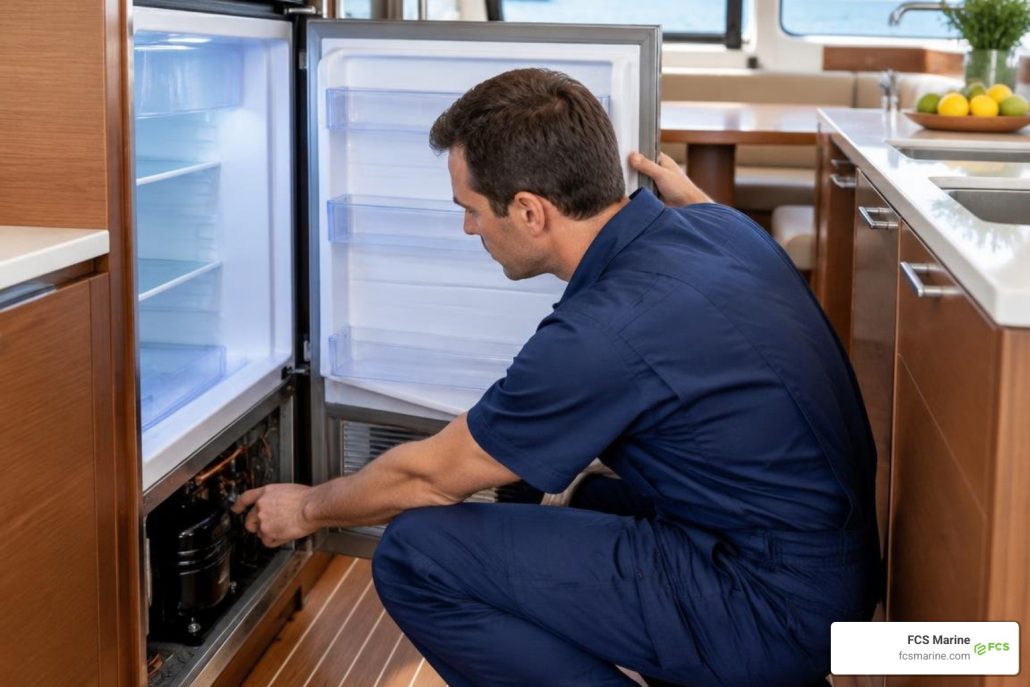
How to Take the Guesswork Out of Marine Refrigeration Repairs
If your boat fridge is warm or draining the battery, start with three checks: Confirm it has power, clear any blocked airflow around the condenser, and inspect the door seal. If it still runs constantly or will not cool, arrange a marine refrigeration inspection. A technician can test the electrical system, compressor, and refrigerant circuit before recommending a repair or replacement.
In South Florida’s heat, a cooling problem can spoil provisions and put extra strain on your battery bank. FCS Marine provides marine refrigeration services to help boat and yacht owners find the cause and choose the next step.

Marine refrigeration repairs helpful reading:
- marine fridge repair Palm Beach
- refrigeration troubleshooting Pompano Beach
- boat AC service Palm Beach
Marine-Specific Causes of Cooling Failures
Marine galleys place extraordinary stress on cooling equipment compared to residential kitchens. Constant exposure to saltwater environments accelerates galvanic corrosion on delicate aluminum evaporator plates, copper tubing, and steel mounting brackets. When salt air penetrates galley cabinetry, it forms a crust on condenser fins, drastically lowering heat transfer.
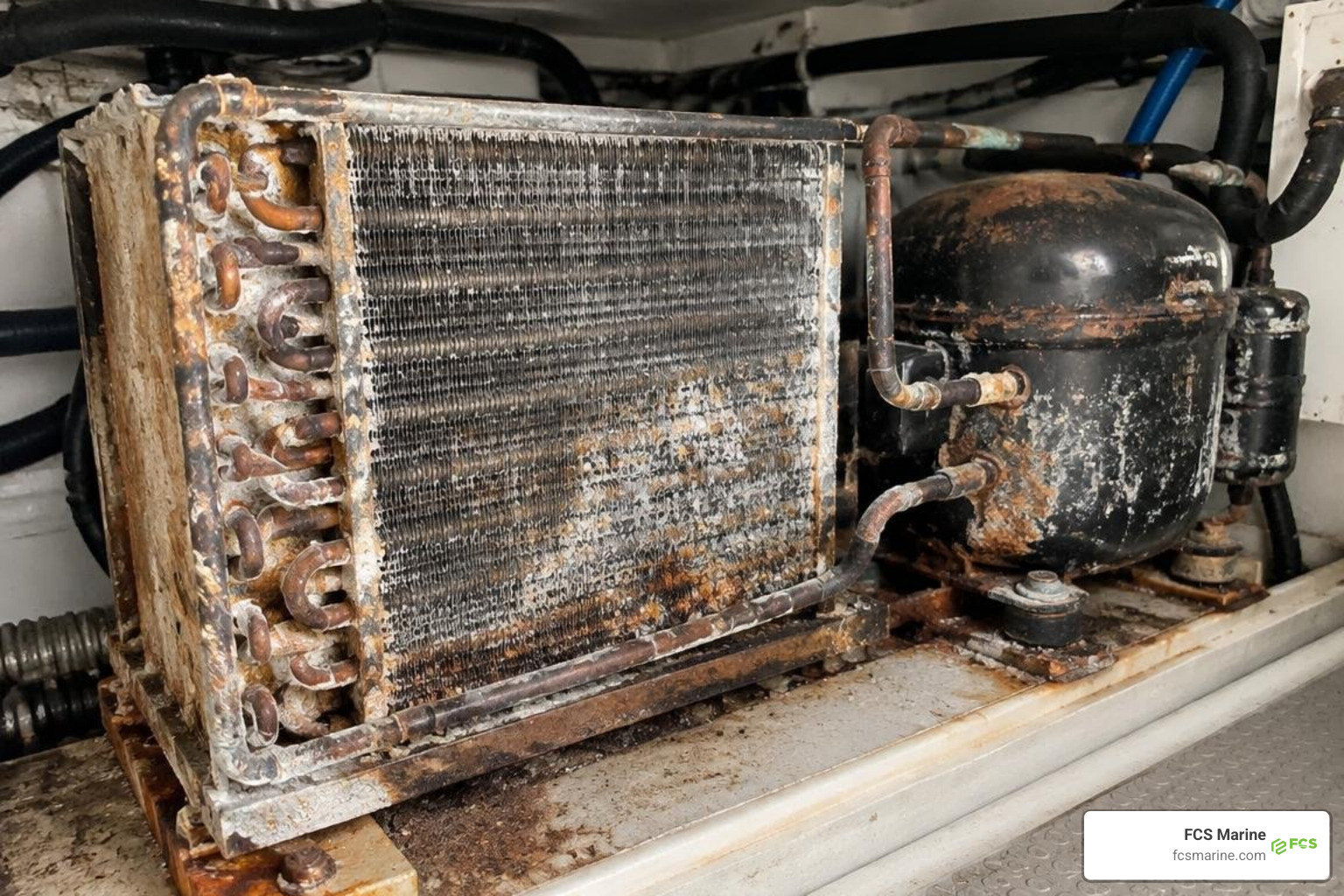
High ambient humidity in tropical regions like Florida compounds these mechanical stressors. As warm, moisture-laden air seeps past imperfect hatch seals or cabinet gaskets, it deposits condensation directly onto the evaporator coil. This leads to heavy ice build-up, blocking air circulation and causing the system to run continuously without cooling the compartment.
Understanding the common causes of marine refrigeration failure helps boaters address minor symptoms before they lead to catastrophic equipment breakdowns. The primary environmental factors include:
- Hull Vibration and Mechanical Shock: Engine rumble, wave pounding, and underway movement cause work-hardening of rigid copper lines, loosening flare fittings and creating pinhole refrigerant leaks.
- Restricted Ventilation in Confined Spaces: Marine units are frequently crammed into unvented hull spaces or under galley counters where ambient temperatures can exceed 120°F (49°C), causing thermal overload cutouts.
- High Seawater Temperatures: Water-cooled refrigeration systems rely on raw water heat exchangers that suffer from marine growth, silt clogging, and scale accumulation, throttling cooling capacity.
- Condensation and Mold Accumulation: Poor drainage leads to standing moisture beneath drip pans, promoting mold spores that compromise galley air hygiene and foul electrical contacts.
Warning Signs That Demand Immediate Marine Refrigeration Repairs
Refrigeration systems rarely fail without warning. Monitoring your unit’s cycling behavior, cooling speed, and electrical draw will alert you to impending issues before provisions spoil on an offshore passage.
When an evaporator frosts unevenly—such as freezing over near the inlet tube while remaining dry and warm across the rest of the plate—you are likely dealing with low refrigerant or a restricted expansion device. Learning why marine refrigeration systems freeze up allows captains to distinguish between simple airflow blockages and internal sealed-system faults.
If you discover a boat fridge that stopped cooling suddenly, observe the unit for these critical warning indicators:
- Continuous Compressor Cycling: A compressor that runs non-stop without dropping box temperature indicates a loss of refrigerant, degraded cabinet insulation, or a failing thermostat.
- Unusual Mechanical Sounds: Clicking, metallic rattling, or buzzing from the compressor motor points to failing internal valves, low oil levels, or loose vibration dampers.
- Spike in DC Amperage: A sudden increase in amp draw on your battery monitor signifies that the compressor is struggling against high head pressure, restricted airflow, or low supply voltage.
- Oily Residue on Fittings: Refrigerant carries lubricating oil throughout the closed loop. Any visible oily sheen near copper joints or service ports confirms an active refrigerant leak.
Diagnosing When Marine Refrigeration Repairs Are Needed vs Replacement
Deciding whether to repair an existing galley unit or invest in a modern replacement comes down to system age, corrosion levels, and compressor integrity. Analyzing how long marine refrigeration systems last provides a practical framework for calculating repair economics.
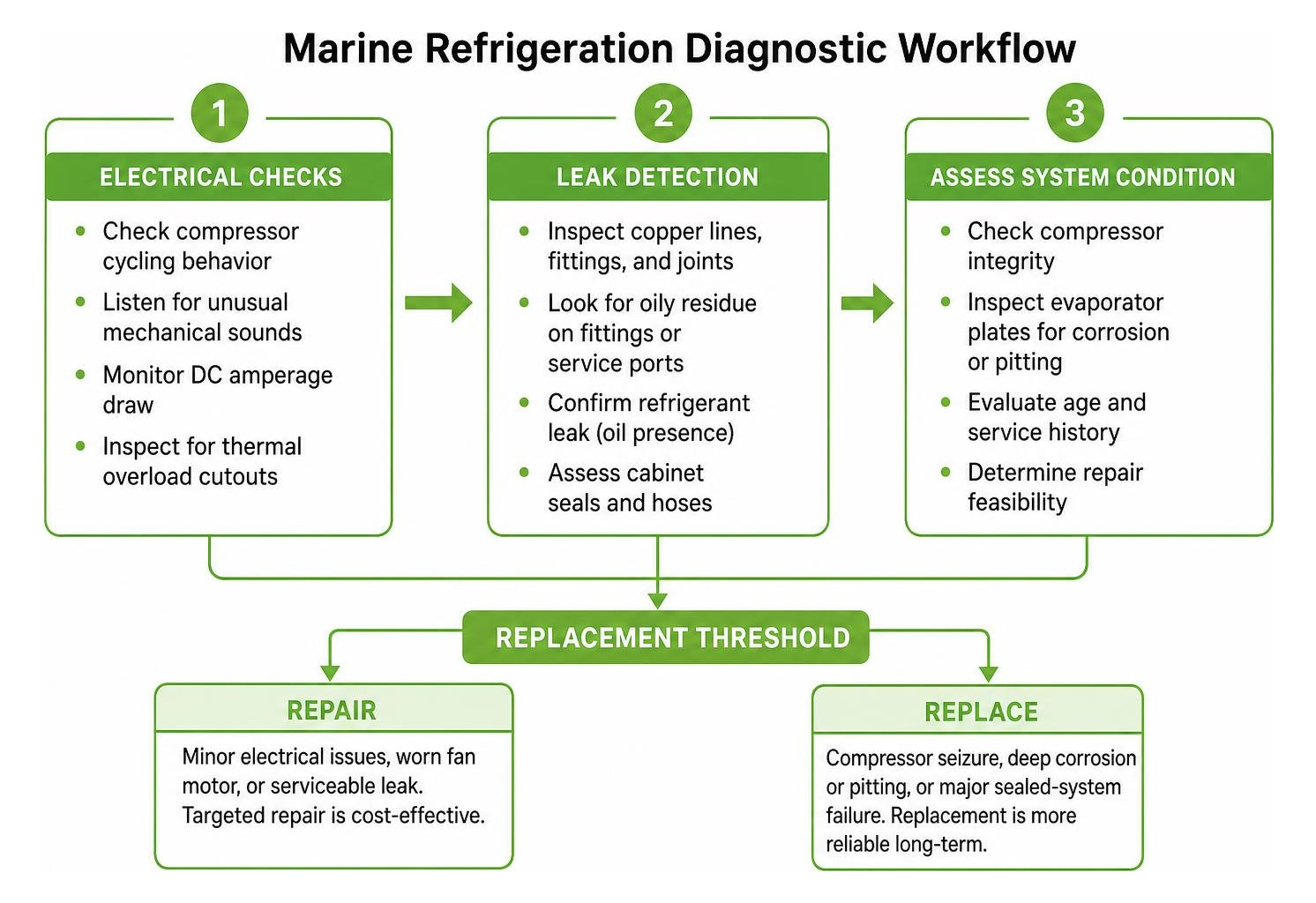
If a system has a minor electrical failure, worn fan motor, or a serviceable flare fitting leak, targeted repair work is cost-effective. However, if the hermetic compressor has suffered an internal mechanical seizure, or if the evaporator plates show deep galvanic pitting, replacing the condensing unit or installing a modern drop-in unit is often the more reliable choice for long-term cruising.
Comparing Galley Systems: Icebox Conversions, Cold Plates, and Self-Contained Units
Choosing the right refrigeration architecture depends on how you use your vessel, your available battery capacity, and galley dimensions.
| System Type | Power Consumption | Holding Time (Off-Power) | Installation Complexity | Primary Maintenance Requirements |
|---|---|---|---|---|
| Icebox Conversion Kit | Moderate (30–60 Ah/day DC) | Low (requires regular cycling) | Moderate (runs lines to existing insulated box) | Fan cleaning, evaporator defrosting, seal maintenance |
| Holding (Cold) Plate System | High burst draw, low daily runtime | High (12–24+ hours holding capacity) | High (heavy plates, expansion valves, complex plumbing) | TXV valve calibration, raw water pump descaling, leak checks |
| Self-Contained Galley Unit | Low to Moderate (pre-balanced) | Low to Moderate | Low (cabinet drop-in, plug-in 12V/120V) | Condenser fin cleaning, rear ventilation clearing, latch adjustments |
Step-by-Step Galley Efficiency and Maintenance Plan
A systematic approach to galley maintenance keeps food safely preserved while reducing mechanical stress on equipment. Following a complete guide to marine refrigeration repair helps keep your unit running efficiently throughout the boating season.
Optimizing 12-Volt Efficiency to Lower Battery Drain
Your 12-volt refrigeration system is most likely the largest amp draw on your battery bank. Improving the efficiency of your refrigeration system can reduce that draw and significantly impact how often you have to run your generator, as well as leaving more battery power for your other DC loads.
To maximize efficiency:
- Minimize Voltage Drop: Undersized wiring creates resistance, dropping voltage at the compressor. This causes variable-speed DC compressors to draw excessive current or shut down on low-voltage safety faults. Ensure wiring runs use heavy-gauge marine-grade tinned copper.
- Enhance Cabinet Ventilation: Add dedicated exhaust venting or small 12V computer-style fans to hot cabinetry to pull cool bilge air across the condenser and discharge hot air into the cabin.
- Maintain Thermal Mass: Keep the box filled. Storing chilled water bottles in empty spaces prevents warm air from flooding the compartment each time the latch opens.
- Upgrade Box Insulation: Old foam insulation absorbs ambient moisture over time, losing its R-value. Adding closed-cell polyurethane or vacuum insulation panels around the coolbox dramatically cuts compressor duty cycles.
Preparing Your Galley for Marine Refrigeration Repairs and Long Cruises
Before setting out on extended voyages:
- Inspect raw water strainers, impellers, and circulating hoses on water-cooled systems.
- Pack spare thermal fuses, replacement electronic control modules, and fan motors.
- Verify that hatch latches pull doors tightly against their perimeter gaskets.
- Defrost the evaporator completely to restore thermal conductivity across the cooling plates.
Selecting On-Site Professional Yacht Services in Coastal Regions
Marine cooling systems operate under rigorous federal environmental standards. Under Section 608 of the Clean Air Act, governed by the U.S. Environmental Protection Agency, technicians must capture and recycle refrigerants rather than venting them into the atmosphere. Proper recovery equipment and marine diagnostic manifolds are required to service sealed cooling loops safely.
When unexpected failures happen at your slip, our mobile, on-site service teams travel directly to your vessel across marinas, boat yards, private docks, and yacht basins throughout Palm Beach County, Broward County, Miami-Dade County, Martin County, and St. Lucie County. This eliminates the hassle of navigating your vessel to a boatyard for technical troubleshooting.
Key Standards for Selecting Marine Refrigeration Repairs Specialists
When evaluating technicians for yacht repairs, ensure the team provides:
- Dedicated Marine Tooling: Electronic micron vacuum gauges, digital leak detectors, and marine manifold sets calibrated for R134a, R404A, and R452A systems.
- Comprehensive Systems Knowledge: Practical experience across DC electrical circuits, hermetic motor controls, raw water plumbing, and thermal insulation barriers.
- Multi-Disciplinary Galley and Cabin Support: Ability to service integrated boat systems simultaneously, including marine air conditioning, mold cleaning, and galley plumbing.
Frequently Asked Questions About Boat Galley Cooling
How do I diagnose whether my boat fridge needs a recharge or a full compressor replacement?
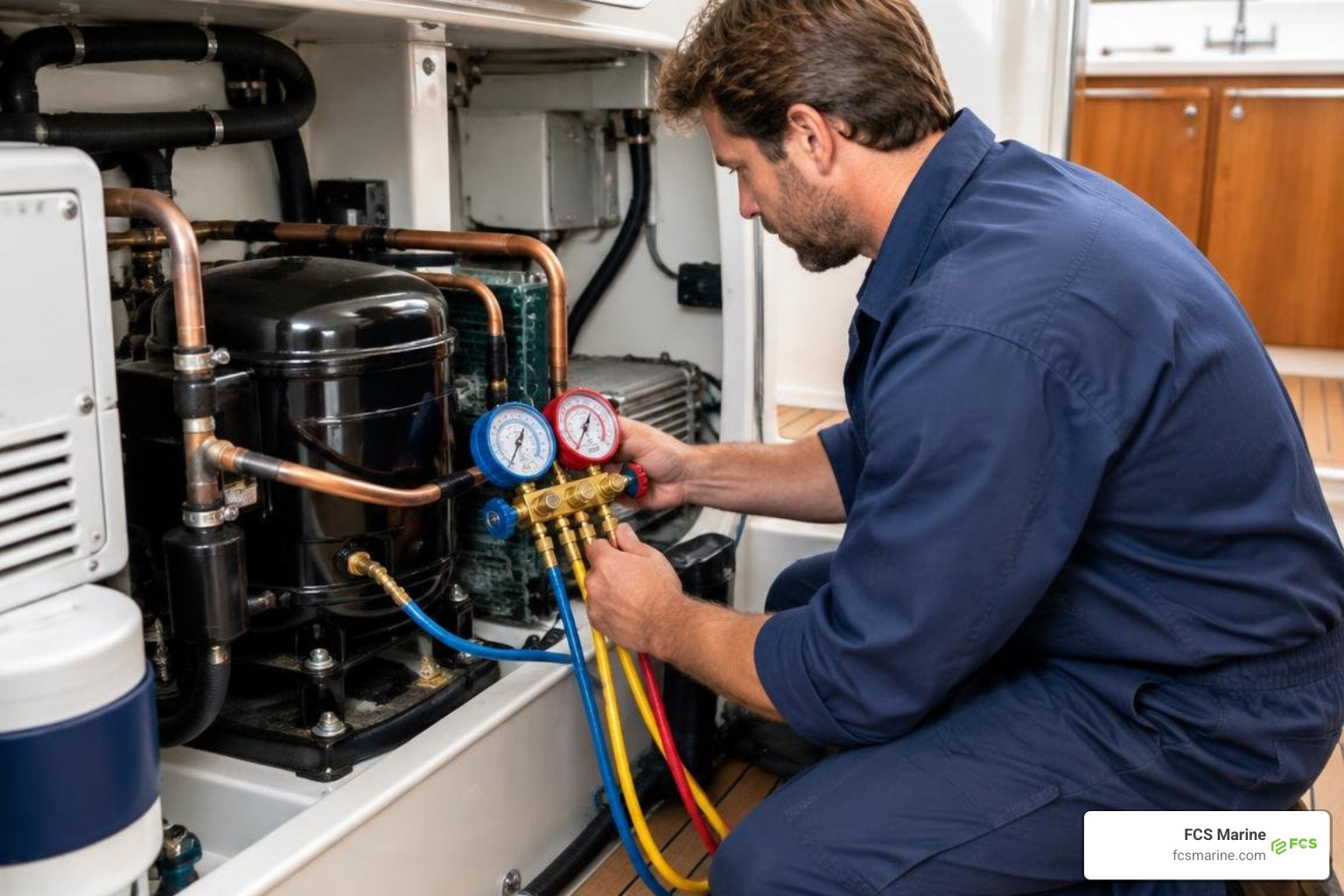
A qualified technician installs digital pressure gauges on the high and low service ports to measure operating suction pressures and superheat. If the system has lost pressure due to a serviceable flare fitting or line leak, locating the leak, repairing it, pulling a deep vacuum, and recharging by exact weight will restore operation. If the compressor motor exhibits internal electrical shorts, grounded windings, or mechanical valve damage that prevents it from building pressure, a complete compressor replacement is required.
Why does my 12-volt marine refrigeration system drain my battery bank so quickly?
Your 12-volt refrigeration unit is typically the single largest consumer of direct current on board. If the compressor runs constantly due to poor cabinet insulation, clogged condenser fins, failing door seals, or low refrigerant levels, its duty cycle can climb toward 100%. This continuous draw rapidly depletes battery banks, forces extra generator run time, and reduces available power for navigation and safety electronics.
What environmental regulations apply to boat refrigerator repairs and refrigerant handling?
The EPA strictly prohibits the intentional venting of fluorocarbon refrigerants during maintenance, servicing, or disposal. All refrigerant recovery, system evacuation, and recharging must be performed by EPA-certified technicians using specialized recovery units. Modern installations and retrofits must also adhere to current guidelines regarding low-GWP (Global Warming Potential) alternative refrigerants.
Contact FCS Marine for Professional Marine Service
Do not let galley cooling problems spoil your provisions or drain your onboard batteries. FCS Marine delivers mobile, on-site marine service directly to your yacht at marinas, boat yards, and private docks throughout South Florida, including Fort Lauderdale, Pompano Beach, Miami, and the Palm Beaches.
Whether you need diagnostic troubleshooting, compressor replacements, or complete system overhauls, our technicians bring specialized tooling directly to your vessel. In addition to our dedicated marine refrigeration services, our team provides expert marine air conditioning maintenance, yacht insulation, marine mold remediation and sanitization, water purification systems, and marine equipment rentals.
Contact FCS Marine today to schedule mobile on-site service for your vessel’s refrigeration and climate systems.