
Why a TXV Valve Matters in Your Marine AC System
A TXV valve AC system uses a thermostatic expansion valve to meter liquid refrigerant into the evaporator coil. Its job is simple but critical: feed enough refrigerant for cooling while keeping liquid refrigerant from returning to the compressor.
To understand whether the TXV is doing its job, watch for three clues:
- Warm cabin air can mean the valve is restricting refrigerant flow.
- A frozen evaporator coil can happen when the coil is underfed or airflow is poor.
- Unsteady cooling may point to a TXV that is sticking, hunting, or responding incorrectly to changing load.
The valve uses a sensing bulb on the suction line to monitor refrigerant temperature leaving the evaporator. It then opens or closes to maintain proper superheat – the small temperature margin that confirms refrigerant has fully boiled into vapor before it reaches the compressor.
On a South Florida vessel, reliable AC is about more than comfort. Poor cooling and excess humidity can contribute to damp cabins and mold-friendly conditions. FCS Marine helps yacht owners understand and service the systems that keep onboard air conditioning stable.
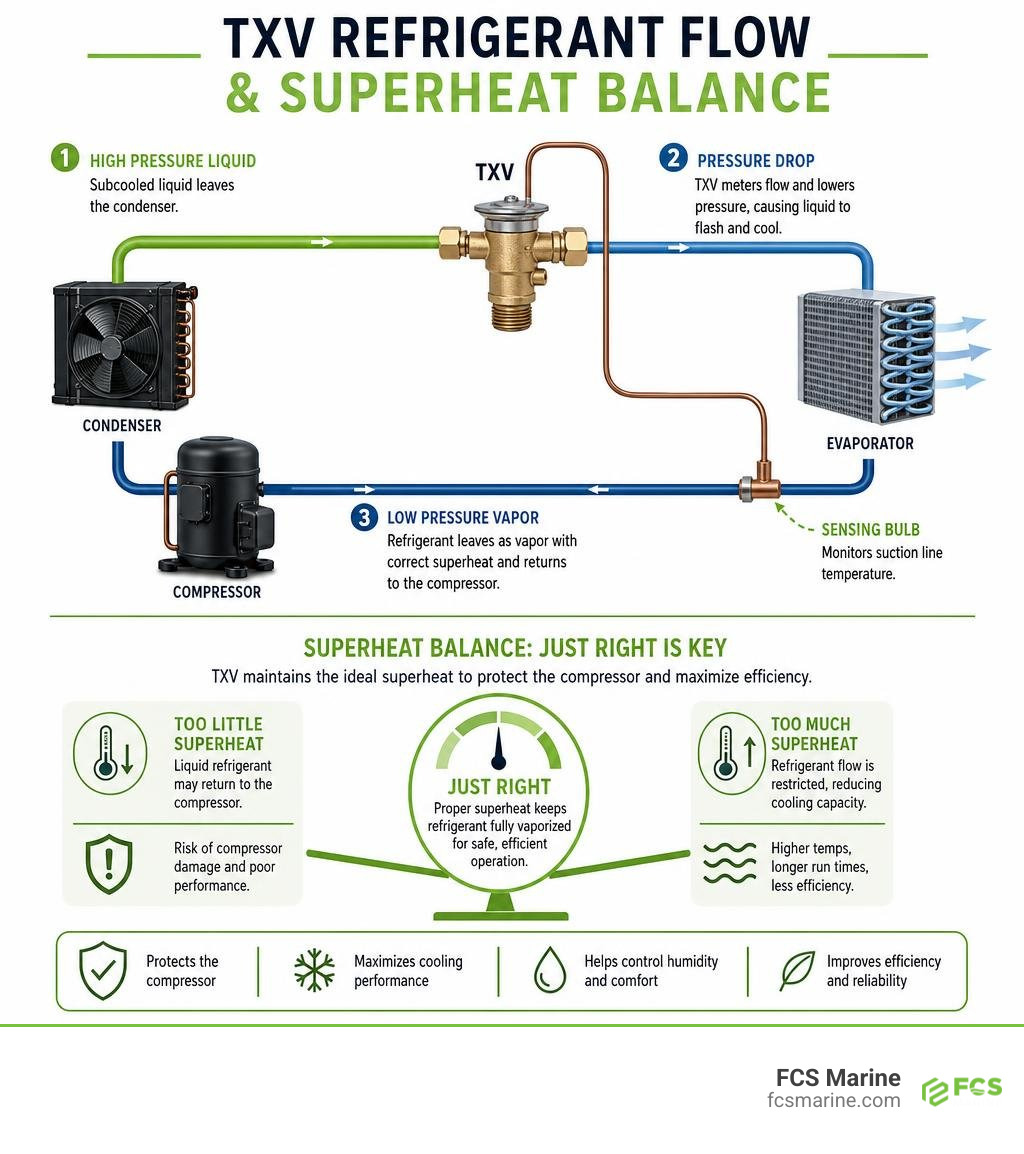
How the TXV Valve AC Unit System Controls Refrigerant Flow
In any direct-expansion marine refrigeration circuit, cooling requires a continuous phase change. High-pressure, subcooled liquid refrigerant leaves the seawater condenser and travels along the liquid line toward the evaporator coil located inside your vessel’s air handler. Before that liquid can absorb heat from the cabin air, it must undergo a dramatic drop in pressure. This is where the Thermal expansion valve performs its essential duty.
The valve acts as a dynamic precision restriction. As high-pressure liquid passes through the narrow internal orifice of the valve body, it experiences an isenthalpic expansion. This sudden pressure drop causes a portion of the liquid to instantly flash into vapor (known as flash gas), chilling the remaining liquid-vapor mixture down to its low saturation temperature.
The expansion valve does not set cabin air temperature or command the compressor to turn on or off. Instead, it modulates the mass flow rate of refrigerant to match the exact thermal load placed on the evaporator coil. When warm, humid Florida air passes across the cooling fins, refrigerant boils off rapidly. The TXV responds by opening wider to inject more liquid. As cabin temperatures fall and the heat load decreases, the valve throttles down to prevent flooding the evaporator.
Maintaining this dynamic equilibrium protects the marine compressor, which is designed exclusively to pump vapor. If unevaporated liquid exits the evaporator, it enters the suction line and damages compressor valves and bearings—a catastrophic event known as liquid slugging.
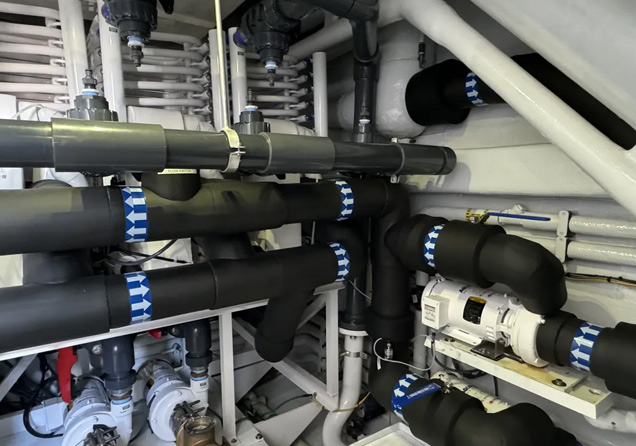
Core Components of a TXV Valve AC Assembly
A mechanical thermostatic expansion valve relies on four interconnected components working in harmony:
- The Valve Body and Orifice Port: Constructed from durable brass to withstand high operating pressures (often rated up to 667 PSI in modern R-410A systems), the body houses the internal seat, pin, and precision metering orifice.
- The Power Head and Diaphragm: Located at the top of the valve, this chamber contains a flexible stainless steel diaphragm welded securely to withstand continuous pressure variations.
- The Sensing Bulb and Capillary Tube: Charged with a dedicated thermostatic fluid, the bulb clamps firmly to the suction line near the evaporator outlet. A slender capillary tube transmits pressure changes from the bulb directly to the upper side of the diaphragm.
- The Superheat Spring: Positioned beneath the valve pin, this spring provides an adjustable closing force that establishes the baseline superheat setting (often set at a factory default of 4K, with manual adjustment ranges spanning 0K to 8K).
Marine systems also vary by how they meter refrigerant compared to alternative technologies:
| Metering Device Type | Control Mechanism | Modulation Ability | Efficiency & Precision | Marine Application Suitability |
|---|---|---|---|---|
| Thermostatic Expansion Valve (TXV) | Mechanical sensing bulb, diaphragm, and spring balance | Dynamic modulation based on real-time superheat | High efficiency; easily meets modern 14+ SEER2 requirements | Standard for direct expansion marine air handlers and chillers |
| Fixed Orifice / Piston | Static drilled hole / calibrated restriction | None (flow changes strictly with system pressure) | Lower seasonal efficiency; risks overfeeding or underfeeding under varying loads | Rarely used in modern marine setups due to wide thermal load swings |
| Electronic Expansion Valve (EEV / EXV) | Microprocessor controller and 1,596-step stepper motor | Digital micro-stepping (up to 200 steps/sec) | Highest precision (0.0000783 inch/step resolution) | High-end inverter marine chillers and variable-speed systems |
Operating Forces and Pressure Balance Dynamics
A mechanical TXV functions through an ongoing battle of physical pressures acting across the flexible internal diaphragm. The position of the metering pin is governed by a precise pressure balance equation:
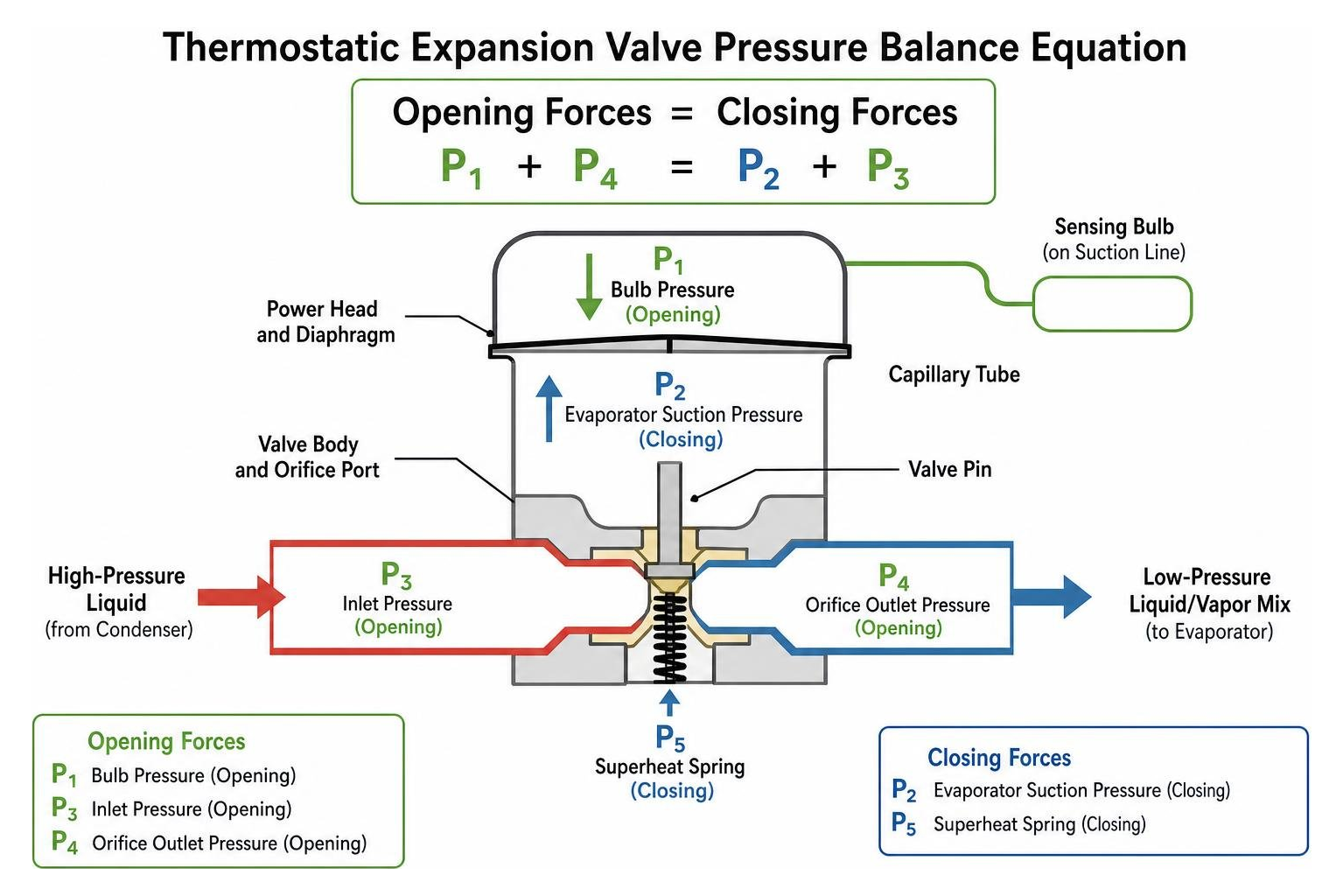
$$text{Opening Forces} = text{Closing Forces}$$ $$P1 + P4 = P2 + P3$$
- $P_1$ (Bulb Pressure): The opening force generated as refrigerant vapor inside the sensing bulb heats up and expands against the top surface of the diaphragm.
- $P_2$ (Evaporator Suction Pressure): The closing force applied to the bottom of the diaphragm by refrigerant pressure inside the evaporator coil.
- $P_3$ (Superheat Spring Pressure): A constant closing force exerted upward by the internal mechanical spring, establishing the target superheat.
- $P_4$ (Liquid Refrigerant Pressure): A minor opening force exerted by high-pressure liquid pushing against the bottom of the valve pin.
When heat load on the evaporator increases, the refrigerant finishes boiling earlier in the coil, and the suction vapor warms up. This extra heat transfers into the sensing bulb, increasing $P1$. As $P1$ overcomes $P2 + P3$, the diaphragm flexes downward, pushing the pin off its seat and allowing more refrigerant into the coil.
Conversely, when the cabin cools, the vapor leaving the evaporator remains colder, dropping $P1$. The closing spring ($P3$) and evaporator pressure ($P_2$) push the diaphragm back up, closing the valve orifice to prevent liquid floodback. Many marine valves incorporate Maximum Operating Pressure (MOP) bulb charges that completely vaporize above a specific threshold, preventing excessive suction pressure from overloading the compressor motor during warm startups.
Diagnosing Operational Failures and Performance Issues
Because marine air conditioners operate in confined engine rooms, lazarettes, and interior cabinetry, diagnostic clarity is essential. When a metering device begins to fail, the entire refrigeration balance collapses, manifesting in severe cooling losses or unexpected system shutdowns.
A malfunctioning expansion valve fails in one of two states: stuck closed (underfeeding) or stuck open (overfeeding).
When a TXV is stuck closed or severely restricted, it starves the evaporator of refrigerant. Because insufficient liquid enters the coil, evaporating pressure drops sharply below the freezing point of water ($32^circtext{F}$ / $0^circtext{C}$). Moisture drawn from cabin air freezes instantly upon contact with the starved tubing, encasing the coil in a block of ice. This condition exhibits unusually high superheat at the evaporator outlet paired with high subcooling in the liquid line.
When a TXV is stuck open, it injects excessive liquid refrigerant into the coil. The evaporator cannot boil the excess volume, causing superheat to drop near zero. Unboiled liquid refrigerant spills out of the evaporator into the suction line, threatening the compressor with liquid slugging.
Another common mechanical symptom is valve “hunting.” If the TXV is improperly sized, uninsulated, or calibrated with incorrect spring tension, it continuously over-corrects—cycling rapidly between flooding and starving the coil. If you listen closely to the air handler during a low-charge or restricted condition, you may hear a distinctive, loud whooshing sound at the valve, indicating that the orifice is metering a turbulent mixture of vapor and liquid rather than a solid liquid column.
Warning Signs of a Failing TXV Valve AC Unit
Vessel owners should keep a watchful eye for several early warning indicators:
- Weak or Warm Airflow: The blower fan runs continuously, but the air discharging from the supply grilles feels lukewarm or humid.
- Frost and Ice Buildup: Solid bands of ice form across the evaporator coil fins or extend along the insulated suction line toward the condensing unit.
- Erratic Temperature Swings: The vessel interior reaches comfortable temperatures during mild mornings but fails completely during hot afternoons as the valve fails to open under load.
- Short-Cycling Compressors: The system trips frequently on low-pressure or high-pressure safety switches.
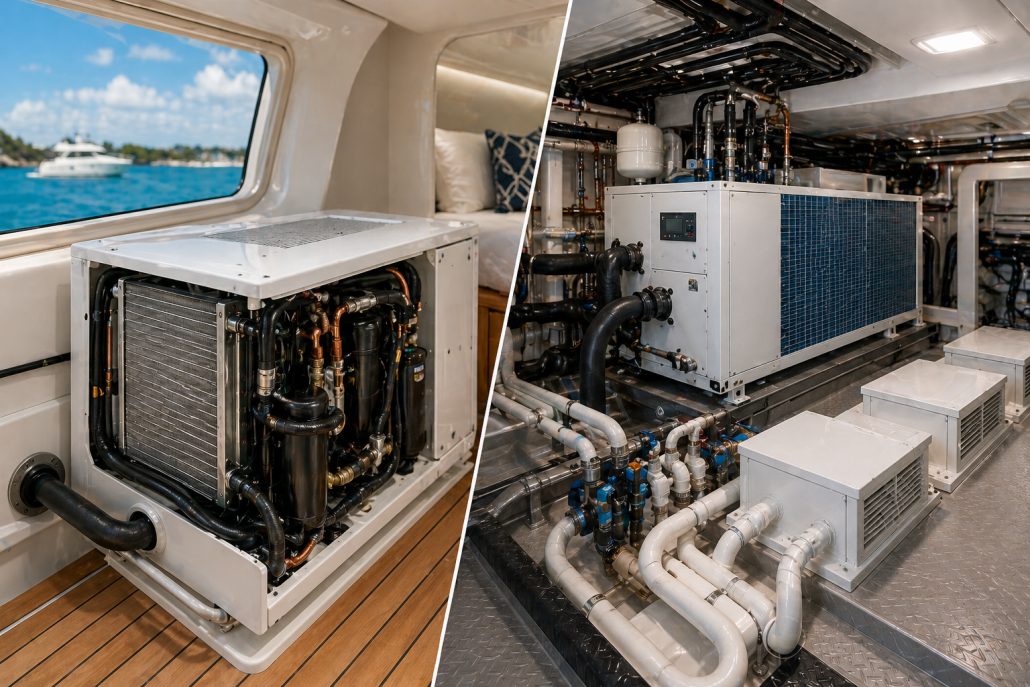
When troubleshooting these issues aboard your vessel, exploring guides like Don’t Sweat It: Fixing Your Boat’s AC TXV Valve can help differentiate between simple airflow restrictions and deeper mechanical expansion valve failures.
Common Causes Behind Metering Device Malfunctions
Why do these rugged brass components fail? In marine environments, several common culprits stand out:
- Particulate and Debris Clogs: Tiny copper shavings, carbon deposits from field brazing, or degraded desiccant beads from a saturated filter-drier can lodge inside the microscopic metering orifice.
- Moisture Contamination and Internal Freezing: If moisture enters the refrigeration circuit during poor servicing or piping repairs, it mixes with refrigerant and oil. As this moisture passes through the freezing pressure drop of the TXV orifice, it turns to ice, instantly choking off refrigerant flow.
- Loss of Sensing Bulb Charge: The thin capillary tube connecting the bulb to the power head is vulnerable to vessel vibration. If the tube rubs against surrounding metal and chafes through, the internal charge escapes. Without $P_1$ pressure, the superheat spring snaps the valve shut permanently.
- Acid Buildup and Sludge: High operating temperatures caused by fouled seawater strainers or poor condenser flow break down compressor lubricating oil, creating acidic sludge that coats internal valve pins and causes them to stick.
Professional Maintenance and Servicing for Marine Air Conditioning Systems
Marine climate control systems operate under conditions residential units never face. Raw seawater is pumped directly through coaxial or titanium condensers to reject heat into surrounding ocean waters. If raw-water flow decreases due to marine growth, head pressures climb dramatically, altering the pressure differential across the expansion valve.
Because servicing refrigerant systems requires specialized manifold gauges, digital micron gauges, vacuum pumps, and EPA-certified handling, troubleshooting should be handled by experienced technicians. Knowing How to Find a Certified Marine AC Technician ensures your vessel receives technicians trained in marine refrigeration circuits, high-pressure brazing safety, and dockside diagnostics.
When our technicians inspect an expansion valve aboard a yacht, we execute a rigorous diagnostic procedure:
- Airflow and Filter Verification: Ensuring blowers, ducting, and return filters are completely clear of dust and obstruction.
- Temperature and Pressure Logging: Attaching calibrated digital pressure transducers and temperature clamps to measure liquid-line subcooling and suction-line superheat simultaneously.
- Bulb Inspection and Thermal Contact: Verifying that the sensing bulb is mounted tightly at the correct orientation (typically 10 to 2 o’clock on horizontal suction lines) and fully insulated against ambient cabin air.
- Thermal Response Testing: Applying controlled warmth or ice water to the sensing bulb while monitoring gauge pressures to verify that the valve modulates smoothly rather than binding internally.
Preventive Care to Protect Marine Compressors
Routine preventive care prevents premature expansion valve failure and protects expensive marine compressors from liquid slugging or thermal burnout:
- Regular Air Filter Cleaning: Keeping return air filters clean maintains designed airflow across the evaporator, ensuring refrigerant boils off predictably.
- Thermal Insulation Inspections: Ensuring all chilled refrigerant lines and TXV bulb bodies are sealed with high-density closed-cell insulation. Uninsulated lines allow cabin heat to distort bulb readings and cause excessive condensation inside vessel cabinetry. For comprehensive details on protecting vessel interior climate efficiency, consult The Ultimate Guide to Yacht Insulation.
- Liquid-Line Filter-Drier Replacements: Installing a fresh liquid-line filter-drier whenever the refrigeration loop is opened captures residual moisture and particulates before they reach the TXV orifice.
- Cooling System Flushes: Keeping raw-water heat exchangers clean ensures stable condensing pressures. Proactive measures, such as following Don’t Let Your Engine Sweat: Yacht Cooling Maintenance Tips, help boaters maintain smooth thermal heat rejection across all onboard raw-water loops.
Frequently Asked Questions About TXV AC Operations
Can a Bad TXV Valve Cause an AC Evaporator Coil to Freeze?
Yes. When a TXV sticks closed, loses its thermal bulb charge, or becomes clogged with debris, it severely restricts refrigerant flow into the evaporator. The drastic drop in internal coil pressure causes the remaining refrigerant to boil at temperatures well below $32^circtext{F}$ ($0^circtext{C}$). Moisture pulled from the humid cabin air freezes onto the coil fins on contact, quickly creating a solid block of ice that blocks all airflow.
What Is the Lifespan of a Thermostatic Expansion Valve?
A high-quality thermostatic expansion valve can operate reliably for 10 to 15 years or more—often lasting the entire operational lifespan of the marine air conditioning unit. However, premature failure can occur if the refrigeration circuit is contaminated with moisture or acid, if the sensing bulb’s capillary tube fractures from vessel vibration, or if excessive debris bypasses a degraded liquid-line filter-drier.
What Is the Difference Between Internally and Externally Equalized TXVs?
An internally equalized TXV senses evaporator pressure ($P_2$) directly at the valve outlet inside the valve body. This design is only suitable for small, single-circuit evaporators with minimal internal pressure drop. An externally equalized TXV uses a separate 1/4-inch copper tube connected to the suction line near the evaporator outlet. This allows the valve to reference true outlet pressure, compensating for pressure drops across multi-circuit distributors and large evaporator coils to prevent improper starvation.
Conclusion and Next Steps for South Florida Vessels
A properly functioning thermostatic expansion valve is central to maintaining comfortable, dry living quarters aboard your yacht. By precisely balancing refrigerant flow against shifting cabin heat loads, the TXV maximizes cooling efficiency, maintains compliance with modern SEER2 performance standards, and shields your compressor from devastating liquid floodback.
When cooling issues, frozen evaporator coils, or erratic cabin temperatures strike your vessel, FCS Marine is ready to assist. We are a family-owned South Florida company specializing in yacht maintenance services, delivering mobile marine service in South Florida. Our technicians travel directly to your vessel across Palm Beach County, Broward County, Miami-Dade County, Martin County, and St. Lucie County, including Fort Lauderdale and Pompano Beach, FL.
Whether your air conditioning system requires valve diagnostics, filter-drier replacements, or comprehensive marine air conditioning repair services, we come to where your vessel is located to ensure your onboard climate control runs smoothly and reliably year-round.