Why a Clogged Filter Is Quietly Killing Your Marine AC
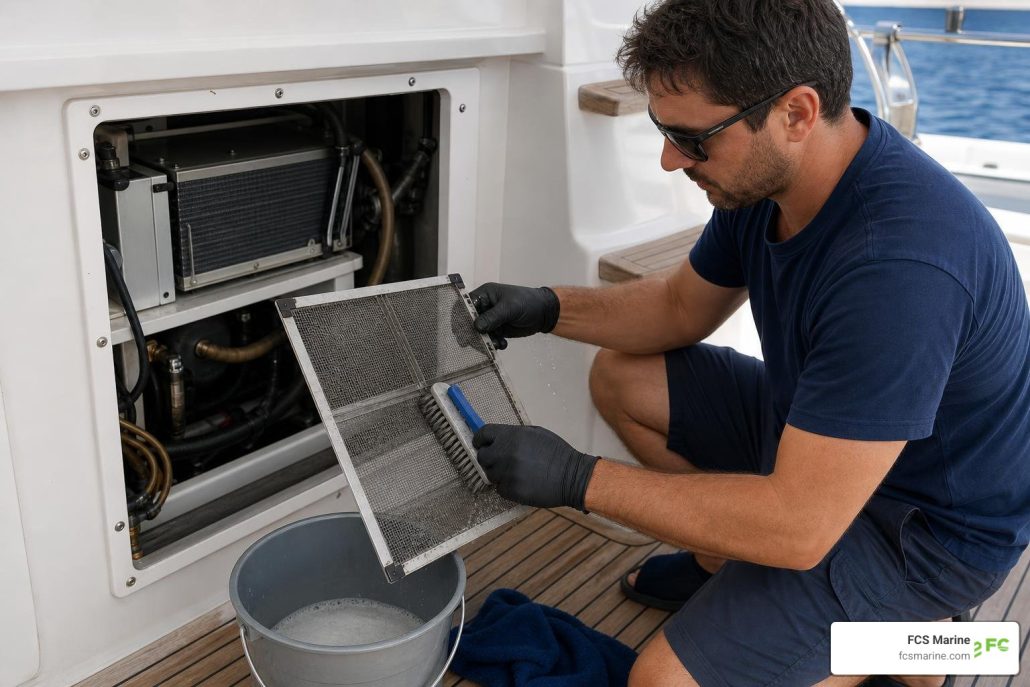
Marine AC filter cleaning is one of the simplest maintenance tasks on your vessel — and one of the most overlooked.
Here’s the quick answer:
- Power down the AC unit at the breaker.
- Remove the return air filter from the front of the evaporator unit.
- Wash the filter with warm water and a small amount of dishwasher soap.
- Rinse thoroughly with clean fresh water.
- Allow the filter to dry completely before reinstalling.
- Wipe down the exterior of the unit with a dry cloth.
- Reinstall the filter and restore power.
Check the filter at least once a month. In South Florida’s heat and humidity, that interval matters more than most boat owners realize.
Now, the bigger picture.
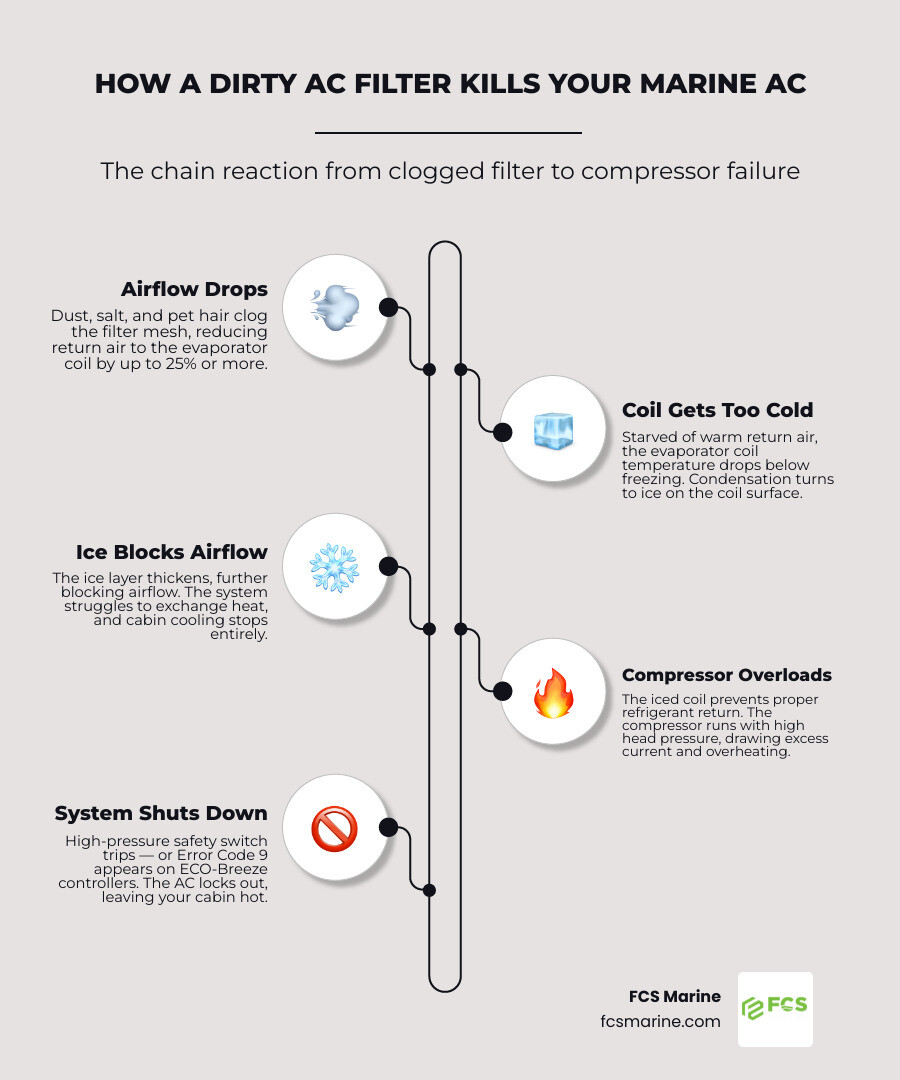
A dirty filter doesn’t just reduce airflow. It forces your evaporator coil to work harder, starves the system of the return air it needs, and can cause the coil to ice over entirely. On some units — like those running the ECO-Breeze controller — a blocked filter will trigger Error Code 9 and automatically shut the compressor down. In South Florida’s summer heat, that’s not an inconvenience. That’s a serious problem.
The salt air, humidity, and near-constant AC runtime that define South Florida boating create the perfect conditions for filters to clog fast. Dust, pet hair, mold spores, and airborne salt particles accumulate quickly on the filter mesh. Once that airflow gets restricted, everything downstream suffers — from coil efficiency to compressor load to cabin comfort.
At FCS Marine, we provide professional mobile marine AC service across South Florida — coming directly to your vessel’s location so you don’t have to move the boat to get the help it needs.
Why Regular Marine AC Filter Cleaning is Essential for Your Vessel
When we ignore the air filter, we set off a chain reaction that directly impacts our comfort and our wallet. The primary job of the return air filter is to capture airborne dust, pet dander, and salt spray before they can settle onto the wet, cold surfaces of the evaporator coil.
If the filter becomes choked with debris, the rate of airflow across the evaporator coil drops dramatically. This airflow restriction causes the temperature of the coil to plummet. Because South Florida’s air is incredibly humid, moisture rapidly condenses on the super-cooled metal fins. Without sufficient warm cabin air blowing across the coil to transfer heat, that condensation quickly turns to ice. Before you know it, you are dealing with a frozen evaporator coil and a cabin that feels more like a sauna.
Furthermore, a restricted return air path forces the compressor to run under a much higher load, consuming more electricity and shortening its operational lifespan. In heating mode, a clogged filter is equally dangerous; the lack of airflow means the unit cannot properly relieve heat, which often triggers the high-pressure safety switch and shuts down the entire system to prevent a meltdown.
We also have to consider the physical layout of our ducting. Airflow is already fighting an uphill battle on a boat. For example, standard marine HVAC engineering reveals that just two 90-degree bends in a ducting run can reduce airflow by up to 25%. When you couple restrictive ducting with a dirty filter, your system is practically gasping for breath.
Regularly performing marine AC filter cleaning is also your first line of defense against onboard mold. Evaporator coils are dark, damp environments. If dust passes by a missing or damaged filter and lands on those wet copper fins, it provides the perfect organic food source for mold spores to colonize. To keep your cabin air clean and safe, keeping that filter spotless is non-negotiable. If you suspect your system is already suffering from restricted airflow or blockages, you can learn more about how a Yacht AC System Needs Cleaning to restore its original performance.
For those running specific systems like Mermaid Marine units, understanding the nuances of your particular setup is key. You can find detailed manufacturer guidelines on How to Clean or Replace the Air Filters: Mermaid Marine AC | ManualsLib to ensure you are meeting OEM recommendations.
Locating and Inspecting Your Boat’s Air Filter
Finding your air filter can sometimes feel like a game of hide-and-seek, depending on how your boat builder packaged the HVAC system.
On most vessels, the air filter is located directly on the face of the indoor evaporator coil (which looks like a small car radiator). To access it, you will typically need to open or remove the return air grille in your cabin.
- Self-contained systems: The filter is usually a thin slide-in mesh screen mounted directly on the face of the unit, which is often tucked away under a stateroom berth, inside a hanging locker, or beneath a salon settee.
- Split systems: The evaporator unit is located in the cabin while the compressor is in the engine room. The air filter will still be found on the cabin evaporator face, behind the return air grille.
We recommend establishing a strict monthly check interval as a baseline. However, if you live aboard, cruise with pets, or operate your AC continuously during the hot South Florida summer, you should inspect it every two weeks.
Keep an eye out for these clear warning signs that your filter needs immediate attention:
- Reduced airflow coming out of your supply vents.
- Visible icing or frost forming on the evaporator coil or the copper lines.
- Musty, damp odors circulating through the cabin when the blower kicks on.
- Error Code 9 showing on your digital thermostat display (specifically on systems utilizing the ECO-Breeze Series controller, indicating a blocked filter protection shutdown).
To build a complete picture of your system’s overall health and keep your vessel in top shape, check out our comprehensive Marine AC Maintenance Checklist.
How to Clean and Replace Your Marine AC Filter
Not all marine AC filters are created equal. Some systems use simple, reusable plastic mesh screens, while others rely on sturdier aluminum pre-filters or specialized high-efficiency media.
| Filter Type | Material | Reusable? | Maintenance Method | Best For |
|---|---|---|---|---|
| Standard Mesh | Thin plastic/nylon | Yes | Wash with warm water & mild soap | Standard self-contained cabin units |
| Aluminum Pre-Filter | Multi-layer aluminum | Yes | Spray with coil cleaner or wash with soap | Heavy-duty units (e.g., Crusair SX16C-S4) |
| Foam Filter | Open-cell foam | Yes (until brittle) | Gentle hand-wash in warm water | Older marine AC units |
| Vent Media Kit | Specialized fiber | Usually disposable | Replace periodically | High-efficiency filtration & salt capture |
When replacing a filter, it is critical to match the exact OEM specifications. For instance, aftermarket aluminum filters designed for popular units like the Crusair SX16C-S4 must match the precise dimensions of 11” x 12-1/2” x 3/32” to slide smoothly into the mounting brackets without leaving gaps where bypass air can sneak through. We always recommend keeping a spare filter or filter kit on board, especially if you plan on taking extended cruises down through the Keys or over to the Bahamas where finding exact replacements can be incredibly difficult.
Step-by-Step Guide to Reusable Marine AC Filter Cleaning
If your vessel is equipped with a reusable mesh or aluminum filter, follow this straightforward cleaning protocol to keep your air clean and your system running efficiently:
- De-energize the System: Turn the thermostat to the “OFF” position and switch off the dedicated air conditioning circuit breaker at your ship’s AC panel. Never service the unit while the blower fan is capable of spinning up.
- Remove the Filter: Carefully slide the filter out from the front of the evaporator coil. Take your time so you don’t shake loose clumps of dust onto your cabin sole or carpet.
- Wash the Filter: Take the filter to a sink or cockpit washdown station. Wash the mesh thoroughly using warm water and a mild, grease-cutting dishwasher soap. Avoid harsh chemical solvents or bleach, which can degrade the filter material.
- Rinse and Dry: Rinse the filter completely with clean fresh water. Gently shake off the excess water and let it air-dry completely. Crucial Tip: Installing a damp filter back into your dark AC unit is an open invitation for mold and mildew to grow.
- Clean the Surrounding Area: While the filter is drying, take a dry microfiber cloth and wipe down the exterior of the AC unit housing and the return air grille to remove any accumulated dust.
- Reinstall and Restore Power: Once the filter is 100% dry, slide it back into its mounting brackets on the evaporator face. Restore power at the breaker panel and turn your thermostat back on.
For more detailed technical guidelines on maintaining self-contained and split systems, you can reference the Maintenance of Self-Contained and Split System Reverse Cycle Air Conditioners – Flow Marine Systems documentation.
Replacing Damaged or Disintegrated Filters
Over time, the harsh marine environment—characterized by high humidity, salt air, and extreme temperature cycles—takes a toll on filter media. This is especially true for older open-cell foam filters, which eventually become brittle, crumble, and disintegrate in your hands.
If you notice your foam filter is tearing, sagging, or falling apart, do not attempt to wash or reinstall it. Operating your AC with a disintegrating filter allows foam particles to be sucked directly into the evaporator fins, creating a major fire and clog hazard.
Instead, replace the damaged filter immediately. You can opt for high-quality aluminum pre/post filters or invest in a specialized marine-grade kit. For example, the Marine AC Vent Filter Kit (311004) | Marisol Marine Company provides excellent grille-level filtration that captures salt particles and dust before they can even reach your ductwork or evaporator coil.
Air-Side vs. Water-Side Maintenance: Filters vs. Descaling
To keep your boat’s climate control system running at peak efficiency, we must understand that a marine AC system operates on two distinct loops: the air-side (which cools your cabin) and the water-side (which cools the refrigerant).
Many boat owners confuse these two maintenance areas, but they require entirely different protocols:
- Air-Side Maintenance: This involves cleaning the return air filter monthly to ensure unrestricted airflow over the evaporator coils.
- Water-Side Maintenance: This focuses on the seawater cooling loop. Seawater is pumped through your condenser heat exchanger to pull heat away from the refrigerant. This loop includes checking your physical raw water strainer daily for weeds, jellyfish, and debris, and inspecting your rubber impeller water pump every 400 hours.
Because warm, nutrient-rich seawater flows through your copper-nickel (cupronickel) condenser lines, marine organisms like barnacles, algae, and calcium scale love to grow inside them. Over time, a 5/8-inch seawater pipe can be restricted to the diameter of a drinking straw. This restriction starves the condenser of cooling water, causing the compressor to overheat and trip out on a High Pressure Fault (HPF).
To clear this water-side buildup, we perform a chemical descaling flush. We use a specialized, biodegradable phosphoric acid-based solution like Barnacle Buster, diluted at a 4:1 (or 3:1) ratio, and circulate it through the seawater lines using a closed-loop bucket pump kit for 1 to 2 hours. In the warm waters of South Florida, we highly recommend performing a descaling flush every 2 years to prevent system shutdowns.
If your air conditioning system is cycling on and off or shutting down with high-pressure errors, it is vital to diagnose whether the issue is air-side or water-side. You can read our troubleshooting guide on what to do when your Boat Air Conditioning Stops Cooling. For a deep dive into water-side flushing, you can read about Using Barnacle Buster for your boat air conditioner | Barnacle Buster Air Conditioner to learn how to safely clear out calcium and marine growth.
Why Professional Marine Service Matters
While basic air filter washing is an easy DIY task, there are times when your marine AC system requires professional intervention.
If a system has been run without a filter or with a torn filter, dust and hair will bypass the screen and lodge deep within the delicate, razor-thin aluminum cooling fins of the evaporator. Once this debris is baked onto the wet coils, simple vacuuming or washing won’t clear it. It requires a professional non-acidic chemical spray foam cleaning or, in severe cases, pulling the unit for a professional acid bath to restore heat transfer.
Attempting to clean these delicate cooling fins yourself can be risky. The fins are incredibly fragile; using a stiff brush or too much water pressure will easily bend them flat, permanently blocking airflow and ruining the coil.
At FCS Marine, our certified technicians carry specialized tools, including fin combs, low-pressure foaming applicators, and safe, marine-grade biodegradable descaling equipment. We provide expert mobile marine service in South Florida, coming directly to your slip, private dock, or boatyard in Palm Beach County, Broward County, Miami-Dade County, Martin County, and St. Lucie County.
If you are looking for qualified assistance, we can guide you on How to Find a Certified Marine AC Technician to ensure your vessel’s climate control is in expert hands.
When to Call a Professional for Marine AC Filter Cleaning and System Descaling
We recommend contacting us for professional service if you experience any of the following persistent issues:
- Persistent Icing: Your evaporator coil continues to freeze over even after you have cleaned or replaced the air filter.
- Weak Airflow: Air velocity from your supply vents remains low, indicating a blockage deep inside the evaporator coil, a crushed duct, or a failing blower motor.
- High-Pressure Errors: Your thermostat repeatedly displays “HPF” or high-pressure safety codes, which means your seawater cooling lines are heavily choked with marine growth and require a professional acid flush.
- Musty Odors or Mold: You notice mold or mildew growing inside the blower assembly, ductwork, or behind the return air grille, which requires professional yacht sanitization and mold remediation.
Frequently Asked Questions about Marine AC Filters
What happens if I run my marine AC without a filter?
Operating your marine AC without a filter allows airborne dust, hair, salt, and debris to lodge deep inside the wet evaporator cooling fins. This rapidly reduces the system’s cooling efficiency, causes the evaporator coil to freeze over, and can trigger high-pressure safety switch shutdowns. Over time, this debris buildup will require a costly, professional acid bath cleaning to restore performance.
How often should I clean my boat’s AC air filter?
As a general rule, you should check your air filter monthly and clean it if necessary. However, if you live aboard your vessel, have pets on board (which shed hair and dander), or are operating your system continuously during the hot, humid South Florida summer, you should inspect and clean the filter every two weeks.
Can I use a brush to clean the delicate cooling fins behind the filter?
No, you should never use a brush, wire brush, or high-pressure washer to clean the delicate aluminum cooling fins behind the filter. These fins bend very easily; brushing them can flatten the metal, permanently restricting airflow and ruining the coil. Instead, use a specialized, non-acidic spray foam coil cleaner and rinse it gently with a low-pressure, open-end hose, or contact a professional technician.
Conclusion
Keeping your boat’s air conditioning filter clean is one of the easiest ways to ensure reliable cooling, prevent ice-clogged coils, and maintain excellent cabin air quality. By spending just a few minutes performing marine AC filter cleaning every month, you protect your system’s compressor, lower your energy consumption, and keep South Florida’s intense humidity at bay.
When your boat or yacht needs reliable, professional marine service, FCS Marine is ready to help. As a family-owned South Florida business, we specialize in mobile marine service across Palm Beach, Broward, Miami-Dade, Martin, and St. Lucie counties—including Fort Lauderdale and Pompano Beach. We bring our expertise directly to your vessel’s location, offering comprehensive marine AC repair, water-side descaling, yacht insulation, and mold remediation with a satisfaction guarantee.
If your vessel is showing signs of poor cooling, rising humidity, or high-pressure faults, contact us today to schedule our premium Marine Air Conditioning Services and keep your boat blowing ice-cold all year long.