Fast Help for Marine Air Conditioner Repair Near Me
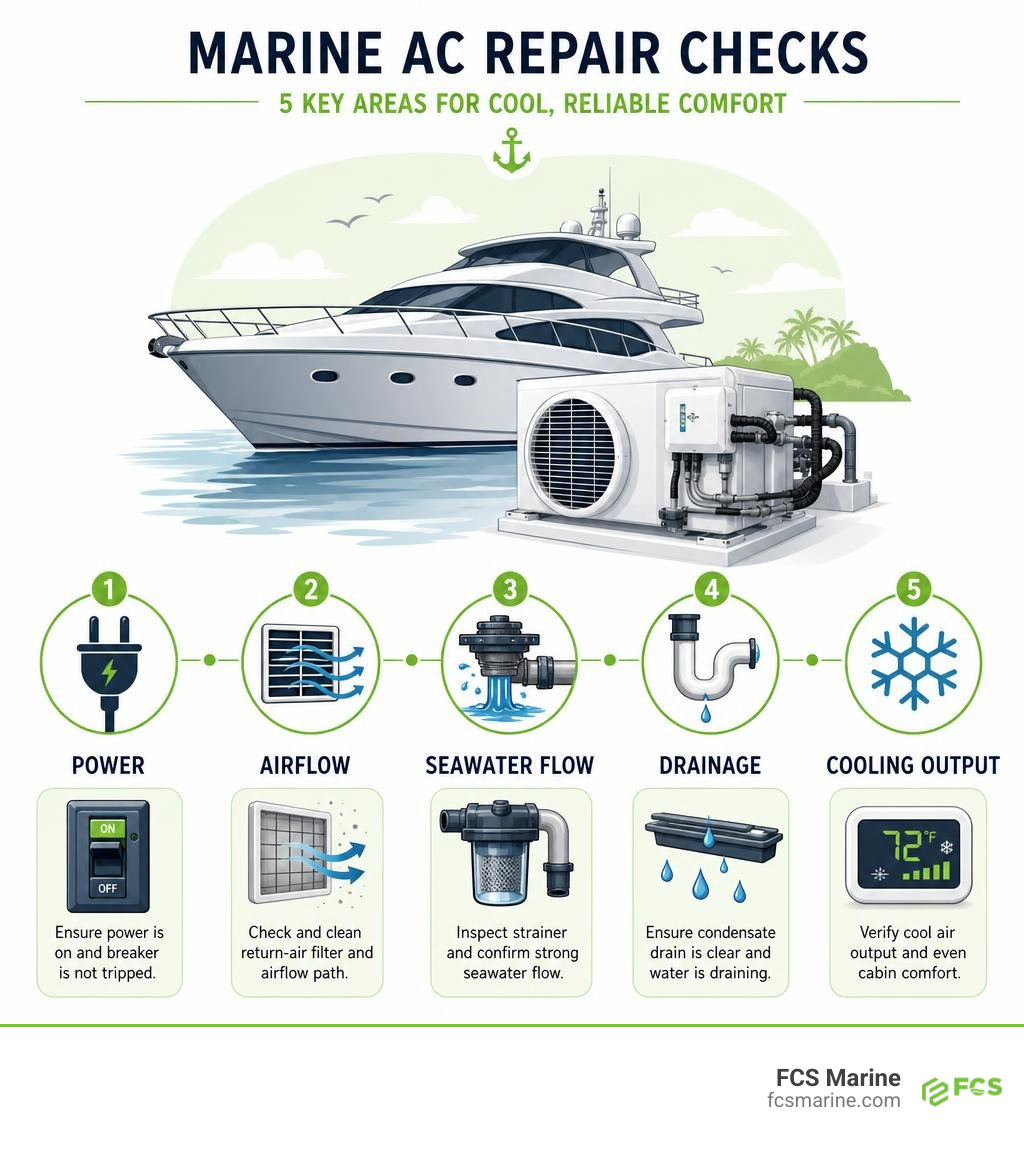
If you need marine air conditioner repair near me in South Florida, start by checking for a tripped breaker, a dirty return-air filter, and restricted seawater flow at the strainer or discharge. Then contact a marine HVAC technician who can inspect the vessel where it is located. Many problems, including weak cooling, water leaks, poor airflow, high cabin humidity, and control faults, can be diagnosed on-site.
South Florida heat, humidity, saltwater exposure, and marine growth put steady strain on yacht AC systems. A small issue – such as a clogged strainer, dirty coil, blocked condensate drain, or failing pump – can quickly turn into poor cooling and excess moisture that supports mold growth.
FCS Marine provides mobile marine service in South Florida to help yacht owners diagnose AC problems, restore cabin comfort, and plan the right repair before a system failure disrupts a trip.
Common Warning Signs Your Vessel HVAC System Needs Service
Marine air conditioners operate under harsh environmental conditions, and they rarely fail without warning. Paying close attention to early changes in performance helps yacht owners protect valuable interior finishes, prevent electrical damage, and learn how to stop your yacht from turning into a floating sauna when summer temperatures peak.
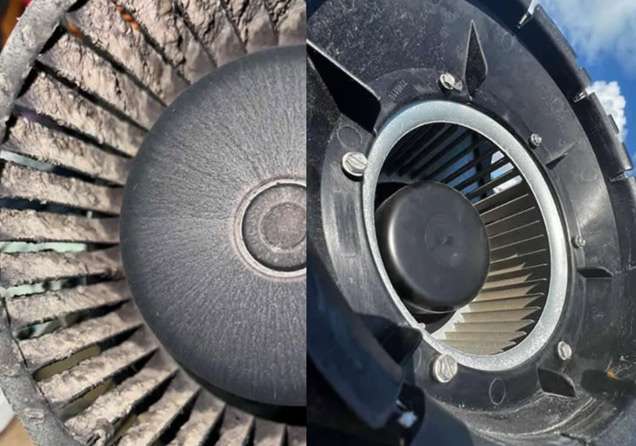
When an air handler struggles to move air across the evaporator coil, cooling output plummets. Weak airflow often points to clogged return filters, failing blower motors, or ductwork that has detached behind cabinetry. Unusual water pooling near the base of an air handler or inside cabinetry indicates that the condensate pan is overflowing, which risks structural rot and interior water damage if left unaddressed.
When to Search for Marine Air Conditioner Repair Near Me
Recognizing specific failure modes allows captains and owners to act before minor issues cause permanent component damage. Key warning signs that warrant an immediate diagnostic inspection include:
- Frequent Short-Cycling: The compressor turns on and off rapidly without completing a full cooling cycle, often triggered by thermal overload or high-pressure cutoffs.
- Musty or Stale Odors: Sour smells emanating from the supply vents indicate biological buildup on damp evaporator fins, confirming your yacht AC system needs cleaning and sanitization.
- Tripped Circuit Breakers or Blown Fuses: Repeated electrical faults suggest a seizing compressor, a shorted capacitor, or severe voltage drops at the slip.
- High-Pressure (HP) Error Codes: Digital display panels flashing high-pressure alerts point to inadequate cooling water circulating through the heat exchanger.
- Audible Grinding or Squealing: Worn bearings inside the blower fan or seawater pump produce distinct mechanical noises before seizing completely.
Why Cabin Humidity Rises While the AC Runs
An operating marine air conditioner should act as an effective dehumidifier. If your cabin feels damp, clammy, or warm despite the display showing continuous cooling, the system has lost its ability to extract moisture effectively.
This issue frequently stems from a malfunctioning thermostatic expansion valve. Understanding the cooling cycle and fixing your boat’s AC TXV valve ensures that refrigerant enters the evaporator at the proper pressure and temperature. When the metering device sticks or fails, the coil cannot sustain the cold surface temperatures required to condense ambient moisture out of the air.
Blocked condensate drain pathways exacerbate humidity issues. When condensation collects in the drain pan rather than flowing out through the overboard through-hull or sump, it re-evaporates back into the cabin airstream, creating a humid, stagnant interior environment.
Why Marine Air Conditioners Fail in South Florida Waters
South Florida waters present a uniquely challenging environment for marine climate control systems. High ambient sea surface temperatures, intense solar loads, and rapid biofouling accelerate mechanical and chemical degradation.
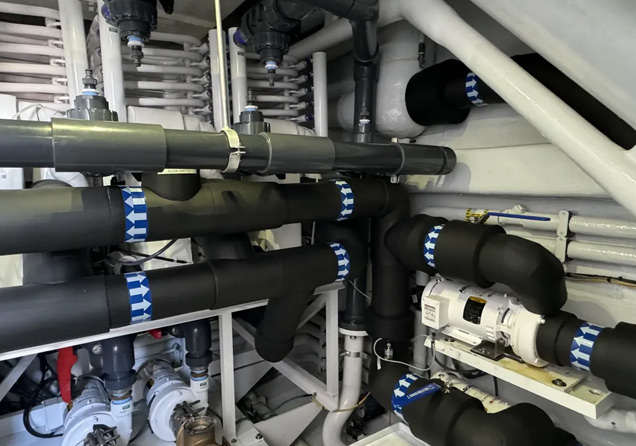
Unlike residential air conditioning systems that reject heat into the ambient air, marine HVAC units rely entirely on raw seawater circulation to cool the refrigerant loop. Warm coastal waters carry heavy concentrations of salt, silt, barnacles, and algae. Over time, these elements accumulate inside the cupronickel heat exchangers, forming scale and biological blockages that severely restrict thermal transfer.
Chilled-Water vs Direct-Expansion System Vulnerabilities
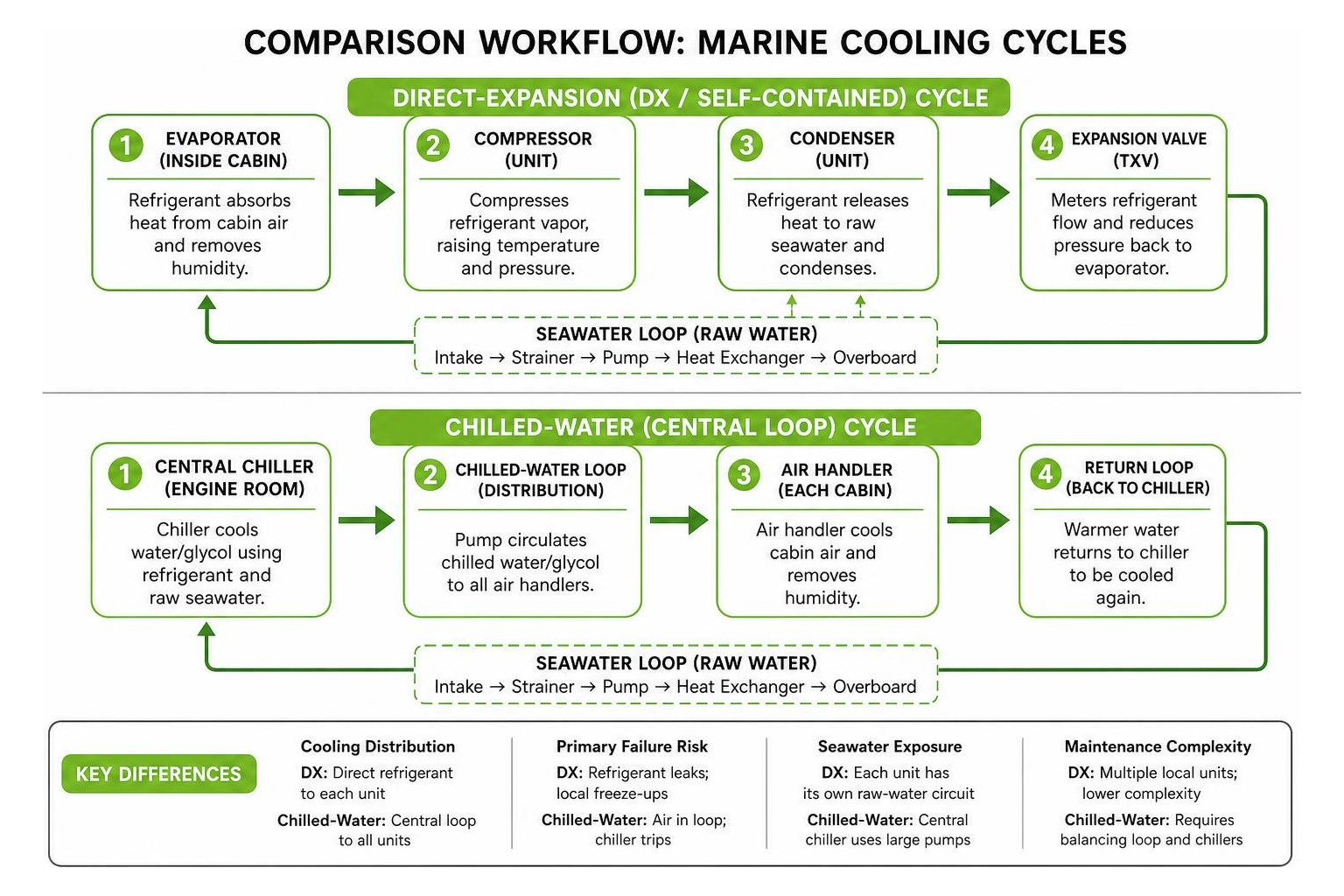
Vessels utilize different HVAC configurations depending on their size and layout. Understanding the structural differences between direct-expansion (DX) self-contained or split systems and central chilled-water loops helps pinpoint vulnerability areas during troubleshooting. Reviewing the operational differences between chilled water vs self-contained AC systems clarifies why specific maintenance protocols are necessary for each design.
| Feature / Vulnerability | Direct-Expansion (DX / Self-Contained) | Chilled-Water (Central Loop) |
|---|---|---|
| Typical Vessel Size | Cruisers & Yachts under 55 feet | Large Yachts & Motor Yachts 50+ feet |
| Cooling Distribution | Direct refrigerant circulation to each cabin unit | Central chiller circulates chilled water/glycol |
| Primary Failure Risk | Refrigerant leaks in living spaces; local freeze-ups | Air binding in water loop; central chiller tripping |
| Seawater Exposure | Individual condensing units require raw water | Central chiller package uses large seawater pumps |
| Maintenance Complexity | Lower initial complexity; multiple local compressors | Requires balancing loop pressure, valves, and chillers |
Seawater Cooling Flow Restrictions and Pump Failures
Seawater circulation systems are the most frequent source of sudden cooling failure in South Florida. Raw-water intake strainers catch grass, jellyfish, and debris, which quickly cuts off the supply to the cooling pump.
When water flow drops below the threshold required to remove heat from the condenser, the compressor’s discharge pressure spikes instantly, triggering a high-pressure safety shutdown. Running a magnetic-drive seawater pump dry—even for a few minutes—can damage the internal impeller and overheat pump seals, leading to complete pump failure.
Finding Dockside Marine Air Conditioner Repair Near Me in South Florida
When cooling systems fail, moving a large vessel to a boatyard or service yard creates unnecessary downtime, logistical stress, and high dockage expenses. FCS Marine comes to where the vessel is located, providing on-site yacht service directly at your marina slip or private dock.
To restore comfort quickly, working with a specialist who understands marine-specific engineering is critical. Following established industry steps for evaluating vessel technicians helps yacht owners identify specialists who arrive fully equipped with marine-grade replacement parts, diagnostic manifolds, and specialized flushing equipment.
Our mobile teams cover key maritime hubs throughout South Florida, including:
- Broward County: Fort Lauderdale, Pompano Beach, Hollywood, Dania Beach
- Palm Beach County: West Palm Beach, Boca Raton, Jupiter, Delray Beach
- Miami-Dade County: Miami, Miami Beach, Key Biscayne, Coconut Grove
- Martin & St. Lucie Counties: Stuart, Port St. Lucie, Jensen Beach
What to Expect During Marine Air Conditioner Repair Near Me
A systematic evaluation ensures that the underlying root cause of an HVAC failure is resolved rather than temporarily masking symptoms. Understanding how marine AC service works helps vessel managers coordinate repairs efficiently.
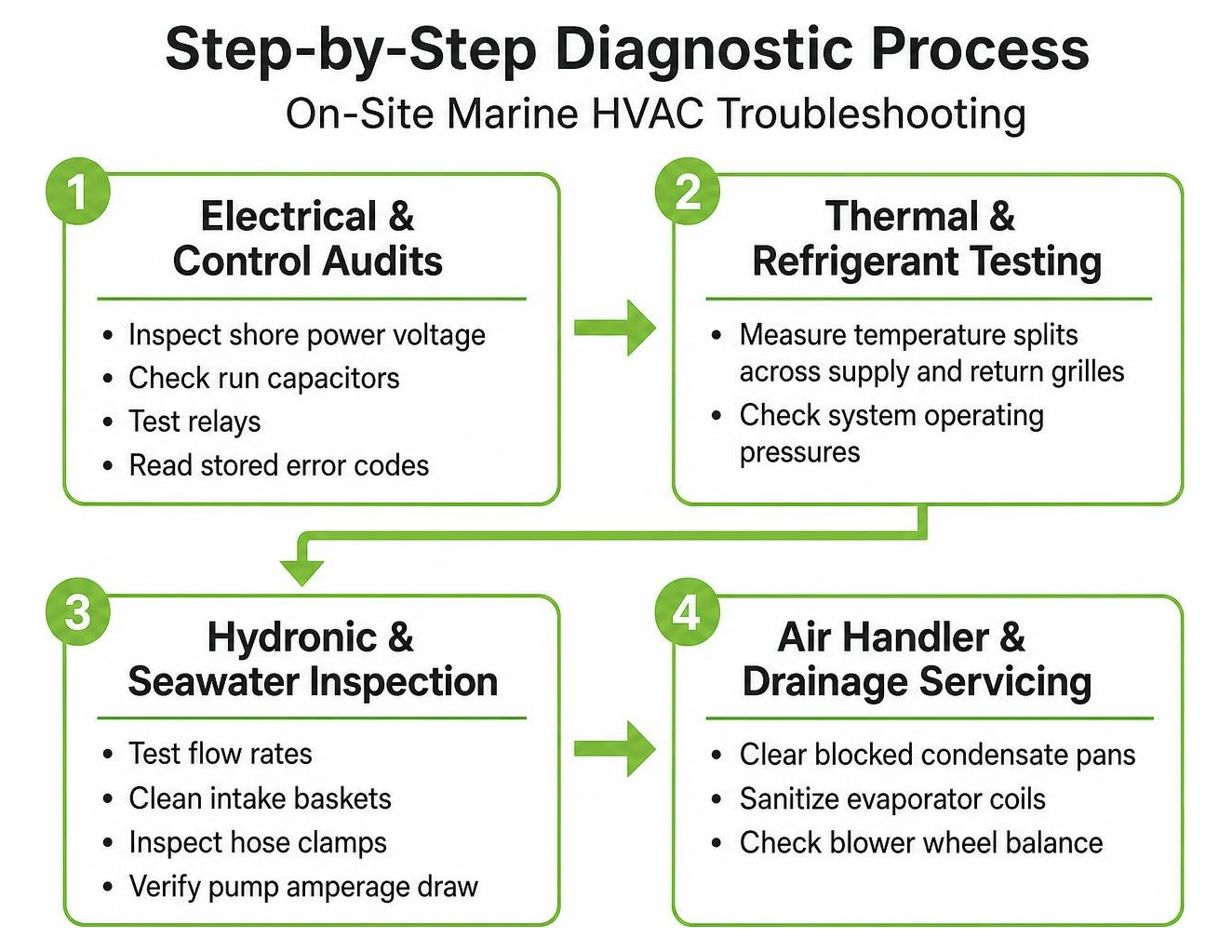
During a mobile service visit, a technician will typically perform the following on-site checks:
- Electrical & Control Audits: Inspecting incoming shore power voltage, checking run capacitors, testing relays, and reading stored error codes on digital displays.
- Thermal & Refrigerant Testing: Measuring temperature splits across supply and return grilles while checking system operating pressures.
- Hydronic & Seawater Inspection: Testing flow rates, cleaning intake baskets, inspecting hose clamps, and verifying pump amperage draw.
- Air Handler & Drainage Servicing: Clearing blocked condensate pans, sanitizing evaporator coils, and checking blower wheel balance.
Typical Repair Timelines and On-Site Component Servicing
Most routine marine AC repairs and component replacements can be completed during a single on-site service visit. Issues such as faulty control boards, blown start capacitors, failed seawater pumps, seized blower fans, or clogged drain lines are regularly resolved right at the dock.
Complex repairs involving extensive line flushing, custom duct routing, or complete multi-stage compressor overhauls may require additional diagnostic testing or specialized component sourcing, but mobile service eliminates the need to navigate the vessel to an external shipyard.
Preventive Marine AC Maintenance to Protect Vessel Comfort
Preventative maintenance is the most effective way to ensure uninterrupted cabin cooling and avoid costly mid-voyage breakdowns. In South Florida’s year-round boating climate, proactive servicing should be performed ahead of peak summer temperatures.
Following a comprehensive marine AC maintenance checklist keeps cooling hardware operating efficiently and preserves interior air quality.
Essential preventive practices include:
- Monthly Filter Inspections: Rinse or replace return air filters every 30 days to prevent dirt from insulating the evaporator fins and choking airflow.
- Strainers and Intake Maintenance: Regularly inspect raw water strainers for marine growth and backflush through-hull fittings.
- Descaling the Heat Exchanger: Periodically flush condensing coils with safe descaling solutions to eliminate scale and barnacle buildup.
- Condensate Line Cleaning: Clear drain pans and flush drain hoses to prevent biological slime from causing cabin leaks.
Frequently Asked Questions About Marine AC Repair
How often should a yacht air conditioning system be serviced in South Florida?
Yacht air conditioning systems in South Florida should undergo professional inspection and servicing at least once a year, with seasonal check-ups scheduled before peak summer conditions. Because warm waters promote rapid biofouling, strainers and raw-water flow should be checked monthly by the owner or crew.
Can marine air conditioning systems be serviced dockside?
Yes. The vast majority of marine AC diagnostic procedures, routine maintenance tasks, electrical troubleshooting, and component replacements can be completed directly at your marina or private dock without moving the vessel.
Why is my marine air conditioning system not cooling properly?
Reduced cooling output is typically caused by restricted seawater flow from dirty strainers or failing pumps, clogged return-air filters, fouled evaporator coils, low refrigerant levels due to a slow leak, or a failing metering valve.
Conclusion
A reliable marine HVAC system is vital for onboard comfort, cabin humidity control, and the long-term preservation of your yacht’s interior woodwork and electronics. South Florida’s unique combination of high heat, dense humidity, and bio-rich waters demands specialized, prompt attention whenever cooling performance begins to decline.
Whether you are dealing with an unexpected high-pressure shutdown, weak airflow, water leaks, or rising cabin humidity, FCS Marine delivers dependable, mobile marine service across South Florida. Contact FCS Marine today to schedule comprehensive Marine Air Conditioning Service and restore peak cooling performance to your vessel.