Why Palm Beach Boat Owners Can’t Afford to Ignore Marine AC Service
If you’re dealing with a struggling cooling system on your vessel, boat AC service in Palm Beach is not something you can put off — especially in South Florida’s relentless heat and humidity.
Here’s what you need to know at a glance:
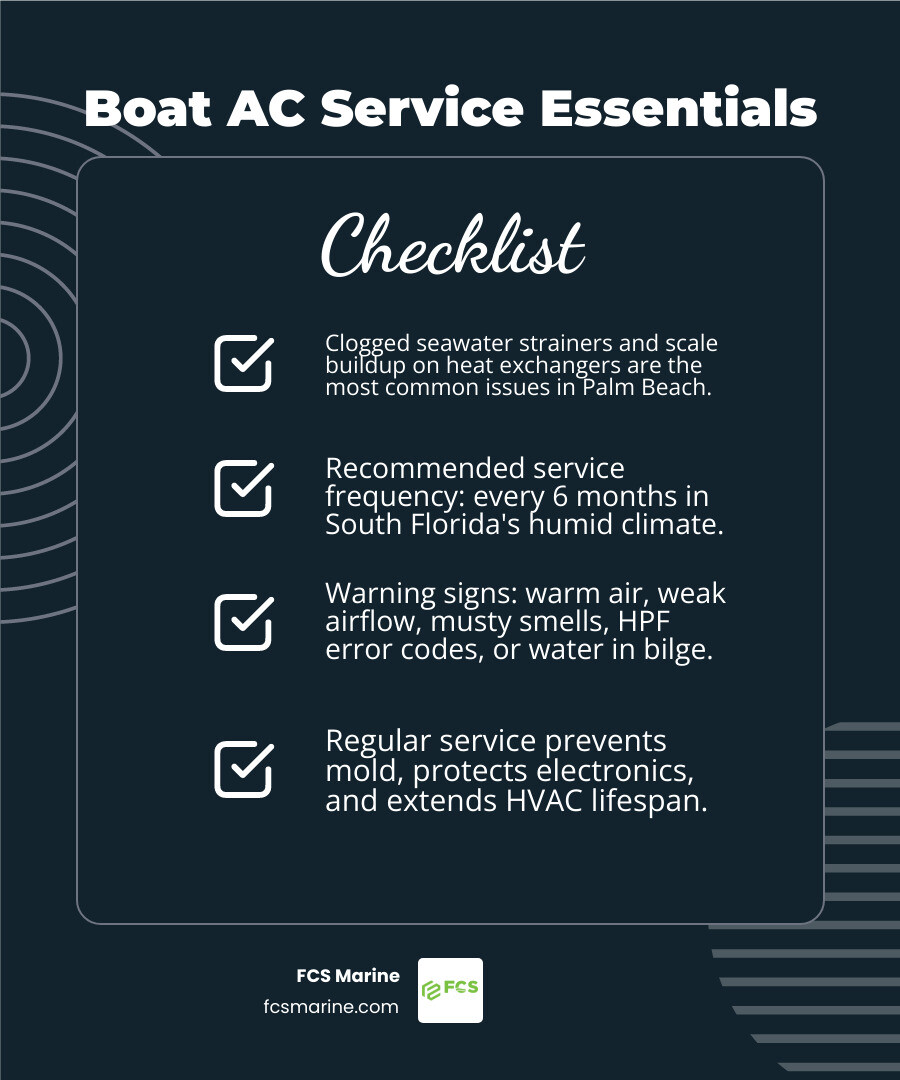
- Most common issues: clogged seawater strainers, scale buildup on heat exchangers, low refrigerant, and corrosion from saltwater exposure
- Recommended service frequency: every 6 months in Palm Beach’s climate, with monthly owner checks
- Typical service includes: coil cleaning, acid flush, seawater pump inspection, electrical testing, and refrigerant check
- Warning signs to act on now: warm air output, weak airflow, musty smells, HPF error codes, or water in the bilge
- Average cost range: varies by system type, vessel size, and parts needed — chilled water systems typically cost more to service than self-contained units
- What to look for in a provider: EPA Section 608 certification, ABYC knowledge, and mobile marine service capability
Palm Beach County’s combination of extreme heat, high humidity, and constant saltwater exposure puts marine AC systems under serious stress year-round. A system that worked fine last season can fail fast without regular attention. The consequences go beyond discomfort — unchecked moisture and heat can accelerate mold growth, damage onboard electronics, and shorten the life of expensive HVAC components.
At FCS Marine, we provide professional marine air conditioning service for vessels across Palm Beach County and the broader South Florida region — coming directly to where your vessel is located so you don’t have to move it to get the help it needs.
Why South Florida’s Climate Demands Regular Boat AC Service in Palm Beach
The marine environment in South Florida is uniquely challenging for climate control systems. According to historical NOAA marine weather data, the coastal waters around Palm Beach routinely experience high temperatures and humidity levels that force onboard air conditioning systems to run almost continuously.
Unlike land-based air conditioners that use outdoor air to cool their coils, marine AC systems rely on surrounding seawater. While seawater is an effective cooling agent, it introduces several severe complications:
- Marine Growth: Barnacles, algae, and oysters thrive in South Florida’s warm waters. They quickly colonize the interior of your seawater intake, hoses, and strainers, restricting the water flow your system needs to cool down.
- Saltwater Corrosion: The high salinity of the Atlantic Ocean accelerates the galvanic corrosion of metal components. Without regular inspections, salt air and water will degrade electrical connections and eat through copper-nickel condenser coils.
- Scale and Silt Buildup: As warm seawater passes through the hot condenser coils, dissolved minerals precipitate out, forming a hard scale barrier. This scale acts as an insulator, reducing heat transfer and forcing your compressor to work much harder.
To prevent these environmental factors from causing a complete system breakdown, proactive vessel owners schedule professional marine air conditioning service twice a year to keep their cooling loops clear and efficient.
Warning Signs Your Vessel Needs Immediate Marine AC Repair
Waiting until your cabin feels like a sauna is the most common mistake boat owners make. Catching the early warning signs of a failing system can save you thousands of dollars in emergency repairs. Keep an eye out for these five indicators:
- Weak Airflow: If you feel only a gentle whisper of air coming from your vents, you may have a clogged air filter, a failing blower motor, or iced-over evaporator coils.
- Warm Air Output: When the blower is running but the air coming out isn’t cold, your compressor might not be engaging, or you could be dealing with a boat AC not cooling due to low refrigerant or restricted water flow.
- High-Pressure Fault (HPF): This is the most common error code on marine digital displays. It indicates that the system cannot shed heat, usually because seawater flow has stopped or been severely restricted.
- Musty Odors: Standing water in the condensate pan or mold growth on the evaporator coils will release a damp, sour smell through your ductwork. Proper humidity control and clean coils are essential to prevent mold from taking over your yacht’s interior.
- Water in the Bilge: If your condensate drain line is clogged with dust or biological slime, the condensation produced by your evaporator will overflow into your bilge or damage your woodwork.
Ensuring your cabin is properly sealed and utilizing high-quality insulation can reduce the workload on your AC system. To learn more about managing onboard thermal efficiency, read The Ultimate Guide to Yacht Insulation.
What to Expect During a Professional Marine AC Maintenance Visit
When you schedule professional marine air conditioning maintenance, the technician shouldn’t just turn the system on and check if cold air is blowing. A comprehensive service visit involves deep diagnostics and preventative cleaning designed to protect your investment.
Step-by-Step Breakdown of a Boat AC Service Palm Beach Specialists Perform
A thorough, professional service visit should follow a structured process to clean, test, and optimize your entire HVAC setup.
Here is what a professional technician from FCS Marine does during a standard visit:
- Seawater Loop Acid Flush: We circulate a safe, marine-biodegradable descaling solution through the condenser coils to dissolve scale, barnacles, and marine growth.
- Evaporator Coil Cleaning: We clean the aluminum fins on the evaporator to remove dust, pet dander, and salt residue, which improves airflow and heat transfer.
- Electrical Inspection: Technicians inspect and tighten all electrical connections, test start/run capacitors, and measure the amp draw of the compressor and seawater pump.
- Refrigerant Level Check: We monitor operating pressures to ensure the system has the correct charge.
- Seawater Pump and Strainer Service: We clean the raw water strainer basket, inspect the pump impeller for wear, and verify that seawater is flowing freely out of the thru-hull discharge.
To understand how these steps keep your cabin comfortable, you can read more about how marine AC service works. Depending on the size of your vessel, you may have a self-contained unit or a larger chilled water system.
| Feature | Self-Contained AC Systems | Chilled Water (Chiller) Systems |
|---|---|---|
| Best Suited For | Boats under 40 feet | Yachts over 50 feet |
| Operation | Direct expansion unit in each cabin | Central chiller circulates cold water to air handlers |
| Space Required | Minimal central space, but takes up cabin locker space | Requires a dedicated engine room or machinery space |
| Maintenance Complexity | Low to moderate | High (requires specialized manifold and loop testing) |
For a detailed comparison of these configurations, check out our guide on Chilled Water vs Self-Contained AC Systems.
EPA Regulations and Refrigerant Handling Standards
Marine air conditioning systems rely on chemical refrigerants to transfer heat. Because these substances can contribute to ozone depletion and global warming if released into the atmosphere, the Environmental Protection Agency (EPA) strictly regulates their use.
Under EPA regulations on refrigerant handling (Section 608), any technician who opens, services, or repairs a refrigerant-containing system must hold a valid EPA certification. It is illegal to intentionally vent refrigerant into the atmosphere, and any leaks must be identified and repaired using professional recovery equipment. When you hire an on-site marine service provider, always verify that their technicians are EPA-certified to handle refrigerants safely and legally.
How to Extend the Life of Your Marine Air Conditioning System
While professional maintenance is crucial, there are several simple tasks boat owners can perform between service visits to keep their systems running smoothly.
- Clean the Raw Water Strainer Weekly: Check your seawater strainer regularly, especially after running your boat through shallow water or areas with heavy seagrass. A clogged strainer will quickly trigger an HPF error.
- Wash the Air Filters Monthly: Most marine AC units have a simple mesh filter located directly behind the return air grille. Wash it with fresh water, let it dry completely, and reinstall it to maintain strong airflow.
- Run the System Regularly: If your boat sits idle for weeks at a time, marine growth will rapidly accumulate in the stationary water lines. Run your AC units for at least an hour every two weeks to flush fresh water through the lines and keep the compressor lubricated.
- Inspect the Condensate Pan: Ensure that the drain pan under your evaporator unit is clean and that water flows freely down the drain line rather than pooling in the tray.
For a complete breakdown of daily, weekly, and monthly tasks, refer to our downloadable Marine AC Maintenance Checklist.
Selecting a Qualified Marine HVAC Technician in South Florida
Your boat is a major investment, and its mechanical systems are complex. Hiring an unqualified technician can lead to incorrect diagnoses, damaged equipment, or even electrical fires.
Key Credentials for a Reliable Boat AC Service Palm Beach Provider
When searching for a reliable marine HVAC provider in Palm Beach, look for the following qualifications:
- ABYC Standards Compliance: The American Boat and Yacht Council (ABYC) sets the safety standards for design, construction, and repair on boats. A technician familiar with ABYC standards understands how marine electrical and plumbing systems must be configured to remain safe on the water.
- EPA Section 608 Certification: As mentioned, this is a legal requirement for any technician performing refrigeration work.
- Mobile Marine Service Capabilities: You shouldn’t have to coordinate moving your vessel to a boatyard just for an AC repair. A reputable provider should offer fully equipped on-site yacht service to perform diagnostics, repairs, and cleanings directly at your marina, private dock, or boatyard.
To help you vet potential contractors, read our guide on how to find a certified marine AC technician.
Understanding Marine AC Service Costs and Pricing Factors
The cost of boat AC service in Palm Beach depends on several variables. Because every vessel is configured differently, pricing is typically calculated based on:
- System Accessibility: Units tucked deep inside tight cabinetry or under berths require more labor time to access and service than those in open engine compartments.
- Type of System: Standard self-contained units are generally faster and less expensive to service than complex multi-stage chilled water loops.
- Repair vs. Routine Maintenance: A preventative flush and inspection is highly cost-effective, whereas replacing a major component like a compressor or a seawater pump will incur higher parts and labor charges.
- Vessel Size: Larger yachts with multiple independent zones require more time for complete system testing and balancing.
Frequently Asked Questions About Marine AC Service
How often should I have my boat’s AC serviced in Palm Beach?
We recommend having your system professionally serviced every six months. Because of Palm Beach’s year-round warmth, marine growth and scale accumulate rapidly. Bi-annual preventative care ensures your system is prepared for seasonal temperature spikes and prevents minor issues from becoming major failures.
Why is my marine AC blowing warm air or showing an HPF error?
An HPF (High-Pressure Fault) error almost always indicates a lack of water flow through the condenser coils. The system automatically shuts down to prevent the compressor from overheating. The most common causes are a clogged raw water strainer, marine growth in the water lines, or a failing seawater pump.
Can I use a regular residential AC technician for my boat?
We highly advise against this. Marine AC systems operate on entirely different principles than residential systems, utilizing raw seawater heat exchangers, marine-grade 12V or 24V DC electrical systems, and specialized plumbing. A residential technician will not have the specialized tools, marine descaling chemicals, or understanding of ABYC safety standards required to work safely on a boat.
Conclusion: Keep Your Vessel Cool and Protected
A properly functioning marine air conditioning system is essential for maintaining comfort, preserving your yacht’s interior, and preventing mold. In Palm Beach’s harsh coastal environment, regular maintenance is the only way to ensure your system performs reliably when you need it most.
At FCS Marine, our family-owned team specializes in comprehensive yacht maintenance services, including marine refrigeration repairs, mold remediation, custom insulation, and water purification. We provide fast, reliable mobile marine service throughout Palm Beach County, Broward County, Miami-Dade County, Martin County, and St. Lucie County.
Don’t wait for your system to fail on a hot weekend. Contact Us today to schedule your professional boat AC service in Palm Beach and enjoy peace of mind on the water.