Why Boat Air Conditioning Repair Fails More Often Than You Think
Boat air conditioning repair is one of the most common — and most urgent — maintenance needs for South Florida yacht owners. If your cabin is warming up, your system is making strange noises, or you’re seeing an HPF error on the control panel, here’s what’s most likely wrong and what to do first:
Quick answers for common marine AC problems:
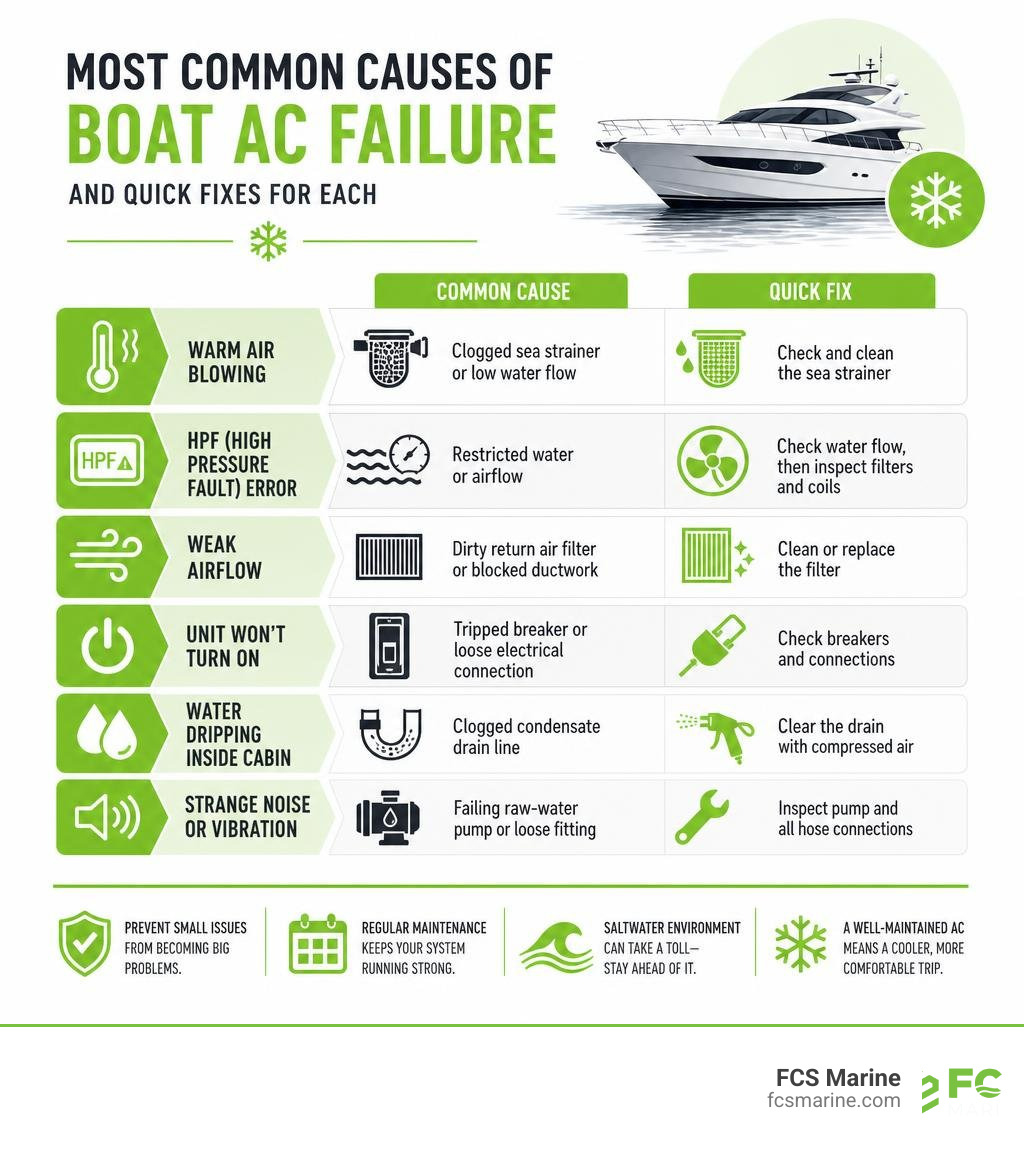
| Symptom | Most Likely Cause | First Step |
|---|---|---|
| Warm air blowing | Clogged sea strainer or low water flow | Check and clean the sea strainer |
| HPF (High Pressure Fault) error | Restricted water or airflow | Check water flow, then inspect filters and coils |
| Weak airflow | Dirty return air filter or blocked ductwork | Clean or replace the filter |
| Unit won’t turn on | Tripped breaker or loose electrical connection | Check breakers and connections |
| Water dripping inside cabin | Clogged condensate drain line | Clear the drain with compressed air |
| Strange noise or vibration | Failing raw-water pump or loose fitting | Inspect pump and all hose connections |
Marine AC systems fail far more often than home units. Salt air corrodes components. Boat movement loosens fittings. Seawater cooling lines clog with marine growth. In fact, 60% of marine AC failures trace back to water flow problems — things like a blocked sea strainer, a salt-crusted condenser, or a failing raw-water pump.
The good news: many of these problems are catchable early — and fixable before they strand you at the dock in July.
This guide walks you through exactly what causes failures, what you can fix yourself, and when to call in a certified marine HVAC technician.
Common Causes of Marine AC Failure
To understand why your boat’s air conditioning system suddenly gave up the ghost, it helps to look at the environment it lives in. Unlike your home AC, which sits quietly on a concrete slab in your backyard, a marine air conditioner is constantly subjected to salt spray, extreme humidity, engine vibrations, and the biological soup of South Florida’s coastal waters.
When your Boat Air Conditioning Stops Cooling, the primary suspect is almost always the seawater cooling loop. Because marine AC systems rely on raw seawater to extract heat from the refrigerant, any disruption in water flow causes the system to overheat rapidly.
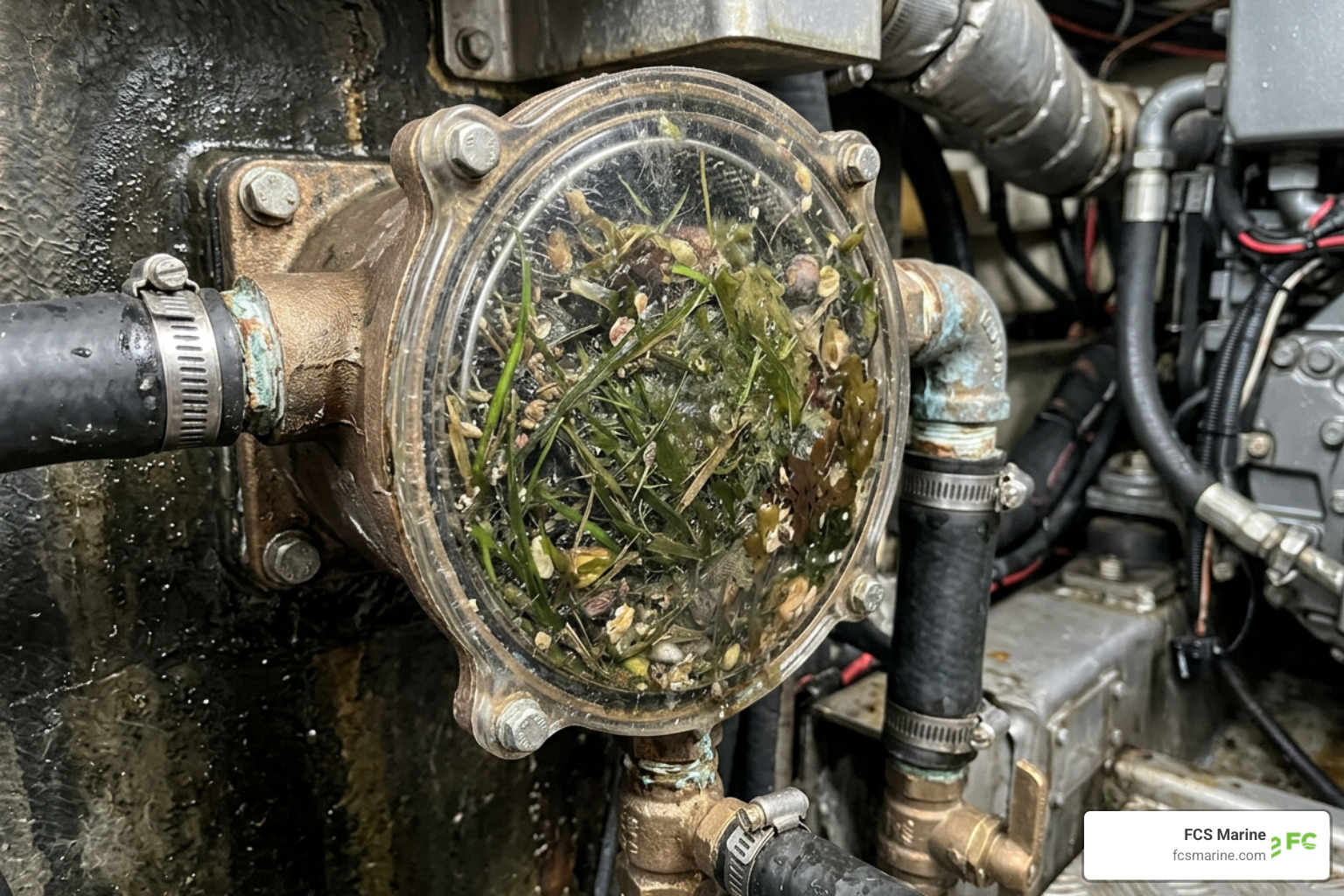
The raw-water pump draws seawater through a thru-hull fitting, pushes it through a sea strainer, forces it through the condenser coils, and finally discharges it overboard. If any part of this pathway is compromised, your system will fail. The most frequent culprits include:
- Clogged Sea Strainers: Floating grass, plastic bags, and small jellyfish love to find their way into your strainer basket, completely blocking water intake.
- Barnacles and Marine Growth: Warm canal waters in Fort Lauderdale and West Palm Beach are breeding grounds for barnacles. If they colonize the inside of your thru-hull fittings or raw-water hoses, water flow drops significantly.
- Air Locks: If you make a sharp turn or run your boat at high speeds, air can get trapped in the raw-water pump, preventing it from priming and moving water.
- Salt-Crusted Condensers: Over time, dissolved salts and minerals bake onto the inside of the condenser coils, forming an insulating barrier that reduces heat transfer.
Troubleshooting Low Water Flow and High-Pressure Faults
If your digital thermostat displays a “High Pressure Fault” (often abbreviated as HPF or HI PS), do not panic. This is actually a safety feature designed to shut down the compressor before it burns itself out due to excessive heat.
Before calling for professional boat air conditioning repair, you can perform a quick diagnostic check. First, look over the side of your boat. Do you see a steady stream of water discharging from the AC thru-hull? If the discharge is dry or merely trickling, you have a water flow issue.
To resolve a suspected air lock or low-flow issue, try these steps:
- Perform the Bucket Test: Disconnect the discharge hose from the pump and run it into a bucket inside the bilge. Turn on the pump briefly. If water gushes out, the pump is primed and working, meaning the blockage is further down the line or inside the condenser.
- Clear the Intake: Close the seacock, open your sea strainer, and clear out any debris.
- Build a Line Clean-Out Tool: You can use a garden hose adapter or a pressurized air line to gently blow water backward from the overboard discharge through the pump and strainer. This often dislodges stubborn grass or mud. Remember to open the seacock before doing this so the debris can escape!
If you’ve cleared the basket and verified the pump is running but still get an HPF error, the blockage might be calcified marine growth inside the condenser coil itself, which requires a professional chemical descale.
The Impact of Dirty Filters and Coils on Efficiency
While water-side issues make up the majority of failures, the air-side of your marine AC system is just as vulnerable. Your cabin air handler relies on a return air filter to capture dust, pet dander, and fabric fibers before they reach the delicate fins of the evaporator coil.
When a Yacht AC System Needs Cleaning, the cooling efficiency drops off a cliff. Dirty condenser coils and clogged air filters can reduce marine refrigeration and AC efficiency by 30% or more.
A blocked return air filter restricts air flow across the evaporator coil. When air cannot pass through freely, the temperature of the coil drops below freezing, causing the humidity in the air to freeze directly onto the fins. This creates a solid block of ice that completely stops all cooling. If you notice weak airflow accompanied by ice forming on the copper lines near your air handler, turn the system off immediately, switch it to “fan only” mode to melt the ice, and clean your filter.
DIY Troubleshooting vs. Professional Boat Air Conditioning Repair
Every boat owner loves the satisfaction of a successful DIY fix, not to mention saving a few dollars. However, marine HVAC systems are complex beasts that combine high-voltage electrical circuits, pressurized refrigerants, and plumbing connections that sit below the waterline. Knowing where your skills end and professional expertise begins is crucial for both your wallet and your safety.

When to Call a Professional for Boat Air Conditioning Repair
There are several scenarios where attempting a DIY fix can permanently damage your system or void your warranty. You should always contact a certified technician for:
- Refrigerant Leaks: If your system has low water flow and high-pressure faults ruled out, but it still blows warm air, you may have a refrigerant leak. Finding and fixing leaks requires specialized electronic sniffers, recovery equipment, and an EPA Section 608 certification to legally handle refrigerants.
- Compressor Replacement: The compressor is the heart of your AC. If it locks up electrically or mechanically, replacing it requires cutting copper lines, brazing with an oxygen-acetylene torch, and pulling a deep vacuum on the system.
- Complex Electrical Diagnostics: If your control board is fried, or if your compressor is tripping the main cabin breaker instantly upon startup, you need professional marine electrical diagnostics. Working around marine electrical panels without proper training can result in severe shocks or boat fires.
If you are experiencing electrical issues that go beyond the AC unit itself, such as shore power fluctuations or generator integration problems, it is wise to consult certified marine electrical specialists to ensure your vessel’s electrical grid is safe and stable.
For boat owners located in South Florida, having local support is incredibly convenient. You can reach out to professional dockside technicians to keep your vessel’s climate control running flawlessly.
Essential Maintenance Checklist for Boat Owners
To keep your system running smoothly and minimize the need for emergency repairs, we recommend following a strict Marine AC Maintenance Checklist. Performing these simple tasks every month can extend the lifespan of your system by years:
- Clean the Sea Strainer: Check and empty the strainer basket at least once a month (more often if you are slipped in a high-growth marina or near a canal with heavy grass).
- Wash the Return Air Filter: Locate your return air grille, slide out the mesh filter, and wash it with fresh water. Let it dry completely before reinstalling.
- Inspect the Condensate Pan: Make sure the drain pan under your evaporator unit is clean and free of standing water. If water accumulates, the drain line is clogged. Clear it by blowing compressed air down the line.
- Flush the Raw-Water Loop: Every six months, flush your seawater lines with a biodegradable descaling solution to remove calcium deposits and barnacle growth.
- Check Electrical Connections: Ensure all wires are tight, dry, and free of green copper corrosion.
For a deeper look into the professional side of these tasks, you can read about How Marine AC Service Works to understand what our factory-trained technicians look for during a comprehensive system tune-up.
Comparing Marine AC Systems: Self-Contained, Chilled-Water, and DC Upgrades
If you are building a new boat, refitting an older trawler, or deciding whether to replace a dead system, you must understand the different types of marine air conditioning architectures available today.
| System Type | Best Suited For | Pros | Cons |
|---|---|---|---|
| Self-Contained | Boats under 40 feet | Easy to install, lower upfront cost, compact | Noisy in cabin, limited zoning |
| Chilled-Water | Yachts over 50 feet | Whisper quiet, highly efficient, unlimited zoning | Expensive, complex plumbing, large footprint |
| DC Low-Voltage | Cruising sailboats & catamarans | Runs directly off batteries, no generator needed | High initial cost, requires massive battery bank |
Chilled-Water vs. Self-Contained Systems
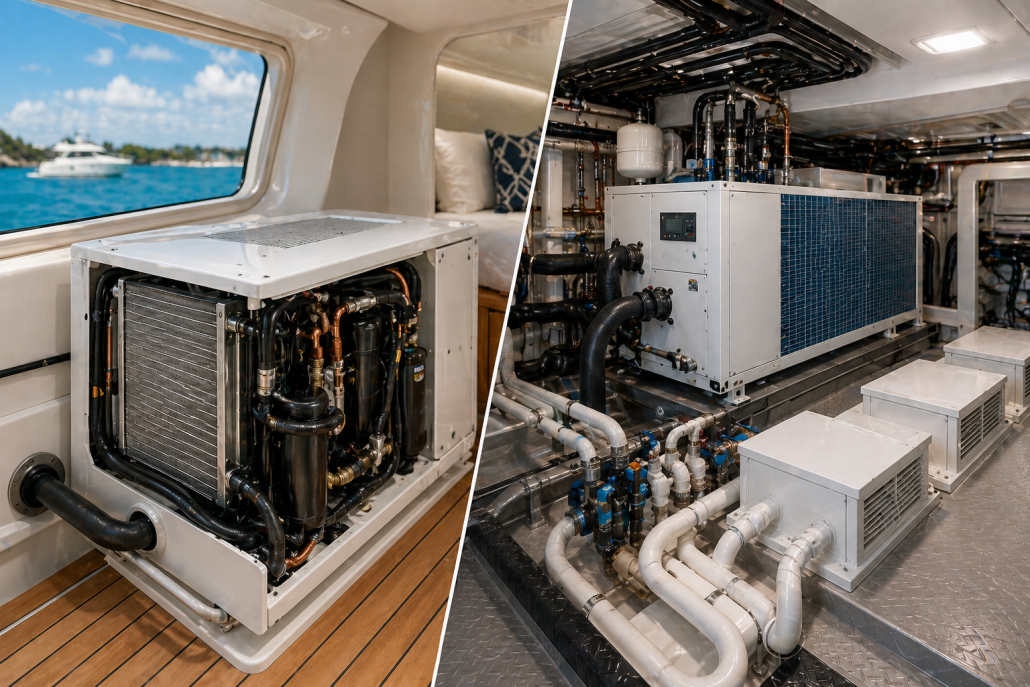
For smaller vessels, self-contained units are the industry standard. In a self-contained system, all the major components — the compressor, condenser, evaporator, and blower — are mounted on a single, compact chassis that typically tucks away under a dinette seat or inside a hanging locker.
Larger yachts, however, usually opt for chilled-water systems. Instead of routing refrigerant lines all over the boat, a centralized chiller plant is installed in the engine room. This chiller cools a closed loop of fresh water (mixed with glycol), which is then pumped through insulated pipes to quiet air handlers in each cabin.
Understanding the differences between Chilled Water vs Self-Contained AC Systems is critical when planning a refit. While chilled-water systems offer unmatched comfort and redundancy, they require professional design, custom manifold plumbing, and a much larger physical footprint in your bilge or engine room.
If you are located in the northern reaches of our service area, such as Port St. Lucie, you can explore options for self-contained AC units and marine refrigeration to see how local boaters configure their climate systems.
Upgrading to Low-Voltage DC Marine AC Units
One of the most exciting advancements in marine HVAC is the rise of 12V, 24V, and 48V DC air conditioners. Traditional marine AC units run on alternating current (AC) power, meaning you must be plugged into shore power at the dock or run a noisy diesel generator while anchored.
DC-powered marine air conditioners run directly off your boat’s house battery bank. By utilizing highly efficient brushless DC compressors and variable-speed fans, these systems can keep your cabin cool all night long without the vibration, noise, and fuel consumption of a generator.
While upgrading to a 12V or 48V system requires a significant upfront investment in a modern lithium battery bank and high-output solar panels, the reward of silent, generator-free cooling at anchor is well worth it for serious cruisers.
Marine AC Brand Comparison: Reliability, Parts, and Warranties
When it comes to selecting a replacement air conditioner, the brand you choose impacts your long-term satisfaction, parts availability, and how easy it is to get service when you travel.
Choosing the Right Brand for Your Boat Air Conditioning Repair
- CTM Marine: Quickly becoming a favorite among marine technicians, CTM Marine units stand out because they utilize titanium condenser coils instead of traditional cupronickel (copper-nickel). Titanium is virtually impervious to salt corrosion, resolving the leading cause of condenser failure. They are also priced competitively and designed to be direct drop-in replacements for older Dometic and Cruisair units.
- Dometic (Cruisair/Marine Air): As the undisputed giant of the marine HVAC world, Dometic has the largest global service network. If you are cruising the Bahamas or the Caribbean, finding a Dometic dealer is relatively easy. However, some boaters have noted that newer Dometic units have shorter lifespans than the legendary, heavy-duty Cruisair systems of the past.
- Webasto: Known for German engineering, Webasto units are exceptionally quiet and reliable. They offer a generous 2-year replacement warranty on their FCF Platinum series. The only drawback is that their proprietary parts can sometimes be harder to source quickly in smaller South Florida marinas.
- Flagship Marine: Built like commercial-grade tanks in the USA, Flagship Marine units avoid complex printed circuit boards (PCBs) in favor of simple, robust mechanical relays. This makes them incredibly durable and easy to repair for any basic electrician.
- Mermaid & MarinAire: These brands offer excellent budget-friendly options for DIY boaters. MarinAire units are particularly popular for their sleek digital displays, built-in pressure gauges, and quiet operations.
If you are cruising along the Gulf Coast or the keys, you can find local support through authorized marine AC service providers to ensure you have access to dealers and parts.
Seasonal Care: How to Winterize Your Marine AC System
Even in South Florida, many boaters leave their vessels sitting idle for several months during the winter or hurricane season. If your boat is going to be hauled out of the water or left unattended, proper winterization of your marine AC system is essential to prevent costly damage.
When water sits stagnant in your raw-water cooling loop, marine organisms die and rot, creating a foul-smelling sludge. Worse, if you store your boat in a region that experiences freezing temperatures, water trapped inside the condenser coil can freeze, expand, and rupture the copper lines, completely ruining the unit.
To winterize your raw-water system:
- Close the seacock and empty the sea strainer basket.
- Disconnect the intake hose from the seacock and submerge it in a bucket of non-toxic marine antifreeze (the pink stuff).
- Turn on the AC pump and run it until you see pink antifreeze discharging out of the overboard thru-hull fitting.
- Reconnect the hose to the seacock and tighten all hose clamps.
This simple process protects your plumbing, prevents biological growth, and ensures your system is ready to run the moment you launch your boat next spring.
Frequently Asked Questions about Boat AC Repair
When should I replace my marine AC instead of repairing it?
If your system is more than 8 to 10 years old and experiences a major component failure — such as a locked compressor or a leaking condenser coil — replacement is usually more cost-effective than repair. The labor cost to cut, braze, evacuate, and recharge an old unit often approaches the price of a brand-new, more efficient unit with a fresh manufacturer’s warranty.
How often should marine AC systems be serviced?
In South Florida’s warm, high-fouling waters, we highly recommend scheduling professional service at least twice per year. A spring commissioning service ensures your system is ready for the brutal summer heat, while a mid-season checkup catches minor scale buildup and electrical wear before they turn into a major breakdown.
Why does my marine AC keep showing an HPF error?
An HPF (High Pressure Fault) error means the refrigerant pressure has exceeded safe limits, almost always due to a lack of cooling. Check your sea strainer for grass, ensure your raw-water pump is running and primed, and verify that water is shooting out of the overboard discharge. If water flow is normal, check your return air filter and evaporator coil for dust or ice buildup.
For more detailed troubleshooting tips, you can explore professional marine HVAC resources to help diagnose complex system faults.
Conclusion
A fully functioning air conditioning system isn’t just a matter of comfort on a hot afternoon — it protects your yacht’s expensive woodwork, electronics, and soft goods from South Florida’s destructive humidity.
At FCS Marine, we are a family-owned South Florida company specializing in comprehensive yacht maintenance services, including marine AC repair, refrigeration, insulation, mold cleaning, and water purification. We understand that your time on the water is precious. That’s why we offer fast, dockside service with a complete satisfaction guarantee across Palm Beach, Broward, Miami-Dade, Martin, and St. Lucie counties.
Whether you need an emergency raw-water pump replacement in Fort Lauderdale, a chemical condenser descale in Pompano Beach, or a complete system upgrade in West Palm Beach, our highly trained technicians are ready to help.
Don’t let a failing AC system turn your beautiful yacht into a floating sauna. Schedule Professional Marine AC Services with us today, and let us keep your vessel cool, dry, and comfortable all year round!