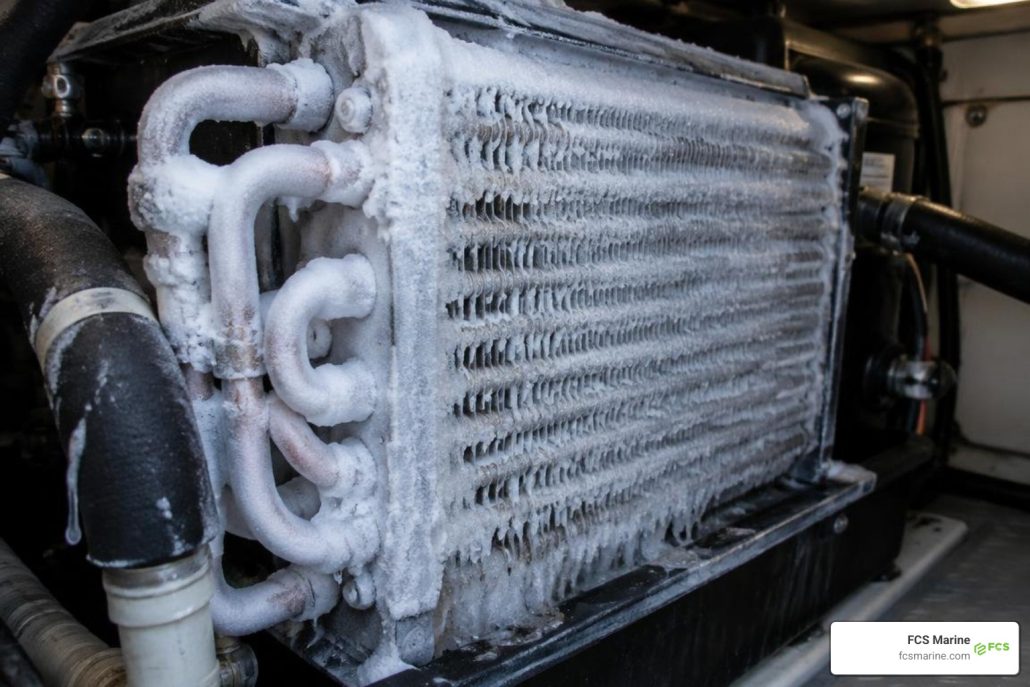
Why Your Boat AC Is Freezing Up
If your boat AC is freezing up and the stateroom air turns warm, turn off cooling and let the ice melt before running it again. Then clean the return-air filter, check for blocked vents or crushed ducts, and make sure the blower moves air steadily. Poor airflow is a common cause; low refrigerant can also ice the coil, even with a clean filter. If the ice returns after these checks, stop running the compressor and arrange a professional diagnosis.
In South Florida, a frozen coil can quickly leave a cabin warm and humid. FCS Marine provides on-site marine AC repair for boats and yachts where they are moored.
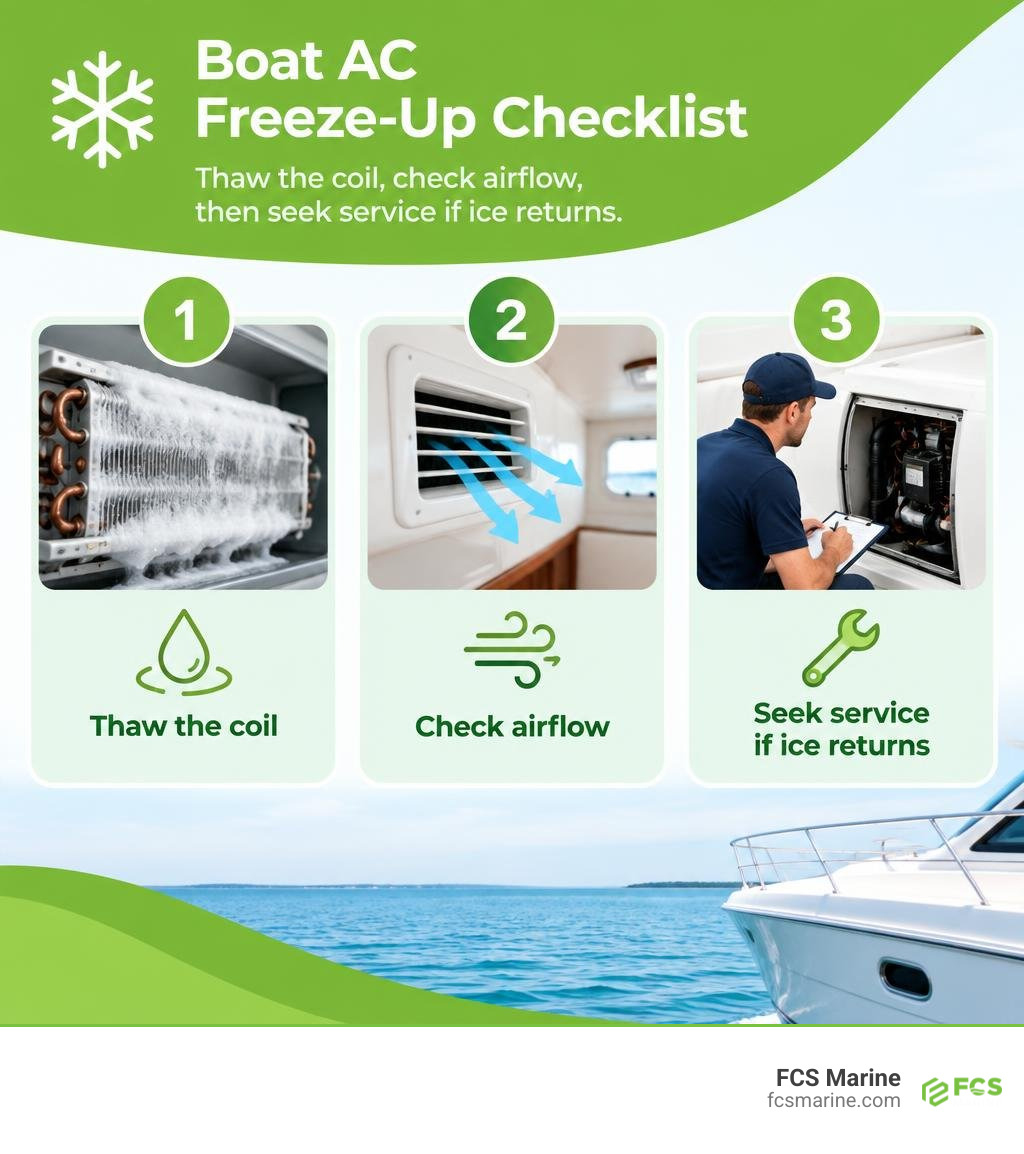
Core Reasons Behind Your Boat AC Freezing Up
When a marine climate control system operates normally, warm cabin air passes over the evaporator coil. The refrigerant flowing inside the coil absorbs heat and moisture from the stateroom. This continuous exchange keeps the coil temperature above freezing while dehumidifying and chilling the cabin.
If this heat exchange is disrupted, the balance is lost. The temperature of the coil drops below 32°F (0°C). Any condensation pulled from the humid cabin atmosphere rapidly turns into frost. This frost accumulates layer upon layer until a solid block of ice encases the evaporator fins.
Ice acts as an insulator rather than a cooling medium. Once the coil is iced over, air can no longer pass through the fins, and the boat air conditioning stops cooling the cabin entirely. The blower fan will continue to spin, but it only pushes stagnant, unconditioned air into the stateroom.
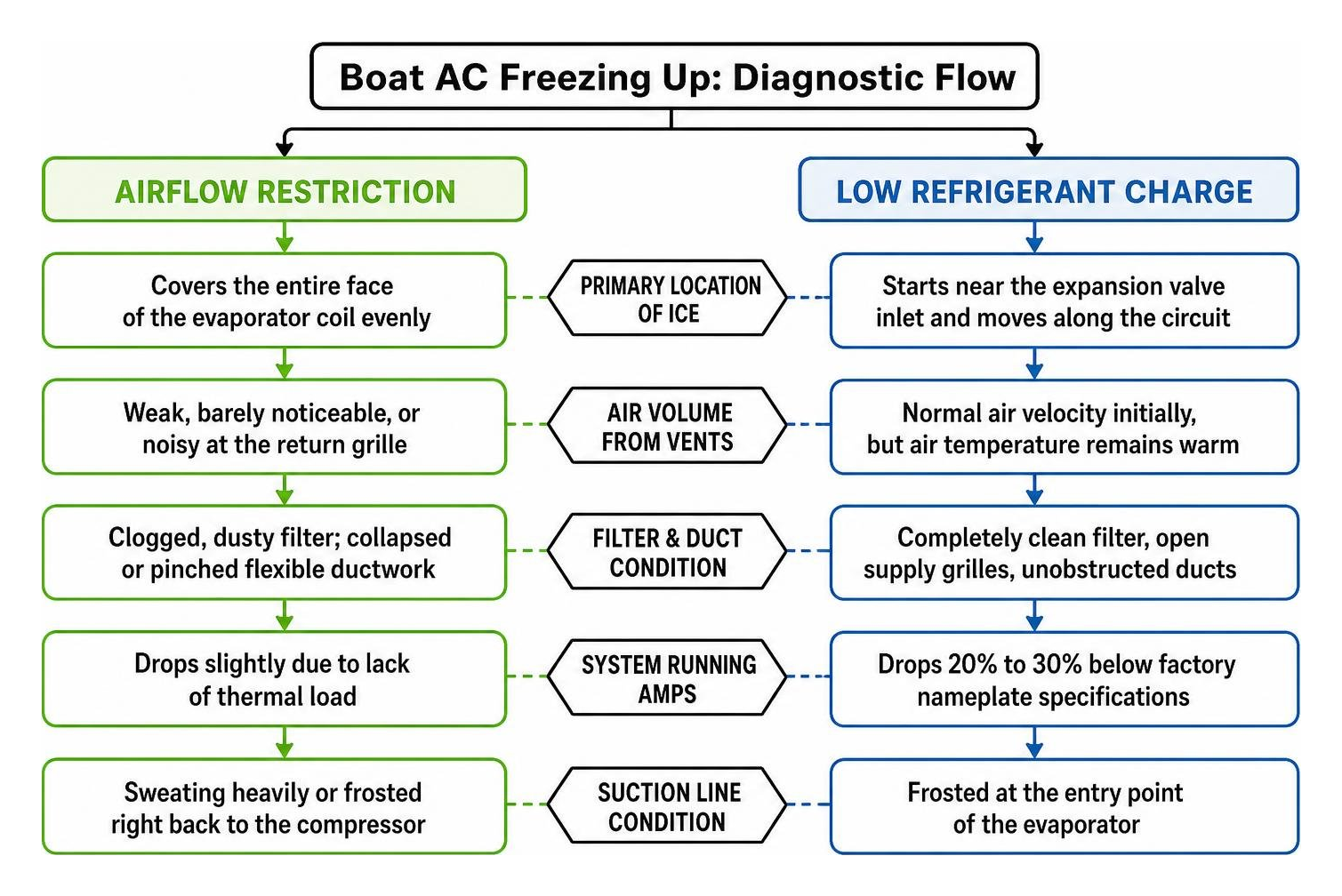
Understanding why your system builds ice comes down to two primary mechanical issues: restricted airflow across the evaporator or an improper refrigerant charge.
| Diagnostic Factor | Airflow Restriction | Low Refrigerant Charge |
|---|---|---|
| Primary Location of Ice | Covers the entire face of the evaporator coil evenly | Starts near the expansion valve inlet and moves along the circuit |
| Air Volume from Vents | Weak, barely noticeable, or noisy at the return grille | Normal air velocity initially, but air temperature remains warm |
| Filter & Duct Condition | Clogged, dusty filter; collapsed or pinched flexible ductwork | Completely clean filter, open supply grilles, unobstructed ducts |
| System Running Amps | Drops slightly due to lack of thermal load | Drops 20% to 30% below factory nameplate specifications |
| Suction Line Condition | Sweating heavily or frosted right back to the compressor | Frosted at the entry point of the evaporator |
Distinguishing Airflow Restrictions When a Boat AC Is Freezing Up
Airflow is the lifeblood of direct expansion marine HVAC systems. Without adequate cabin air moving across the fins, the refrigerant inside cannot absorb sufficient ambient heat to maintain a safe evaporating temperature.
To resolve this issue, boaters should regularly clean your marine AC filter to prevent dust, pet dander, and salt residue from choking intake air.
Beyond a dirty filter, airflow problems can stem from:
- Crushed or pinched flexible ducting hidden behind bulkheads or under berths.
- Supply air louvers accidentally closed in guest staterooms or heads.
- A blower motor running on a low manual fan speed during peak afternoon heat.
- Heavy lint or fungal growth built up directly on the backside of the evaporator coil fins.
Low Refrigerant Symptoms and Why Your Boat AC Freezes Up
It might seem counterintuitive that having less refrigerant makes an air conditioning unit freeze. However, refrigeration systems rely on maintaining precise pressure thresholds.
When a system suffers from a pinhole leak—often due to galvanic corrosion or vibration rubbing copper lines against fiberglass hulls—the internal pressure drops. In a lower pressure environment, the boiling point of the refrigerant drops below freezing. The chemical boils off immediately upon entering the coil, super-chilling the inlet tubes.
Moisture in the air immediately freezes onto this super-chilled metal. Over time, that frost spreads across the rest of the coil. A similar symptom happens with faulty expansion valves that stick closed, restricting refrigerant flow into the evaporator.
Marine-Specific Causes and Environmental Triggers
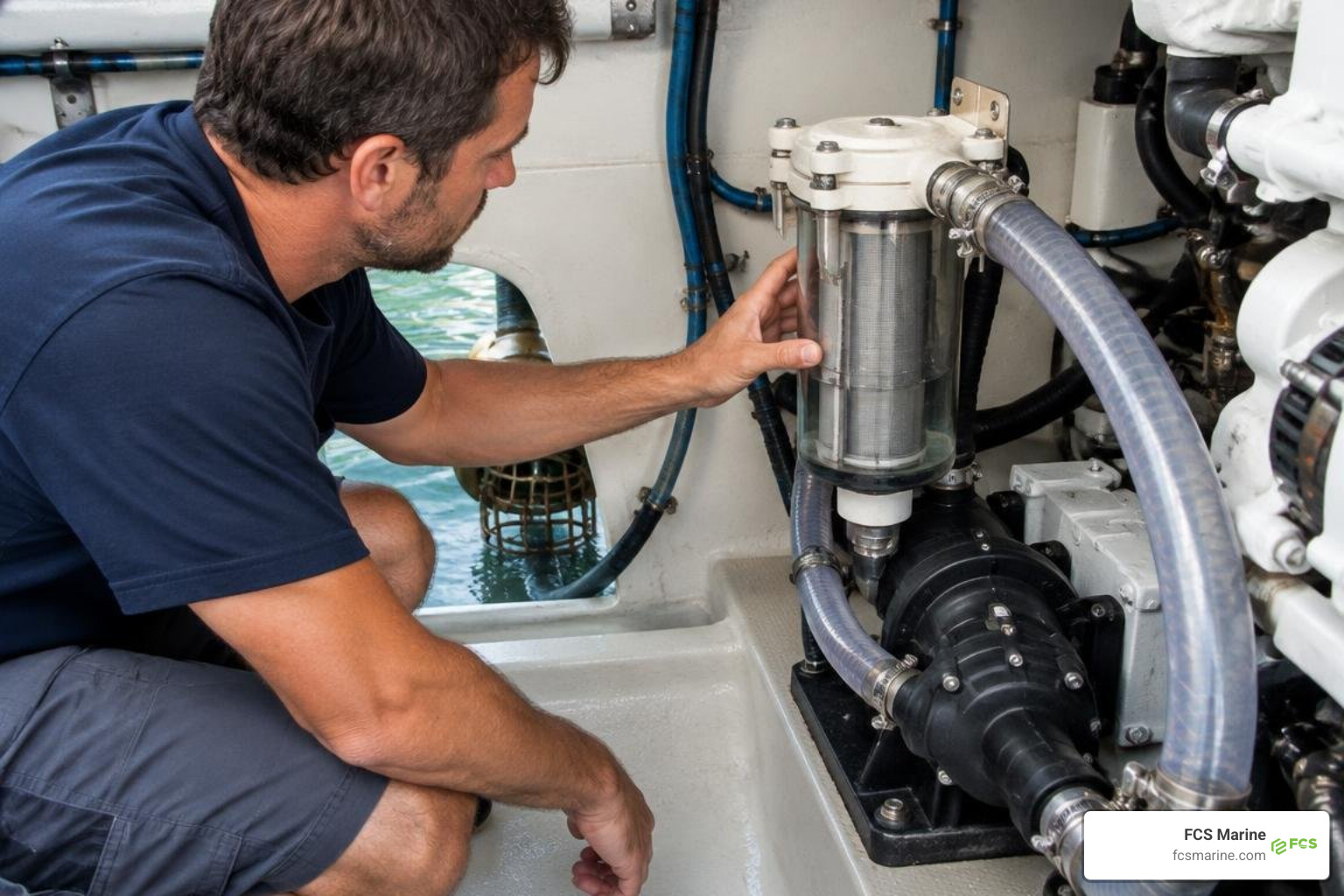
Unlike residential split units that reject heat into outdoor air, marine self-contained and split systems rely entirely on seawater to cool their condensers. The unique marine environment introduces several variables that influence freeze-ups:
- Strainer Fouling and Bio-Growth: South Florida waters are rich in marine life. Barnacles, sea grass, and jellyfish can quickly clog a raw-water sea strainer or the hull’s intake scoop. When water flow drops, head pressures shift wildly, creating unstable operating dynamics.
- Pump Impeller Wear: Magnetic-drive seawater cooling pumps depend on clean water flow. A worn or slipping impeller reduces overall gallons-per-hour delivery, reducing system efficiency and causing pressure switches to cycle erratically.
- Low Seawater Temperatures (Reverse-Cycle Heating): In reverse-cycle heating mode, the refrigerant flow is reversed. The seawater coil acts as the evaporator, pulling heat from the ocean to warm the cabin. If seawater temperatures dip below 40°F (4.4°C), or if water flow through the heat exchanger is restricted, the raw-water coil can freeze solid and burst.
- Extreme Cabin Humidity: High ambient humidity places an intense moisture load on the evaporator. If the cabin door or companionway hatches are left open while running the air conditioning, the sheer volume of water condensing on a cool coil can accelerate frost formation if airflow is slightly restricted.
Warning Signs and Step-by-Step DIY Diagnostics
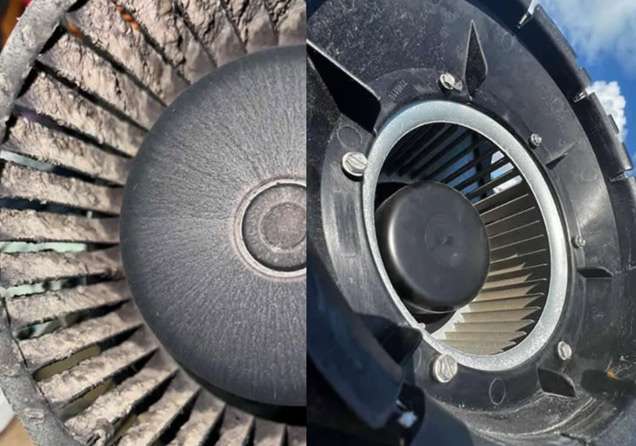
Catching a freeze-up early prevents strain on the compressor and saves cabin woodwork from water damage when the ice inevitably thaws. Follow these steps to diagnose boat AC issues in clear steps:
- Check the Air Delivery: Place your hand over the supply discharge grilles. If you hear the blower fan running at full speed but feel almost no air moving, ice has likely blocked the coil passages.
- Inspect the Evaporator: Remove the return air grille or access hatch. Look at the aluminum fins. A light dusting of white frost or a thick layer of ice confirms a freeze-up.
- Measure the Temperature Drop (TD): Use an infrared thermometer to measure the difference between return air entering the filter and supply air exiting the nearest vent. A healthy system typically shows a temperature differential between 15°F and 20°F (8°C to 11°C). If the differential is significantly wider, check for restricted airflow; if it is lower, water flow or refrigerant levels are suspect.
- Inspect the Seawater Discharge: Look over the side of the hull while the unit is running. You should see a steady, vigorous stream of cooling water discharging overboard. A sputtering discharge indicates trapped air, strainer clogging, or pump issues.
- Listen to the Compressor: When a coil is heavily iced, the compressor does not have a thermal load to work against. It will sound quieter than usual and run with an electrical amperage draw roughly 20% to 30% below its normal operating rating.
For broader troubleshooting strategies, vessel operators can consult the Dometic Journal’s marine AC troubleshooting guide to understand how system components interact.
Temporary Workarounds and Defrost Steps for Vessel Owners
If you discover an iced coil while anchored out or away from home port, do not chip away at the ice with screwdrivers or knives. The copper tubes and aluminum fins are fragile and easily punctured.
Follow this safe thawing and operational routine:
- Switch the Thermostat to “Fan Only”: Turn the AC mode from COOL to OFF, and set the fan speed to MANUAL HIGH. Running the fan forces warm cabin air across the ice block, melting it naturally in 15 to 30 minutes.
- Monitor the Condensate Drain: As pounds of ice melt, a massive volume of water drains into the condensate pan. Ensure the drain fitting and hose are completely clear so water drains into the sump box rather than overflowing into stateroom cabinetry or under-bunk storage.
- Raise the Setpoint Temperature: When restarting cooling, do not set the digital thermostat down to 60°F in an attempt to cool the boat faster. Set the thermostat to a reasonable 74°F (23°C) to allow the system to cycle normally.
- Lock Fan on High Speed: Avoid setting the blower fan to “AUTO” mode in hot, humid weather. Auto mode drops fan speed as the room nears the setpoint, which can lower airflow enough to trigger another freeze cycle on marginal systems.
To maintain reliable operation over the season, keep up with a structured preventive marine AC maintenance checklist throughout the year.
Why Professional Mobile Service Matters for Yacht HVAC Systems
While cleaning a filter or thawing a coil is an easy DIY task, resolving recurring freeze-ups requires specialized refrigeration tools and marine engineering knowledge.
Marine HVAC systems are compact, sealed environments. Low-pressure switches open around 35 PSI and reset at 55 PSI, while high-pressure safety switches trip near 425 PSI. Verifying whether a freeze is caused by a leaking capillary tube, a bad thermal expansion valve (TXV), or an out-of-calibration pressure switch requires connecting manifold gauges and measuring superheat and subcooling levels.
Handling marine refrigerants like R-410A or legacy R-22 also requires compliance with EPA Section 608 guidelines, which mandate certified recovery and leak repair procedures.
FCS Marine provides mobile, on-site service across South Florida. Our technicians travel directly to your vessel at marinas, private docks, and boat yards in Fort Lauderdale, Pompano Beach, Miami, and throughout Palm Beach, Broward, Miami-Dade, Martin, and St. Lucie counties. We diagnose complex electrical faults, fix line leaks, and perform precision recharges on-site so you never have to move your boat.
Frequently Asked Questions About Marine AC Icing
Can low refrigerant freeze my evaporator coil if the filter is completely clean?
Yes. When refrigerant leaks from the system, the operating pressure inside the evaporator coil drops significantly. Lower pressure lowers the temperature at which the refrigerant boils. As a result, the coil drops below 32°F (0°C), freezing moisture from the air onto the metal fins even if airflow is completely unrestricted.
Why does my reverse-cycle marine AC freeze up during the heating cycle?
During reverse-cycle heating, the flow of refrigerant is reversed using a reversing valve. The raw-water heat exchanger becomes the evaporator, extracting heat from the ocean water. If seawater temperatures fall below 40°F (4.4°C) or if water flow through the sea strainer is restricted, the seawater inside the heat exchanger can freeze solid, risking split pipes and flooding.
How do I know if poor seawater flow is causing my system to malfunction?
Check your hull’s overboard discharge port while the air conditioner is running. A healthy system delivers a solid, continuous stream of water. If the flow is weak, sputtering, or hot to the touch, inspect your sea strainer for grass and debris, check the pump impeller, and ensure the through-hull seacock is fully open.
Keep Your Cabin Cool with FCS Marine
A frozen air conditioning unit can quickly ruin a weekend cruise or create costly interior moisture damage. Whether your system requires a fast filter overhaul, expansion valve calibration, electrical diagnostic, or sealed-system leak repair, our team is equipped to restore your onboard comfort.
FCS Marine specializes in mobile, on-site yacht systems service throughout South Florida. From comprehensive marine air conditioning repair and marine refrigeration to yacht wall insulation, mold remediation, and watermaker maintenance, we deliver reliable solutions right to your dock.
Contact FCS Marine today to schedule an on-site diagnostic inspection for your vessel in Broward, Miami-Dade, Palm Beach, Martin, or St. Lucie County.