When Your Boat’s AC Quits in the South Florida Heat
Marine AC unit replacement is one of the most high-stakes maintenance decisions a boat owner can face — especially when you’re tied up in Fort Lauderdale, Miami, or anywhere along South Florida’s coastline in the middle of summer.
Here’s a quick overview of what’s involved:
- When to replace vs. repair: Compressor failure, corroded coils, or refrigerant phase-outs usually mean replacement is the smarter call
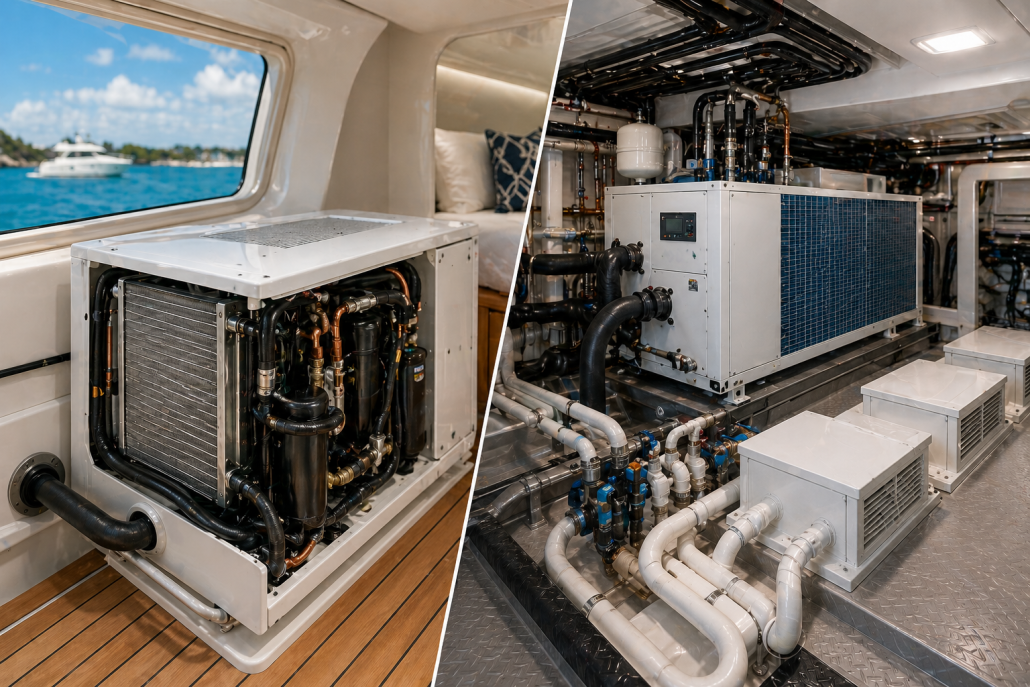
- System types: Self-contained units (boats under 40′), split systems (up to 80′), and chilled water systems (larger yachts)
- Sizing formula: (Cabin length × width × height) × 14 + 1,000 = BTUs needed
- Top brands: CTM Marine, Webasto, Dometic, Flagship, and Mermaid — each with different warranties, coil materials, and price points
- Installation essentials: Dedicated breaker, raw water strainer, pump below the waterline, and properly routed ducting
South Florida’s heat and humidity put marine AC systems under enormous stress. Saltwater-cooled units that work hard from April through October wear out faster here than almost anywhere else. When a system starts struggling — or stops working entirely — the discomfort is immediate. And on a live-aboard vessel or a yacht with guests aboard, “immediate” is an understatement.
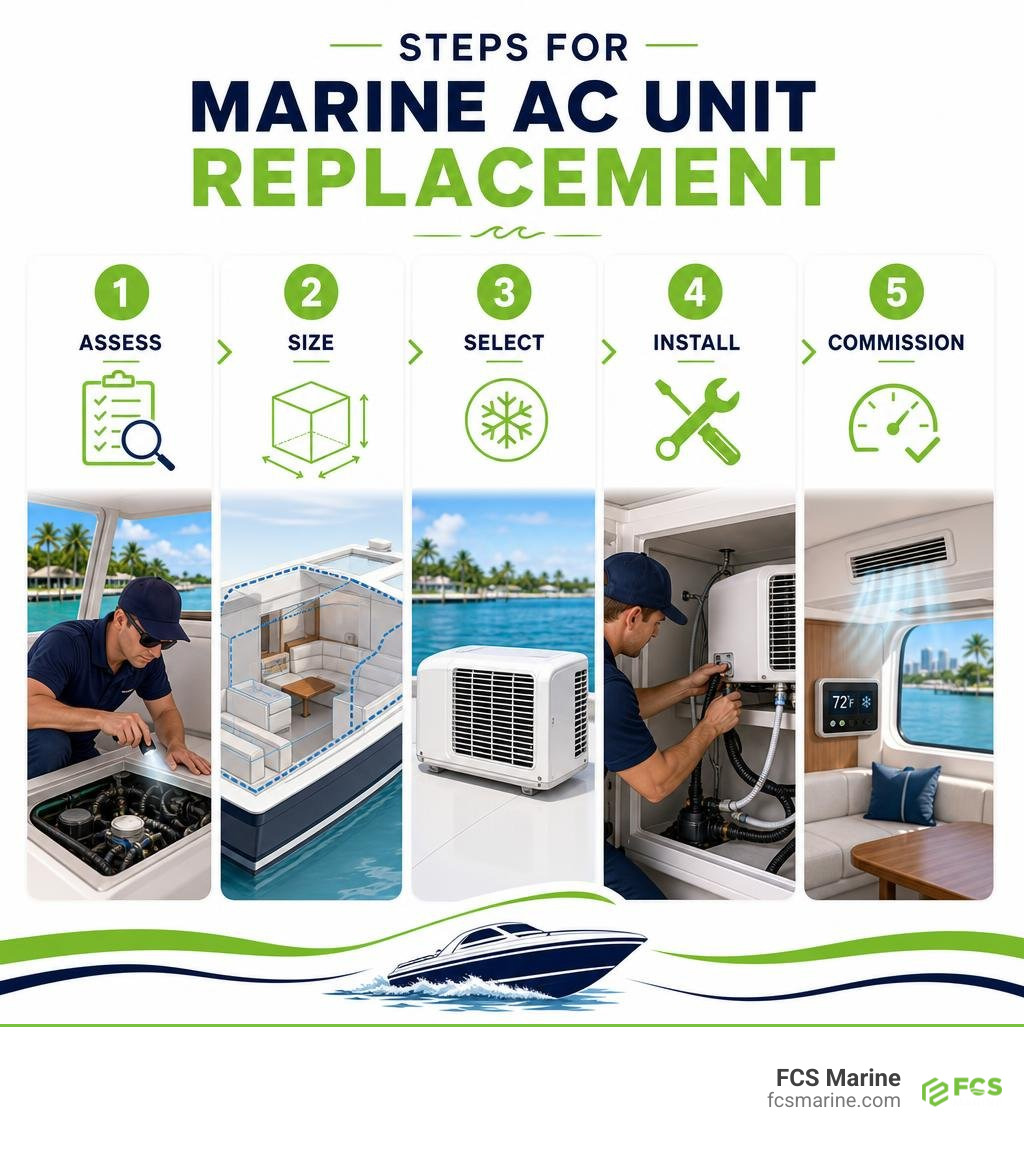
At FCS Marine, we provide professional mobile marine AC service across South Florida, coming directly to your vessel wherever it’s located — so you don’t have to move the boat to get expert help.
Repair vs. Marine AC Unit Replacement: When is it Time to Upgrade?
It is a scenario every boat owner dreads: you step down into the cabin after a long day on the water, only to be greeted by a wall of hot, humid air. Before you immediately budget for a brand-new system, it is important to determine whether you need a quick fix or a complete marine AC unit replacement.
Minor issues—such as a tripped breaker, a clogged seawater strainer, or a blown fuse—can be resolved quickly. However, several major issues point directly toward replacement as the most cost-effective long-term path.
Major indicators that it is time to upgrade include:
- Compressor Failure: The compressor is the heart of your air conditioner. If it locks up or fails electrically, replacing it is highly labor-intensive and costly. On an older unit, investing in a new compressor rarely makes sense.
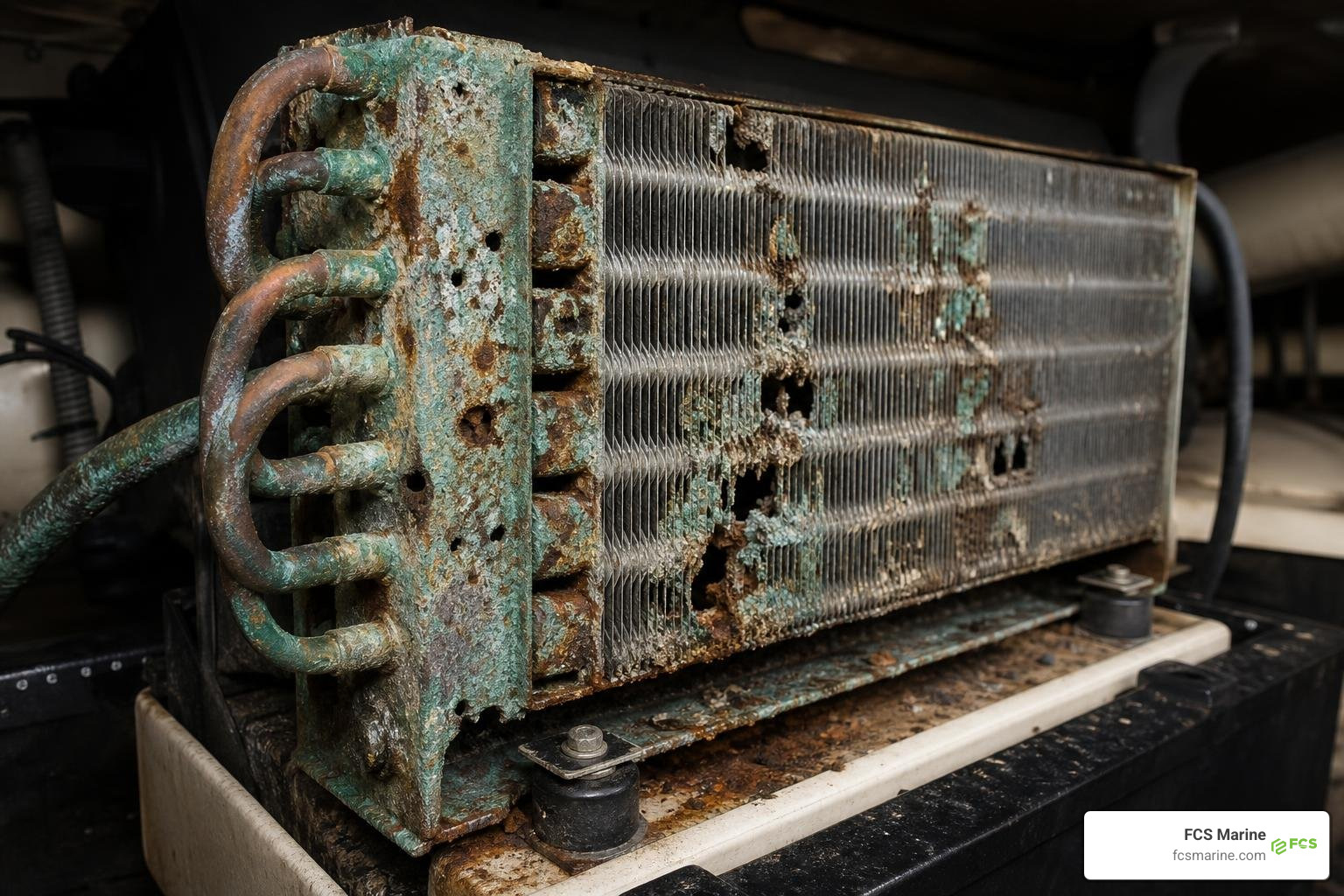
- Severe Coil Corrosion: Because marine systems rely on raw seawater to reject heat, the condensing coils are highly susceptible to corrosion. Once copper coils develop pinhole leaks and lose refrigerant, the unit is effectively done.
- Refrigerant Phase-Outs: Older marine AC units running on R22 refrigerant are increasingly difficult and expensive to service. Modern systems utilize environmentally friendly R410A, making replacement the only viable option when older systems leak.
To better understand how these systems are diagnosed, you can read how marine AC service works. If your system is running but failing to lower the cabin temperature, check out our guide on what to do when your boat air conditioning stops cooling.
Common Causes of Marine AC Failure
Marine air conditioners operate in one of the most unforgiving environments on earth. Constant exposure to saltwater, high ambient temperatures, humidity, and continuous vessel vibration eventually takes its toll.
The most common catalysts for complete system failure include:
- Thermal Expansion Valve (TXV) Failures: The TXV regulates refrigerant flow. When it fails or becomes clogged, the system cannot cool properly. For more details, see our guide on fixing your boat’s AC TXV valve.
- Scale and Marine Growth Buildup: Barnacles, algae, and calcium scale build up inside the condenser coils. This restricts water flow, leading to high-pressure lockouts. If left untreated, the heat buildup can permanently damage the compressor.
- Electrical Burnouts: Corroded wiring connections, failing start capacitors, or damaged control boards can cause severe electrical faults that ruin the motor windings inside the compressor.
Choosing and Sizing the Right System Type for Your Vessel
Selecting the perfect system requires balancing your vessel’s physical layout, length, and your cruising habits. Modern marine AC units also double as highly efficient heat pumps. This reverse-cycle heating capability allows the system to reverse the flow of refrigerant, warming your cabin using the ambient temperature of the surrounding water.
To explore the fundamental differences between these setups, read our technical breakdown of chilled water vs self-contained AC systems. For an even broader look at marine climate systems, consult this Boat AC Systems: A Complete Guide to Marine Air Conditioning.
Calculating BTU Sizing for Your Marine AC Unit Replacement
Sizing a marine air conditioner is not a guessing game. An undersized unit will run constantly without ever cooling the cabin, while an oversized unit will cool the space too quickly without removing humidity, leaving you with a cold, clammy cabin.
To calculate the British Thermal Units (BTUs) required for your vessel, use the following industry-standard formula:
- Measure the Cabin Volume: Multiply the Length × Width × Height (in feet) of the living space you need to cool.
- Apply the Marine Multiplier: Multiply the total cubic volume by 14.
- Account for Solar Load: Add 1,000 BTUs to the total to account for the heavy solar heat load experienced by boats in sunny South Florida.
Formula: $$text{Required BTUs} = (text{Volume in Cubic Feet} times 14) + 1,000$$
Here is a general guideline for BTU requirements based on typical boat lengths:
- Boats up to 28–30 feet: 6,000 to 10,000 BTUs
- Boats up to 32–34 feet: 12,000 to 14,000 BTUs (often served by a single mid-sized unit)
- Boats up to 36–40 feet: 16,000 to 24,000 BTUs (often split into multiple zones)
Self-Contained, Split, and Chiller Systems by Boat Size
The size of your boat largely dictates the architecture of your air conditioning system:
- Self-Contained Systems (Best for boats up to 40 feet): These compact units contain all major components—the compressor, evaporator, condenser, and blower—on a single chassis. They are typically mounted in a locker or under a bunk.
- Split Systems (Best for boats up to 80 feet): These divide the components. The noisy condensing unit (compressor and condenser) is installed in the engine room or mechanical space, while the quiet evaporator and air handler are located in the living space, connected by copper refrigerant lines. For technical layouts, see these guides on Condensing Units and L-2028.p65.
- Chilled Water Systems (Best for yachts over 80 feet): These commercial-grade systems use a central chiller unit in the engine room to cool fresh water. This chilled water is then pumped through insulated pipes to individual air handlers throughout the yacht.
Comparing Top Brands and Retrofit Compatibility
When planning a marine AC unit replacement, choosing the right brand is about more than just the price tag. You must evaluate the materials used (such as corrosion-resistant titanium coils vs. traditional copper), the manufacturer’s warranty, and the physical footprint of the unit.
Below is a comparison of the industry’s leading marine AC brands:
| Brand | Warranty Period | Key Material / Feature | Ideal Application |
|---|---|---|---|
| CTM Marine | 2-Year Warranty | Titanium Condenser Coils | Premium corrosion resistance & high value |
| Webasto | 2-Year Free Replacement | FCF Classic & Platinum series | Direct drop-in replacement for legacy units |
| Dometic | 6-Month to 2-Year (varies) | Turbo & EnviroComfort Series | Broad OEM replacement network |
| Flagship Marine | 5-Year Parts / 1-Year Labor | No-PCB Mechanical Relays | Commercial-grade, ultra-reliable |
| Mermaid | 5-Year Warranty | Heavy-duty construction | High-durability US-built retrofits |
For those looking at Dometic retrofits, the Dometic EnviroComfort ECD16K-HV AC Retrofit Kit – 115V – 16,000 BTU – Legacy Marine Supply is a highly popular option.
Key Brand Differences: CTM, Webasto, Dometic, Flagship, and Mermaid
- CTM Marine: A highly competitive option, CTM Marine offers units at a lower price point than comparable models of the same BTU capacity from other major brands. Their standout feature is the use of titanium condensing coils, which are vastly superior to copper in resisting saltwater corrosion. The CTM CT-16 (16,000 BTU, 115V) is priced around $2,789.00 and serves as an excellent, durable replacement.
- Webasto: Webasto FCF Classic and Platinum series units are renowned for their reliability and come with a 2-year free replacement warranty if the unit cannot be repaired. They are great direct replacement options—for example, the Webasto FCF Classic 12k can directly replace an older Dometic ECD10k, and the FCF Platinum 12k is a great match for a Dometic DTU12.
- Dometic: As the industry giant that acquired Cruisair and Marine Air, Dometic’s EnviroComfort (ECD) and Turbo series are incredibly common. The ECD16K-HV retrofit kit lists at $3,580.00 (frequently sold around $2,725.26) and offers a complete, self-contained solution.
- Flagship Marine: Built to commercial and military standards, Flagship Marine units feature a 5-year parts warranty. Uniquely, they completely avoid PCB circuit boards, opting instead for simple, highly reliable mechanical relays and standard household thermostats that are easy to service.
- Mermaid Manufacturing: Offering an industry-leading 5-year warranty covering defects in materials and workmanship, Mermaid units are built in the US and are known for their rugged construction.
Compatibility Checks for Controls, Cables, and Footprints
If you are retrofitting an older system, you cannot always assume your old control panel or thermostat cable will plug into a new unit.
- Wiring & Keypads: While CTM Marine units are engineered to be highly compatible with legacy SMX II and SMXir keypads, other brands like Dometic require you to run the new digital control cable and use the thermostat keypad supplied with the retrofit kit.
- Physical Footprint: Modern units are often more compact than those built 20 years ago, making physical placement easier. However, you must ensure you have at least 2 inches of additional clearance around the unit for proper installation and airflow.
- Rotatable Blowers: Opt for units featuring 360-degree rotatable blowers. This allows you to align the air discharge collar directly with your existing ductwork, preventing sharp bends that strangle airflow.
Critical Installation, Electrical, and Plumbing Requirements
Installing a marine air conditioner is a highly technical process that involves managing three distinct systems: electrical, seawater plumbing, and ducting.
To ensure safety and performance, installations must align with American Boat and Yacht Council (ABYC) standards. For detailed manufacturer specifications, refer to the FCF Platinum Marine Air Conditioner Series installation manual.
Electrical Specifications for a Marine AC Unit Replacement
A standard 16,000 BTU self-contained marine AC unit draws approximately 2,400 watts during normal operation (which translates to roughly 20 amps at 120V, or 10 amps at 240V).
However, the most critical electrical factor is the startup surge (Locked Rotor Amps or LRA). When the compressor starts, the current spike can be 3 to 4 times higher than the running current.
- Breaker and Wiring: The unit must run on a dedicated circuit breaker. All wiring must utilize multi-strand, tinned copper marine-grade cable (minimum 12 AWG for most 115V installations) to resist corrosion and vibration.
- Generator Sizing: If you plan to run your AC away from the dock, your generator must be sized to handle the startup surge. A good rule of thumb is to budget 1,500 to 2,000 watts of generator capacity per ton (12,000 BTUs) of air conditioning.
- Bonding and Grounding: To prevent stray-current galvanic corrosion, the AC unit’s chassis and all metallic plumbing components (seacock, strainer, pump housing) must be securely connected to the vessel’s bonding system.
Seawater Plumbing and Ducting Best Practices
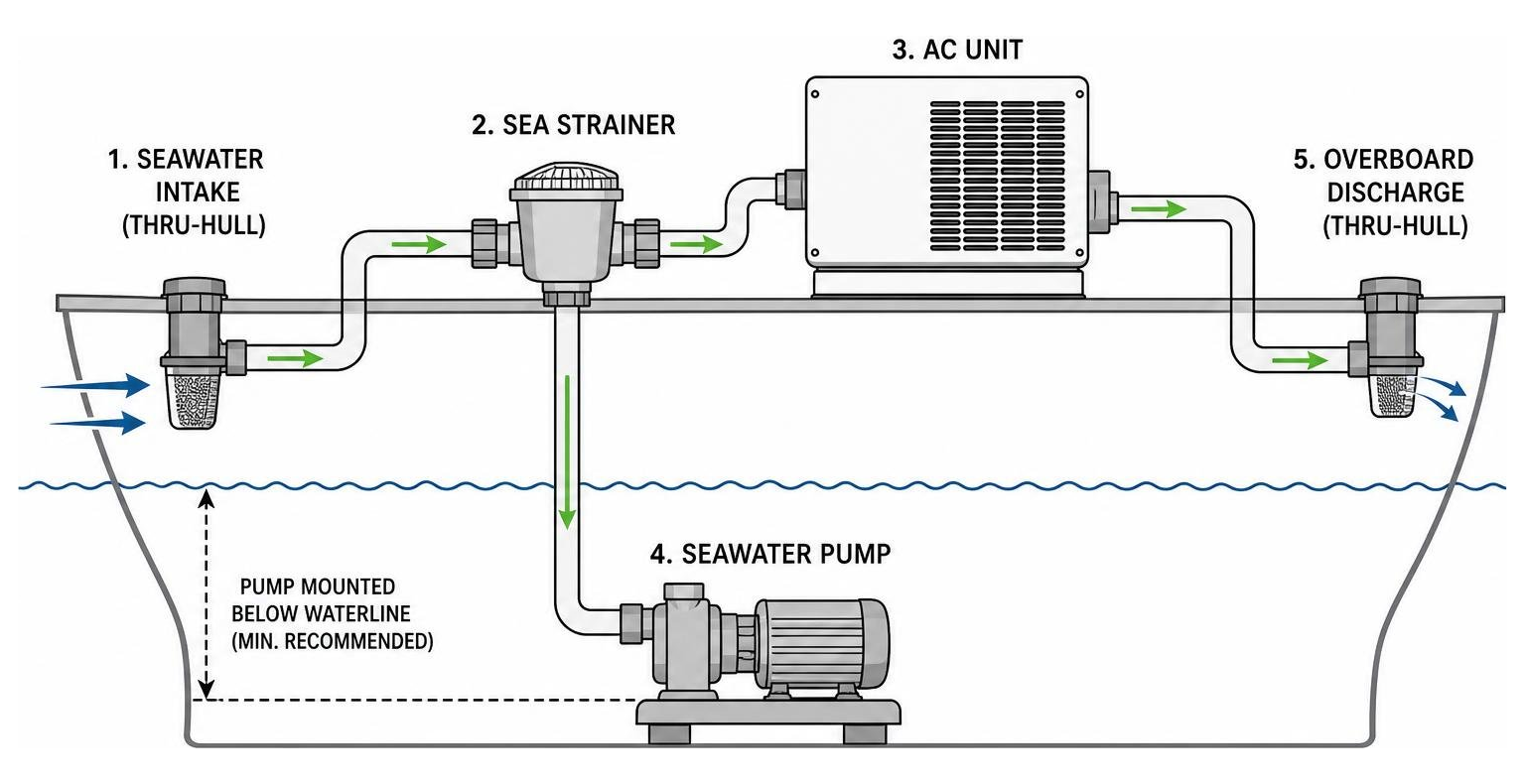
Because marine AC pumps are centrifugal, they are not self-priming. This means they rely entirely on gravity to stay flooded with water.
- Pump Placement: The seawater pump must be mounted at least 1 foot below the waterline so that water naturally flows into it.
- Hose Routing: Avoid any loops or high spots in the seawater hose that could trap air and cause an airlock. Secure every hose connection with double stainless steel hose clamps, reversing the direction of the clamps.
- Strainer Installation: A raw water strainer is mandatory between the seacock and the pump to catch weeds, grass, and marine debris.
- Ducting Efficiency: Keep duct runs as straight and tight as possible. Just two tight 90-degree bends can reduce your system’s airflow by up to 25%. Secure ducting to transition boxes using stainless steel sheet metal screws rather than simple tape or band clamps.
- Condensate Management: A marine AC can produce up to 0.5 gallons of condensate water per hour in humid climates. Route the drain pan to a sealed sump pump rather than directly into the bilge to keep your bilge dry and prevent musty odors.
Frequently Asked Questions About Marine AC Replacement
Regular upkeep is vital to protecting your investment. You can keep your system running smoothly by following our comprehensive marine AC maintenance checklist.
Can I install a replacement marine AC unit myself?
While handy boat owners can physically swap out a self-contained unit, professional installation and commissioning are highly recommended. Working with high-voltage electrical panels, plumbing below-the-waterline thru-hulls, and handling refrigerants carry significant safety risks. Furthermore, many manufacturers require a certified marine technician to sign off on the installation to validate the warranty.
What is reverse-cycle heating and do I need it?
Reverse-cycle heating reverses the flow of refrigerant using a reversing valve, turning your AC into a highly efficient heat pump. Instead of cooling the cabin, it extracts heat from the surrounding seawater and transfers it into your boat. Yes, you want this feature. Even in South Florida, winter nights can get surprisingly chilly, and reverse-cycle heating is far safer and more efficient than space heaters. Heat pumps work highly efficiently in water temperatures down to about 40°F (4.4°C).
Why is my new marine AC unit short-cycling?
Short-cycling occurs when the compressor turns on and off too rapidly. This is almost always caused by an airflow restriction or poor sensor placement. If your cool supply air is blowing directly toward your return air grille, the thermostat sensor will think the cabin is cool and shut the system down prematurely. Ensure your return air grille has at least 4 inches of clearance and that the temperature sensor is located in the path of the returning cabin air, not directly in front of a supply duct.
Conclusion: Professional Mobile Marine AC Services in South Florida
A reliable marine air conditioning system is not a luxury in South Florida—it is an absolute necessity for protecting your vessel from mold, maintaining cabin comfort, and keeping your time on the water enjoyable.
When your system shows signs of failing, trying to tackle a complex marine AC unit replacement on your own can lead to costly mistakes, electrical hazards, or plumbing leaks.
At FCS Marine, we specialize in professional, certified marine air conditioning services across South Florida. As a family-owned business, we understand the local climate and the unique demands placed on your yacht’s systems.
Our technicians are fully mobile, meaning we come directly to where your vessel is located—whether you are tied up at a private dock, a local boat yard, or a marina in Palm Beach County, Broward County, Miami-Dade County, Martin County, or St. Lucie County.
From Fort Lauderdale to Pompano Beach, we provide fast, on-site diagnostics, expert system sizing, and flawless installation backed by our satisfaction guarantee. If you want to make sure your system is installed to the highest industry standards, let us help you find a certified marine AC technician from our experienced team.
Don’t let the South Florida heat take over your cabin. Contact FCS Marine today to schedule your professional mobile marine AC replacement or service!