Stay Cool at Anchor With a 12V Marine AC System
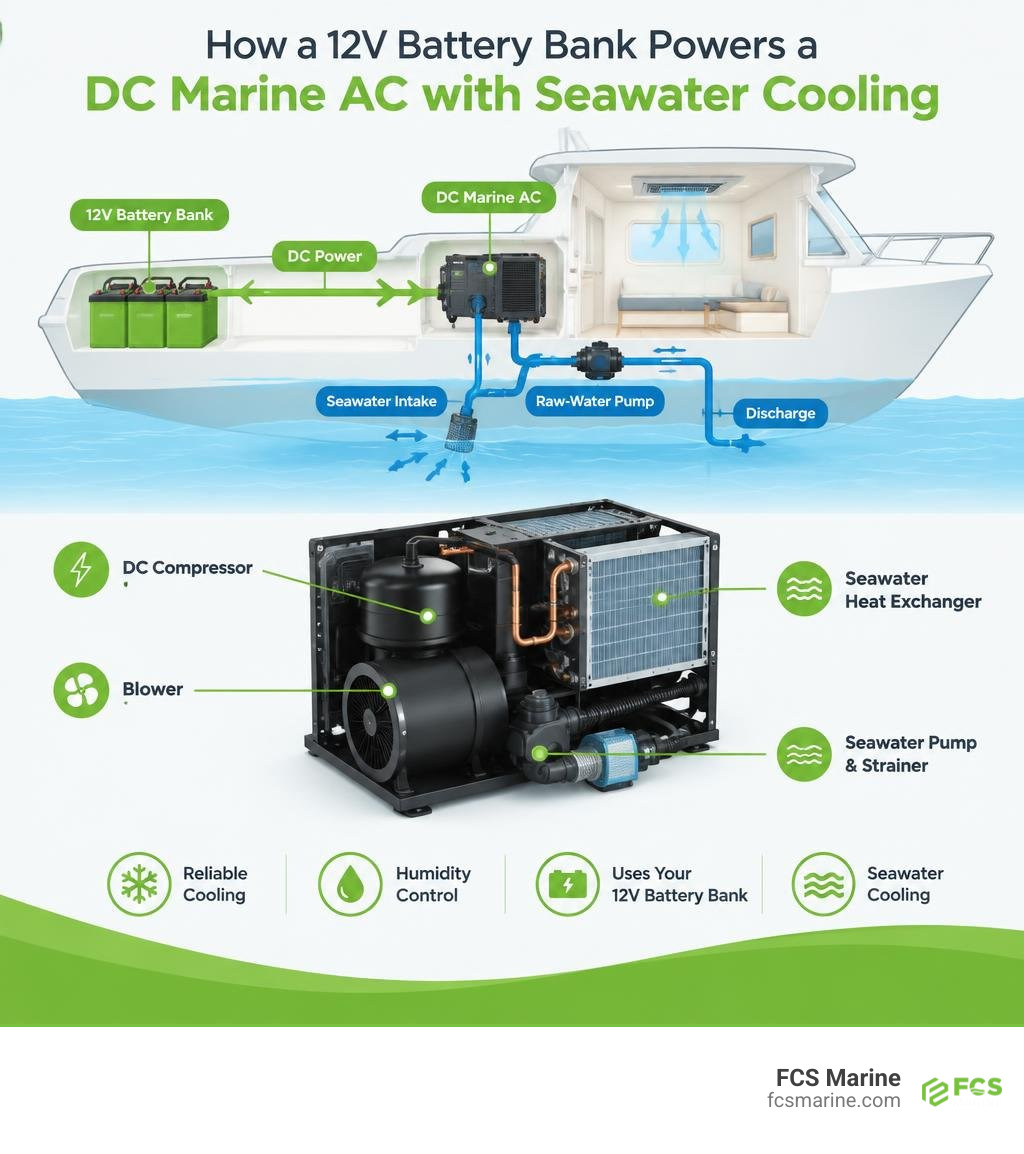
A 12V marine AC lets you cool a boat cabin directly from a properly sized DC battery system, reducing the need to run a generator at anchor. Modern variable-speed units are available from roughly 6,000 to 12,000 BTU, but they draw substantial current: commonly about 34 to 70 amps at 12V, depending on capacity, cabin temperature, compressor speed, and the raw-water pump.
Before choosing a system, confirm these three basics:
- Cooling capacity: Match BTU output to cabin volume, insulation, sun exposure, and the number of people onboard.
- Battery and wiring capacity: LiFePO4 battery banks handle high, sustained loads better than conventional lead-acid batteries, which can suffer voltage drop.
- Marine installation needs: Plan room for the unit, ducts, condensate drain, seawater intake, pump, strainer, and corrosion-resistant heat exchanger.
For South Florida boat owners, cooling is also a humidity-control issue. A correctly installed marine air conditioner helps limit condensation and the damp conditions that can contribute to odors and mold inside cabins. FCS Marine provides mobile, on-site marine air-conditioning support at marinas, boat yards, private docks, and other vessel locations throughout South Florida.
Understanding 12V Marine AC Systems and Core Cooling Performance
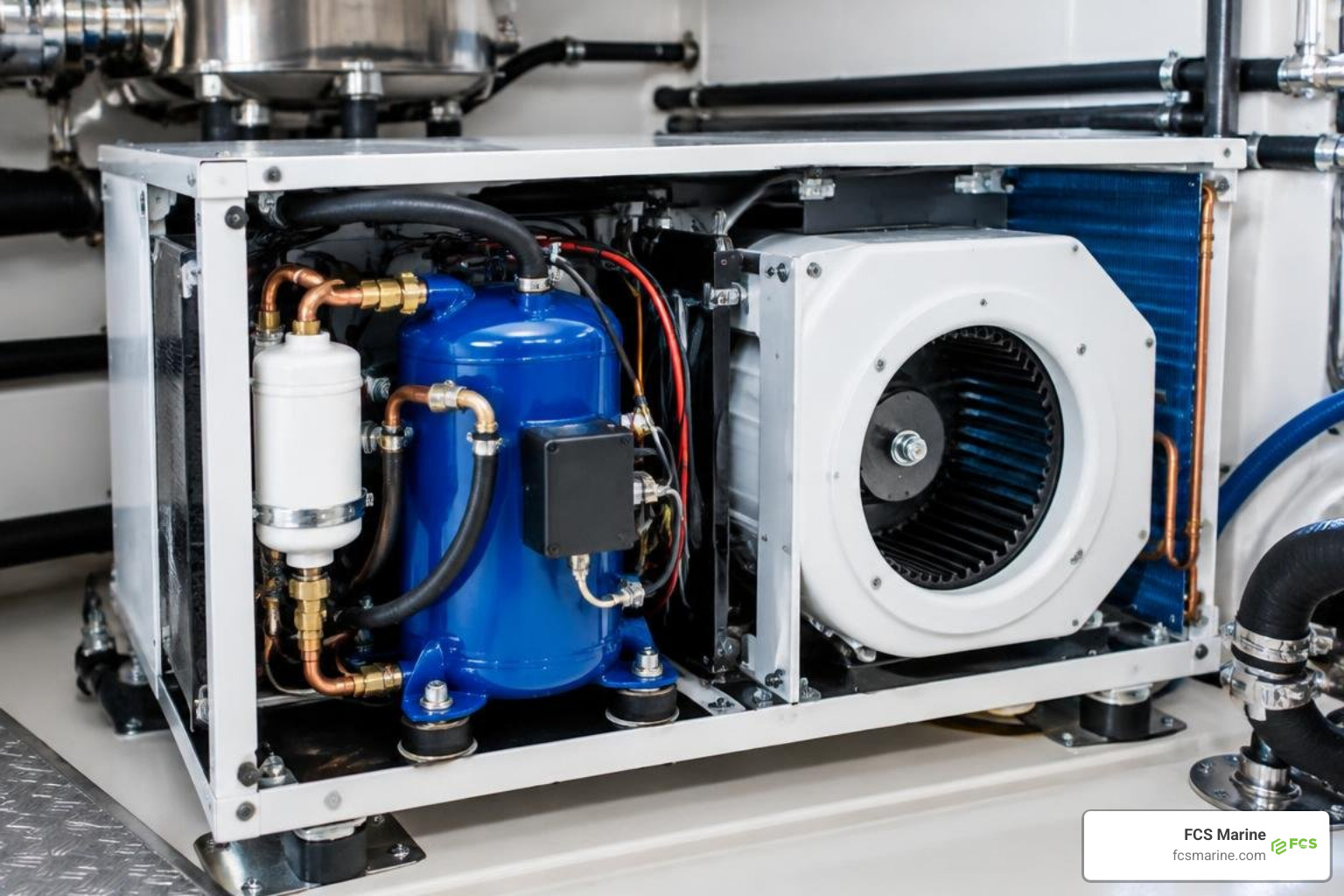
Operating climate control off-grid has evolved significantly. Historically, running air conditioning at anchor meant listening to the steady drone and vibration of an onboard auxiliary generator. Today, direct-current cooling allows boaters to maintain a comfortable cabin entirely off house battery banks. To understand how this fits into overall boat systems, learning how marine AC service works gives owners a clear picture of heat transfer, power distribution, and seawater flow dynamics.
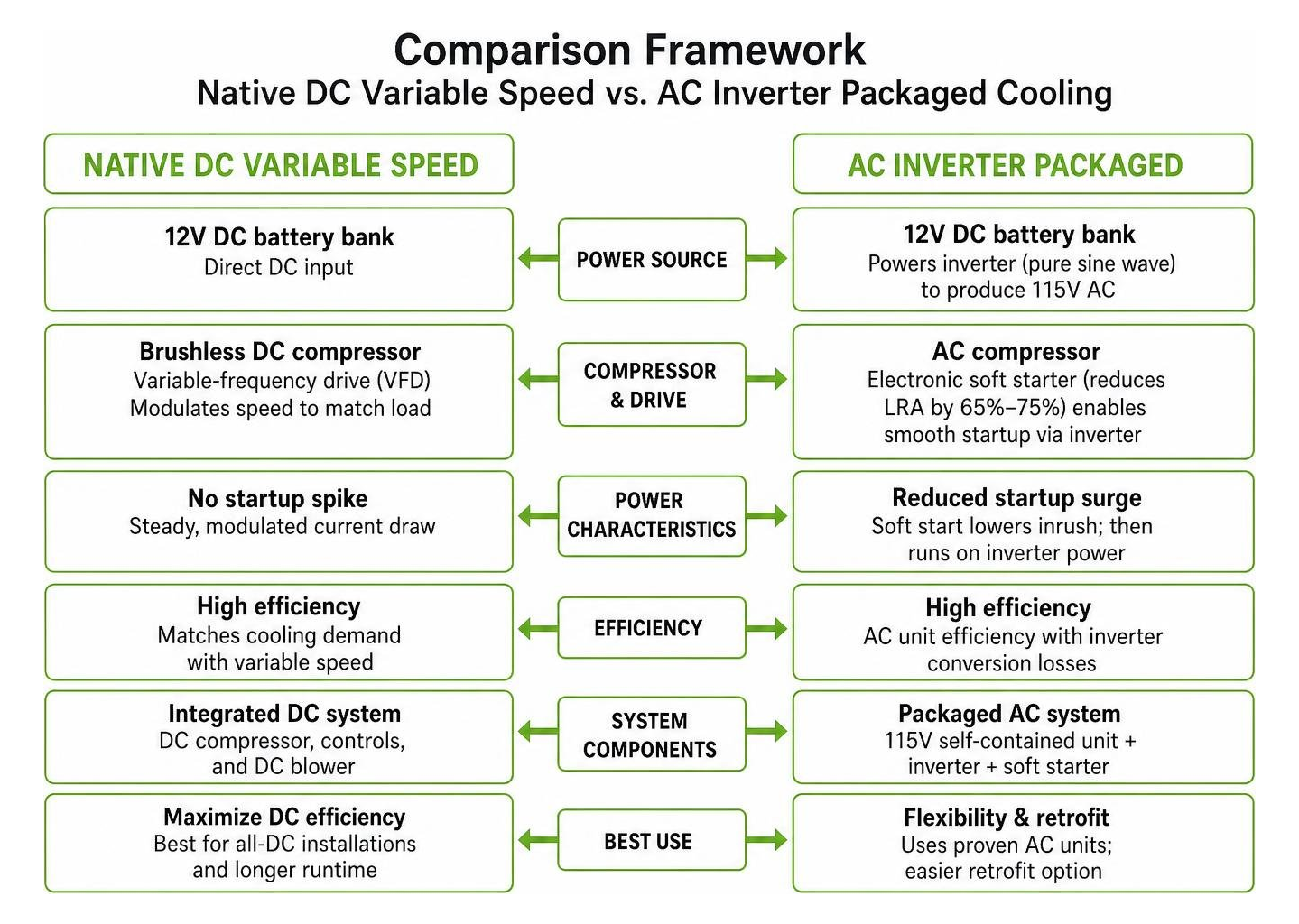
Marine DC cooling systems generally take two main engineering paths:
- Native DC Inverter Systems: These units feature brushless DC variable-speed compressors that run directly on battery power. Variable-frequency drive (VFD) technology modulates compressor RPM to match real-time thermal load, eliminating hard startup spikes.
- Inverter-Packaged Systems: These setups pair a high-efficiency 115V marine self-contained unit with an integrated pure sine wave inverter and an electronic soft starter. The soft starter reduces locked rotor amperage (LRA) by 65% to 75%, allowing the inverter to start the compressor smoothly from a 12V DC source.
| System Model / Type | Rated Capacity (Cooling / Heating) | Input Voltage | Rated Power Input (Watts) | Steady-State Current Draw | Key Features |
|---|---|---|---|---|---|
| 6k BTU Inverter Kit | 6,000 BTU / Cool Only | 12V DC (via 1200W Inverter) / 115V AC | ~600W–1200W Surge | 5.6A @ 115V (~50A–55A @ 12V) | Titanium coil, soft start included, ABS drain pan |
| 9k BTU Native DC | 9,000 BTU / 10,000 BTU | 12V DC Native | 400W–750W | 34A (Maintain) to 62.5A (Max Cool) | Native DC variable speed, R134a, titanium condenser |
| 9k BTU Compact DC | 9,000 BTU / 10,450 BTU | 12V DC Native | 660W (720W Max) | 55A Rated | 304 Stainless chassis, digital control, IP68 motor |
| 12k BTU Variable DC | 12,000 BTU / 13,000 BTU | 12V DC Native | 300W–850W | 25A–46A (Maintain) to 66A (Max Cool) | Variable-speed compressor, R410A, dual heating |
| 12k BTU High-Flow DC | 12,000 BTU / 12,250 BTU | 12V DC Native | 840W (900W Max) | 70A Rated | Electronic expansion valve, titanium tube, 1080 L/h flow |
| 12k BTU AC Inverter Setup | 12,000 BTU / 13,500 BTU | 110V AC (Inverter-ready) | ~1,250W | 11.4A @ 110V (~105A @ 12V via Inverter) | Heavy-duty reverse cycle, compact footprint |
Sizing and Capacity for Your 12V Marine AC Setup
Choosing the right capacity involves calculating the cubic volume of your cabin, hull material, glass area, and sun exposure under the intense Florida sun. While larger yachts frequently evaluate chilled water vs self contained AC systems, mid-size cruisers, center consoles, and sailing vessels depend on self-contained DC units tailored to specific spaces:
- 6,000 BTU Systems: Ideal for small cuddy cabins, compact v-berths, or single staterooms up to approximately 400–500 cubic feet. These utilize standard 4-inch ducting collars and require around 2.5 gallons per minute (GPM) of cooling water flow.
- 9,000 BTU Systems: Designed for mid-sized cabins, express cruisers, and main sleeping quarters up to 700–800 cubic feet. They deliver roughly 290–300 CFM of airflow through 4-inch or 5-inch insulated ducting.
- 12,000 BTU Systems: Suitable for salon areas or entire interior layouts on vessels between 30 and 35 feet (up to 1,000 cubic feet). Delivering upwards of 320 CFM, these setups generally require at least two 4-inch supply grilles or a single 5-inch to 6-inch discharge line to prevent high static backpressure on the blower motor.
Electrical Architecture and Battery Bank Requirements for 12V Marine AC Units
Running high-amperage direct-current equipment demands a robust electrical foundation. A 12,000 BTU unit drawing 66 to 70 amps continuously will deplete a standard bank quickly if capacity is underestimated.
- Battery Chemistry: Lithium Iron Phosphate ($text{LiFePO}_4$) batteries are strongly recommended over traditional flooded or AGM lead-acid batteries. Lead-acid cells experience severe voltage sag under high, continuous 50A+ loads. When voltage drops below 11.0V, the air conditioner’s low-voltage protection shuts the compressor down prematurely. $text{LiFePO}_4$ maintains a flat discharge voltage curve (12.8V–13.2V) across 80% to 90% of its depth of discharge.
- Battery Bank Sizing: To run a 9,000 BTU unit drawing an average of 45 amps over an 8-hour overnight period, you consume roughly 360 amp-hours ($text{Ah}$). Accounting for safety margins and baseline house loads (refrigeration, lighting, electronics), a dedicated lithium house bank of at least 400Ah to 600Ah at 12V is recommended.
- Wiring and Circuit Protection: At 12 volts, continuous high current produces heat and voltage drop over distance. Heavy-gauge tinned marine copper wire (such as 2/0 or 4/0 AWG, depending on the run length) paired with marine-grade ANL or Class-T fuses is essential to maintain safety and comply with American Boat and Yacht Council (ABYC) standards.
Marine-Specific Operating Challenges in Harsh Environments
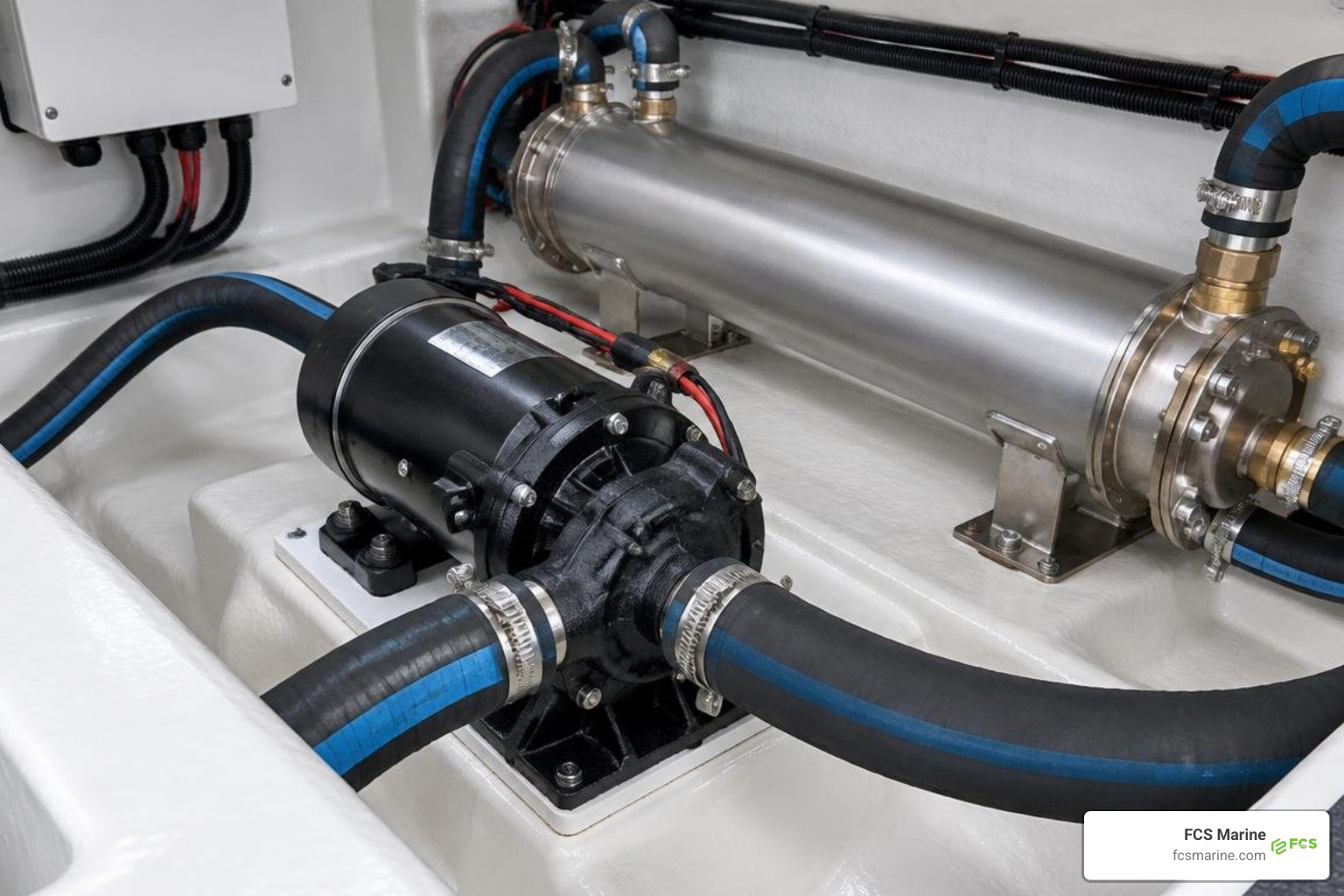
Operating in South Florida’s coastal waters exposes air conditioning equipment to intense environmental stress. The combination of high ambient water temperatures—frequently recorded by the National Oceanic and Atmospheric Administration (NOAA) to exceed 85°F to 90°F in shallow bays and canals during summer—elevated humidity, and corrosive salt air demands specialized hardware:
- Condenser Corrosion Resistance: Seawater is exceptionally aggressive toward standard metals. Modern DC units utilize cupronickel or pure titanium alloy coaxial coils. Titanium offers over 40% greater resistance to pitting and crevice corrosion compared to traditional copper, ensuring long-term integrity against salt water.
- Chassis & Fastener Construction: Salt mist in bilge compartments rapidly oxidizes low-grade steel. Units engineered for marine durability feature 304 stainless steel or epoxy-coated structural bases, ABS composite insulated drain pans that never rust, and electrophoretic anti-corrosion finishes.
- Seawater Circulation Rates: Because DC units rely on water-cooled condensers rather than exterior fans, consistent raw water flow is crucial. A 9,000 BTU unit requires approximately 720 liters per hour (around 3 to 5 GPM), while a 12,000 BTU system demands 1,080 L/h (around 5 GPM). Any restriction from marine growth, barnacles, or weed accumulation causes head pressure to spike, which is why a yacht AC system needs cleaning and periodic descaling.
Thermal Load and Cabin Humidity Control
Marine air conditioning is as much about moisture extraction as temperature reduction. High relative humidity makes cabin interiors feel stifling and promotes mold growth behind bulkheads and headliners. Modern DC units remove between 0.8 and 1.2 liters of moisture per hour under standard operating conditions.
To keep interior moisture under control and prevent excessive heat buildup, learning practical methods on how to stop your yacht from turning into a floating sauna helps reduce the thermal burden placed on your electrical bank. In cooler months, reverse-cycle DC systems utilize a four-way reversing valve to extract heat from the surrounding seawater, delivering efficient cabin warmth without resistive heating coils.
Warning Signs and Critical Failures in DC Marine Air Conditioning
DC marine climate systems incorporate digital diagnostics to protect the compressor and electrical components. When issues arise, captains and vessel operators should monitor for these distinct symptoms:
- High-Pressure Cutouts (HP Fault): Occurs when the condenser cannot reject heat into the seawater loop. Commonly caused by an airlock in the raw water pump, a clogged sea strainer, crushed intake hoses, or heavy scale accumulation inside the heat exchanger.
- Low-Voltage Tripping (LV Fault): Triggered when heavy compressor draw causes terminal voltage to drop below the safety threshold (typically below 10.5V DC). This often indicates undersized battery cabling, loose or corroded battery terminals, or degraded battery cells.
- Loss of Cooling Efficiency: When the blower runs and the seawater discharge is flowing normally, but the boat air conditioning stops cooling, the system may suffer from a stuck electronic expansion valve (EEV) or a slow refrigerant leak.
- Drain Pan Overflow: Water pooling under cabin sole boards or beneath berths indicates a blocked condensate drain line, unlevel pan installation, or restricted drain barbs.
Why Professional Service and Preventive Maintenance Matter
Maintaining a low-voltage, high-current marine cooling system requires specialized knowledge spanning marine refrigeration and high-output DC electrical systems. Professional marine technicians verify that DC connections remain torqued to specification, inspect electronic control boards for moisture ingress, ensure alignment with U.S. Coast Guard vessel electrical safety standards, test expansion valve modulation, and chemically descale heat exchangers without damaging sensitive titanium or cupronickel tubing.
Following a thorough marine AC maintenance checklist ensures your raw water strainers, impellers, return air filters, and electrical terminals remain in peak operational condition throughout the year.
Frequently Asked Questions About 12V Marine AC Systems
How many amps does a 12V marine AC unit draw during normal operation?
A native 12V marine air conditioner typically draws between 34 and 70 amps at 12V DC under full cooling load, depending on BTU capacity (6,000 to 12,000 BTU) and seawater temperature. Variable-speed models can modulate their compressor speed downward once the cabin reaches set temperature, reducing steady-state maintain draw to as low as 25 to 34 amps, including the raw water pump.
Can a 12V marine AC system run on traditional lead-acid batteries?
While technically possible for short bursts, standard flooded or AGM lead-acid batteries are not recommended for continuous DC air conditioning. High continuous current draws (50A+) cause substantial voltage sag in lead-acid chemistries, which quickly triggers the unit’s low-voltage cut-off switch. Lithium Iron Phosphate ($text{LiFePO}_4$) batteries provide the stable voltage curve and deep discharge capability needed for reliable overnight operation.
Does a 12V marine air conditioner provide reverse-cycle heating?
Yes. Most modern self-contained 12V DC marine units include reverse-cycle capability via an internal reversing valve. In heating mode, the refrigeration cycle is reversed to extract heat from the surrounding seawater and transfer it into the cabin air. Reverse-cycle heating is highly energy-efficient and typically yields 10% to 15% more thermal BTU output than standard cooling mode.
Keep Your Vessel Comfortable With Mobile Marine Service
Reliable climate control is vital for enjoying your time on the water across South Florida. Whether you are outfitting a cruiser with a battery-powered DC cooling system, repairing an existing self-contained unit, or seeking routine maintenance for your refrigeration and electrical components, FCS Marine provides expert support directly at your vessel.
Our technicians travel directly to your marina, private dock, boat yard, or yacht club across:
- Broward County: Fort Lauderdale, Pompano Beach, Hollywood, Dania Beach, Deerfield Beach
- Miami-Dade County: Miami, Miami Beach, Coconut Grove, Key Biscayne, Aventura
- Palm Beach County: West Palm Beach, Boca Raton, Delray Beach, Jupiter, Palm Beach Gardens
- Martin & St. Lucie Counties: Stuart, Jensen Beach, Port St. Lucie, Fort Pierce
We deliver complete mobile diagnostics, maintenance, and system repairs without requiring you to move your vessel. Contact our team today to schedule professional marine air conditioning services or discuss your vessel’s refrigeration, yacht insulation, mold remediation, and water purification needs.