Choosing a Marine AC Installation in Florida
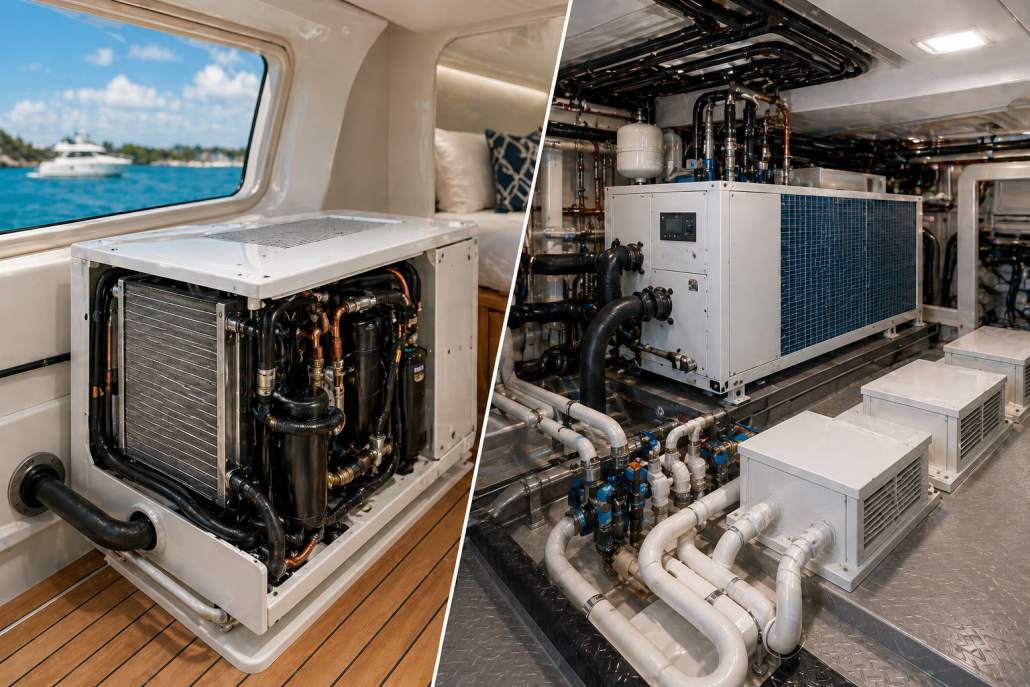
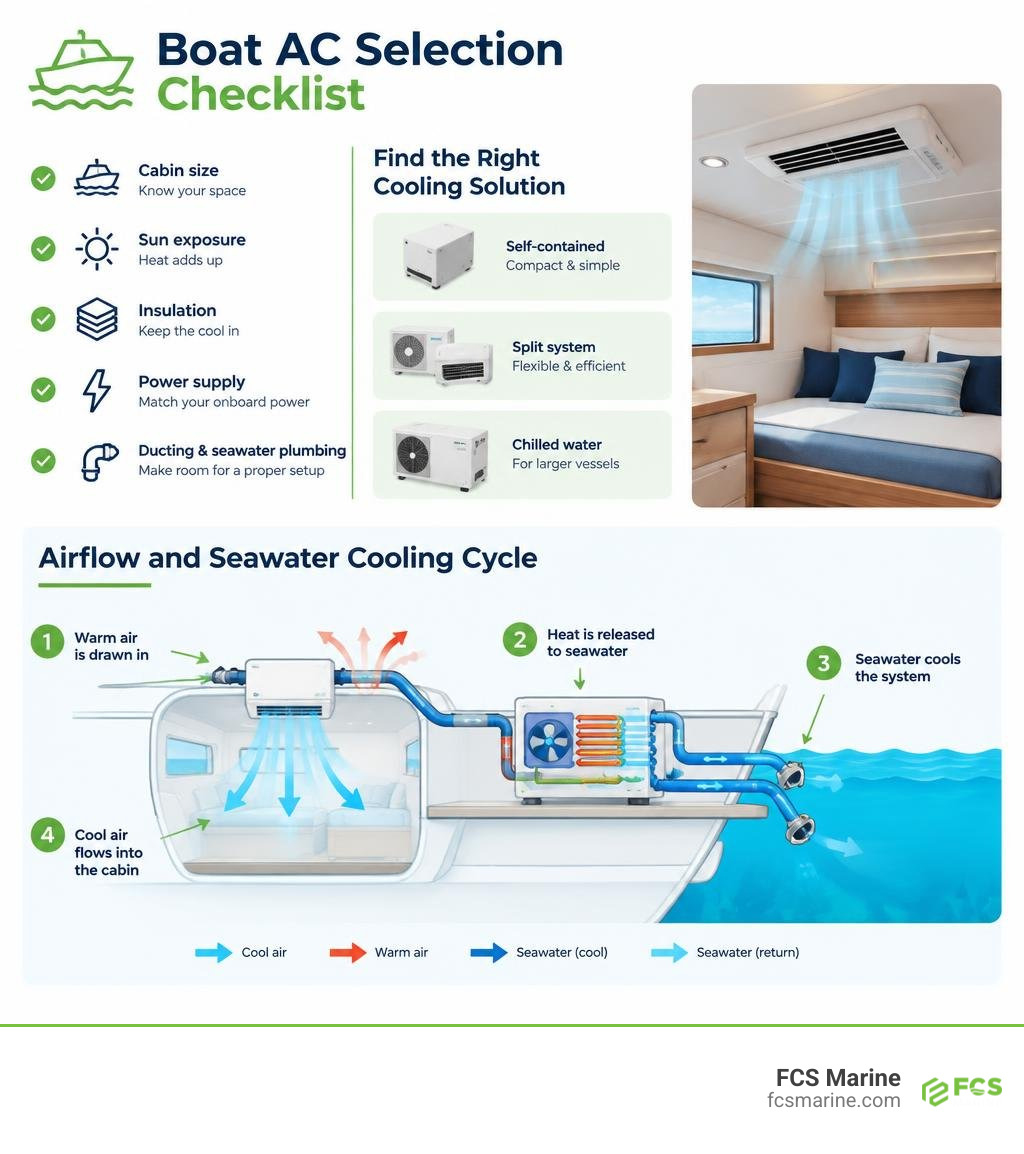
Start with an onboard survey, not just your boat’s length. A marine AC installer should check cabin size, sun exposure, insulation, power supply, and space for ducting and seawater plumbing. Those details help determine the right cooling capacity and whether a self-contained, split, or chilled water system fits your boat.
In South Florida, heat and humidity make poor sizing and restricted seawater flow hard to ignore. If you are replacing a weak unit or adding AC for the first time, ask for a plan that covers the equipment, installation work, and testing before you commit. A properly planned marine AC installation in Florida should account for the vessel’s actual operating conditions, not just a generic size estimate.
FCS Marine provides professional, mobile marine air conditioning service at vessel locations across South Florida.
Marine AC installation Florida vocab to learn:
Marine AC Installation Florida: Types, Sizing, and System Options
Selecting the right cooling architecture is the most important decision when planning a vessel upgrade. Marine air conditioning systems differ significantly from residential units because they rely on seawater heat exchange rather than ambient air-cooled condensing coils. In our subtropical coastal waters, choosing between self-contained units, split systems, and central chilled water loops dictates comfort, operational noise, and electrical efficiency.
| System Type | Typical Vessel Size | BTU Capacity Range | Key Advantages | Primary Considerations |
|---|---|---|---|---|
| Self-Contained | 20 to 45 ft | 4,000 – 16,000 BTU | Compact footprint, single package, lower initial cost | Requires localized duct space; compressor runs near cabin living areas |
| Split System | 30 to 60 ft | 4,000 – 60,000 BTU | Quiet interior operation, flexible component layout | Requires copper refrigerant line sets between engine room and air handlers |
| Chilled Water | 50 to 200+ ft | 24,000 – 120,000+ BTU | Infinite zoning flexibility, low refrigerant volume in living quarters, peak efficiency | Higher installation complexity, demands dedicated mechanical space |
Self-contained units house the compressor, evaporator coil, blower fan, and seawater condenser coil on a single composite chassis. They are ideal for center consoles, express cruisers, and smaller sportfish boats where space is at a premium.
For mid-sized yachts and motor vessels, split systems separate the noisy condensing unit (placed in the engine room or machinery space) from the compact, whisper-quiet air handling units nestled behind interior cabinetry.
When managing multi-stateroom yachts or vessels exceeding 50 feet, evaluating chilled water vs self-contained AC systems becomes necessary. Chilled water systems circulate fresh water and glycol through an insulated closed loop to individual air handlers, eliminating lengthy high-pressure refrigerant runs throughout the vessel’s hull.
Sizing and Requirements for Marine AC Installation Florida
Correct thermal load sizing requires calculating more than gross hull dimensions. South Florida’s ambient heat index, high solar radiation, and water surface reflection add significant thermal loads to a boat’s interior. We evaluate cabin volume alongside several crucial environmental variables:
- Glass Surface Area and Window Rake: Large salon windows and raked windshields act as greenhouse collectors. Vessels without solar film or exterior canvas require up to 25% more cooling capacity.
- Hull and Bulkhead Thermal Boundaries: Cored composite hulls resist heat transfer better than solid fiberglass. Inspecting compliance with boat wall insulation standards ensures the cabin retains cooled air effectively.
- Below-Deck vs. Above-Deck Living Spaces: Staterooms situated below the waterline benefit from natural water insulation, requiring roughly 14 to 15 BTUs per cubic foot. In contrast, flybridge lounges or upper salons exposed to overhead deck heat often need 18 to 20 BTUs per cubic foot.
- Auxiliary Electrical Loads: Modern boaters frequently power systems away from shore power using lithium battery banks. Integrating modern 12V marine AC units requires precise sizing of DC-to-DC charging networks and dedicated breaker panels.
Under-sizing an air conditioner leads to continuous compressor operation without satisfying the thermostat, leaving the cabin warm and humid. Over-sizing causes rapid short-cycling, which drops the cabin temperature before the system has sufficient runtime to wring moisture from the air, resulting in a cold, clammy interior prone to mildew.
Marine-Specific Environmental Challenges and Warning Signs
Operating cooling machinery in coastal Florida subjects equipment to harsh marine conditions. Elevated water temperatures in shallow canals during mid-summer—frequently exceeding 88°F to 90°F—drastically reduce the heat-rejection capacity of seawater-cooled condensers according to data from the National Oceanic and Atmospheric Administration.
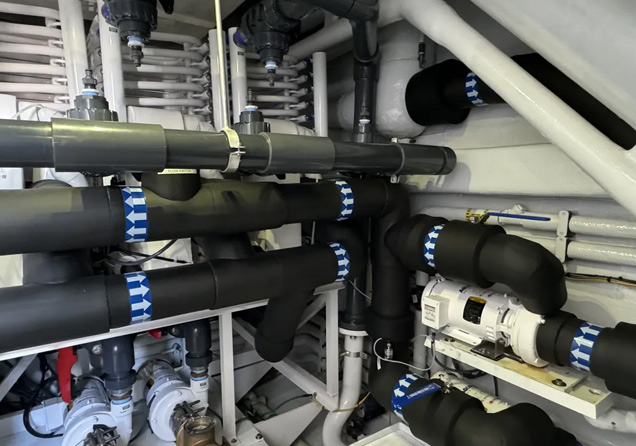
Salt air accelerates galvanic and atmospheric corrosion on unprotected electrical terminals, blower motors, and solder joints. In addition, raw seawater intake systems pull in barnacle larvae, algae, silt, and jellyfish. Without proper flow, heat builds up rapidly in the condenser coil, triggering thermal overloads.
Key warning signs that an onboard HVAC system is struggling include:
- High-Pressure Cutout Errors (HP Faults): The compressor trips offline within minutes of activation due to restricted raw water flow or internal scale accumulation.
- Weak Air Delivery at Supply Grilles: Ducting has pinched behind bulkheads, transition boxes have delaminated, or return air filters are clogged.
- Continuous Water Pooling in Bilge Compartments: Evaporator condensate drain pans have cracked, overflowed, or developed fungal blockages.
- Rattling or Excessive Harmonic Vibration: Loose compressor mounts, unbalanced centrifugal blower wheels, or failing pump isolation brackets.
Recognizing these symptoms early allows vessel operators to carry out fundamental boat AC diagnosis steps before component failure occurs. Implementing standard marine HVAC repair tips keeps minor plumbing restrictions from turning into full compressor burnouts.
Professional Engineering and Installation Standards
Marine HVAC retrofits must strictly comply with the engineering safety guidelines established by the American Boat and Yacht Council. Unlike residential installations, marine systems introduce sea connections below the waterline, presenting potential flooding risks if plumbed incorrectly.
Every thru-hull penetration must feature a marine bronze or stainless steel seacock directly flanged to the hull, paired with reinforced, wire-inserted raw water hoses secured with dual 316-grade stainless steel hose clamps. Electrical wiring must use marine-grade tinned copper conductors to resist corrosion, sized appropriately to manage compressor inrush starting currents without dangerous voltage drops.

When an existing system has reached the end of its serviceable lifespan, following a structured marine air conditioning replacement protocol ensures that updated units interface safely with existing stringers, duct plenums, and raw water manifolds.
Step-by-Step Process for Marine AC Installation Florida Projects
A reliable retrofit follows an orderly, multi-stage engineering workflow to ensure safety, performance, and durability:
- Onboard Spatial and Electrical Survey: Technicians measure cabin cubic volume, trace existing wire runs back to the AC distribution panel, evaluate hull penetrations, and map return air pathways.
- Mechanical Mounting and Vibration Isolation: Technicians mount the self-contained unit or split air handler on an elevated, vibration-damped tray with an integrated condensate collection pan.
- Plumbing and Seawater Integration: Crews install a dedicated high-flow seawater pump, a sea strainer with an accessible cleanout basket, and continuous-uphill discharge lines to prevent air-locks.
- Insulated Duct Routing and Airflow Balancing: Installers run flexible, R-value insulated ducting without sharp bends to minimize static pressure and prevent condensation from dripping behind bulkheads.
- Electrical Hookup and Digital Control Integration: Technicians complete wiring to dedicated circuit breakers, install smart digital thermostats, and integrate pump relays.
- Commissioning and Performance Validation: The system is operationalized, measuring water flow rate, refrigerant operating pressures, blower CFM, and air temperature differential across the evaporator coil.
Following this structured methodology illustrates how marine AC service works to safeguard vessel hull integrity and electrical systems.
Preventative Care and Ongoing System Upkeep
Florida’s extended cooling season means marine HVAC equipment operates under high annual duty cycles. Establishing a rigorous maintenance schedule keeps cooling systems operating at peak efficiency and avoids unexpected downtime during hot summer months.
Vessel operators and engineers should regularly conduct key preventative maintenance tasks:
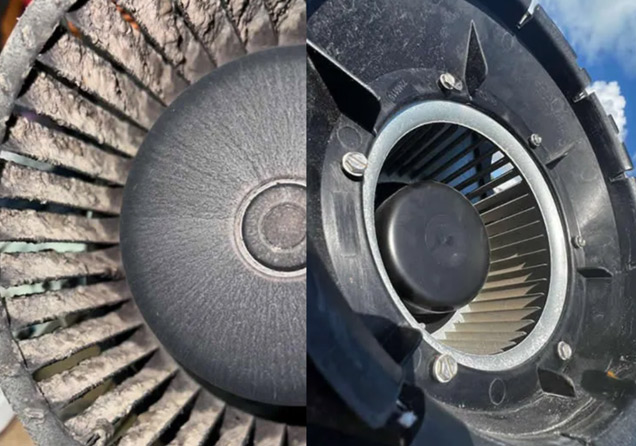
- Clean Return Air Filters Monthly: Dust, pet hair, and airborne fibers collect on the evaporator face. Regularly taking time to clean your marine AC filter prevents evaporator freeze-ups and maintains optimal airflow across the cooling fins.
- Inspect and Clear Seawater Strainers: Check the raw water sea strainer basket weekly for seagrass, sediment, and marine growth. Ensure seacocks cycle smoothly without binding.
- Descaling the Heat Exchanger: Recirculate an eco-safe descaling solution through the raw water cooling circuit every six months to dissolve calcium buildup, barnacle shells, and algae deposits.
- Flush Condensate Drain Lines: Treat evaporator condensate drain pans with algicide tablets and flush drain hoses with fresh water to clear algae plugs that can cause cabin flooding.
- Inspect Sacrificial Anodes and Grounding Straps: Ensure bonding wires attached to the seawater pump housing and sea strainer are intact to shield against stray current corrosion.
Following a comprehensive marine AC maintenance checklist prevents premature component deterioration and maintains consistent climate control throughout the vessel.
Mobile On-Site Marine Service Across South Florida
Transporting a vessel to a shipyard for air conditioning service is time-consuming and disruptive. FCS Marine eliminates this hassle by operating fully equipped mobile service vehicles that travel directly to your vessel’s location, whether it is tied up at a private residential dock, berthed in a marina slip, or undergoing refit work in a commercial boat yard.
Our technicians handle complete climate system services on-site across South Florida’s major maritime hubs, including Fort Lauderdale, Pompano Beach, Miami, and West Palm Beach.
Working with an experienced marine AC technician ensures all system retrofits, component diagnostics, and seawater plumbing conform to ABYC guidelines and manufacturer specifications. Knowing clear boat AC service expectations helps yacht captains and vessel owners plan system overhauls and seasonal maintenance without operational delays.
Alongside air conditioning installations, our team supports vessel owners with integrated marine services, including:
- Marine refrigeration repair and cold-plate upgrades
- Thermal and acoustic yacht insulation
- Marine mold remediation and cabin sanitization
- Reverse osmosis watermakers and water purification systems
- Commercial-grade marine dehumidifier and equipment rentals
Frequently Asked Questions About Marine Air Conditioning
How long does a typical boat air conditioning installation take?
A direct, like-for-like replacement of a single self-contained unit typically takes 1 to 2 business days. A complete retrofit on a vessel that has never had air conditioning—which requires cutting and glassing thru-hull fittings, running insulated ducting behind joinery, mounting raw water pumps, and installing electrical distribution sub-panels—typically takes 2 to 4 business days. Large yachts requiring multi-zone split systems or complex chilled water networks may require a week or more to complete properly.
Can air conditioning be installed on a boat that never had it?
Yes. Professional technicians can design and install a complete cooling system on vessels that were built without factory air conditioning. The installation includes selecting an appropriate machinery space for the unit, cutting and sealing an underwater thru-hull intake with a seacock, installing a dedicated sea strainer and raw water pump, running insulated supply and return air ducting through bulkheads, and wiring the system into the vessel’s AC distribution panel.
What causes marine AC units to shut down unexpectedly in warm Florida water?
Unexpected shutdowns in South Florida waters are most often triggered by a high-pressure (HP) safety cutout. When high ambient water temperatures combine with raw water flow restrictions—caused by clogged sea strainers, barnacles in the heat exchanger, or an air-locked raw water pump—the system cannot shed heat from the compressed refrigerant. When internal pressure reaches critical limits, safety switches trip the compressor to prevent mechanical destruction. Engaging qualified marine air conditioning repair professionals quickly resolves these flow restrictions and restores reliable cooling.
Professional Marine Service in South Florida
Maintaining consistent interior climate control is essential for protecting your vessel’s fine cabinetry, upholstery, and onboard comfort against Florida’s harsh coastal heat and humidity. Whether you need a self-contained unit replacement, a multi-zone split system retrofit, or a chilled water refit, our mobile service team brings full-service capability directly to your vessel.
FCS Marine provides reliable, mobile on-site marine services throughout Broward County, Palm Beach County, Miami-Dade County, Martin County, and St. Lucie County. From complete HVAC installations and refrigeration repairs to yacht insulation and mold remediation, our team ensures your boat remains comfortable and seaworthy year-round.
Contact our team today to schedule an onboard survey and discuss professional Marine Air Conditioning Services tailored to your vessel.